





Bitget Token has shed more than half its value since November 2025, and the daily chart is not showing any credible signs that the selling is finished. BGB currently trades at $2.0479, a price level that places it 44% below its own 200-day moving average. It is the single most important context for everything else the technicals are saying right now.
On Wednesday, BGB opened at $2.0456, hit a session high of $2.0567, and printed a low of $2.0355, closing up just 0.11% on the day. Daily chart volume registered 3.33 million, while the broader 24-hour volume came in at $15.97 million. A 0.11% gain on nearly $16 million in volume is not a recovery. It is a market sitting on its hands, with neither buyers nor sellers willing to commit to the next directional move.
Where the Moving Averages Place BGB
The moving average stack is uniformly bearish across every relevant timeframe. The 7-day SMA sits at $2.09, the 30-day SMA at $2.16, and the 200-day SMA at $3.68. On the EMA side: 7-day at $2.08, 30-day at $2.21, and 200-day at $3.35.
The structure here is worth pausing on. The centralized exchange token sitting below its 7, 30, and 200-day averages on both SMA and EMA measures is not experiencing a routine pullback. Every time horizon is confirming the same directional bias. The 200-day SMA at $3.68 is now $1.63 above spot price. That is not a resistance level to trade around and it is a marker of how much ground would need to be recovered before BGB re-enters anything resembling a neutral trend.
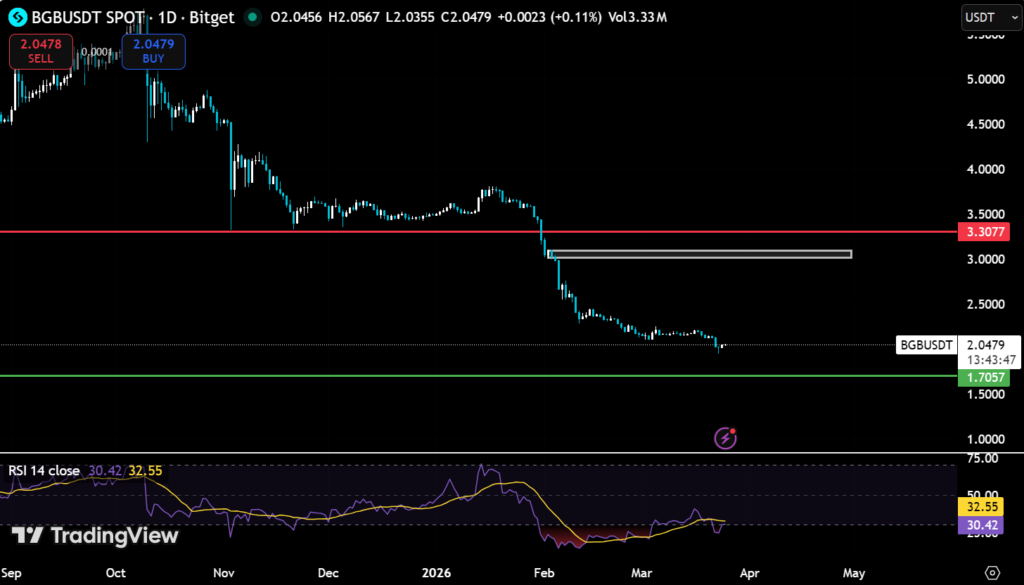
The chart confirms this information visually. The sharp break below the $3.3077 level in early February was the structural pivot. Price dropped from the $3.00 supply zone, accelerated into the $2.20s, and has ground lower into the current $2.04 to $2.05 range over the past several weeks.
MACD and RSI: Exhaustion Without Confirmation
The MACD reading provides a nuanced signal. The MACD line is at -0.075798 and the signal line at -0.078881, meaning the MACD line sits above the signal line by a margin of 0.003. The histogram at +0.0030834 is technically positive. This is a very early and unconfirmed cross, not a reversal signal. The lines remain in negative territory, and the histogram margin is narrow enough to be erased within a single session.
The RSI picture is more definitive. The daily RSI reads 30.42, and this zone is visually confirmed on the chart, where both RSI lines at 30.42 and 32.55 (signal line) hover just above the oversold threshold. It reflects sustained, not sudden, selling pressure. BGB has not spiked into oversold territory, and it has drifted there steadily, suggesting that the exhaustion is structural rather than panic-driven.
Importantly, the RSI reached its most extreme levels during the February sell-off before recovering slightly. That prior extreme and the subsequent partial RSI recovery have not produced any meaningful price recovery, which is the cautionary detail here.
The Fibonacci Cluster That Defines the Current Range
From the swing high of $2.29 to the swing low of $1.95, BGB’s current price at $2.05 sits between the 78.6% retracement at $2.02 and the 61.8% retracement at $2.08. This is a 6-cent band acting as the immediate battleground.
The classic pivot point from the prior day is $2.04. BGB is holding above that pivot by just $0.01. A daily close below $2.04 would confirm that even this minor structural anchor has failed. Below that, the next meaningful reference on the chart is the green support line at $1.7057, which sits 16.7% below the current price.
On the upside, the 50% retracement at $2.12 and the 38.2% level at $2.16 represent the first band of resistance. The 30-day SMA at $2.16 coincides almost exactly with that 38.2% level, reinforcing it as genuine overhead supply. Any recovery attempt that stalls below $2.12 without follow-through volume would likely be absorbed by sellers re-entering near those averages.
Implications for Traders
The setup presents an asymmetric picture that is not straightforwardly bullish. Oversold RSI readings in downtrends routinely remain oversold for longer than expected. Traders who buy purely on RSI proximity to 30 without a confirming price structure often absorb additional drawdown before any recovery materializes.
The positive MACD histogram is a preliminary data point, not a trigger. One session of histogram expansion in deeply negative MACD territory has a poor track record as a standalone entry signal. Price is sandwiched between $2.02 support and $2.12 resistance, a 10-cent range where directional bias is genuinely unclear on a short-term basis.
The key variable is whether the RSI can begin recovering toward the 40 level while the price holds above $2.02. That would suggest momentum exhaustion is translating into actual stabilization rather than a brief pause within a continuing decline. Consecutive daily closes above $2.08, the 61.8% Fibonacci retracement, would add further weight to any stabilization case. A break below $2.02 on elevated volume, however, removes the Fibonacci support entirely and opens the path toward the $1.7057 structural level marked clearly on the chart. That level is not a minor technical line. It represents a 16.7% drop from the current price and would constitute a new leg lower in an already extended downtrend.
The $3.3077 red resistance line, the breakdown origin from February, remains the macro overhead reference. It sits 61.5% above the current price. The supply zone between $3.00 and $3.3077, visible on the chart as the area where price consolidated briefly before accelerating lower, would need to be absorbed before any structural recovery argument holds up. Until that level is meaningfully challenged, the long-term trend designation does not change. Short-term RSI readings and histogram ticks do not override a 44% discount to the 200-day moving average.


