




XRP price remains under pressure as Ripple’s long-term expansion story clashes with weak market action. The token is trading around a critical support area following a number of unsuccessful recovery efforts. Simultaneously, analysts remain divided on whether the wider payments push by Ripple can restore demand on the XRP Ledger (XRPL). At this point, the chart appears weak, the activity of the network is more gentle, and the momentum remains with the sellers.
Ripple’s Treasury Push Opens a Much Larger Payments Door
Ripple recently expanded its financial reach through its $1 billion GTreasury acquisition. The company has now rebranded that business as Ripple Treasury. That move gives Ripple a stronger position inside traditional corporate finance systems. Consequently, the company now sits closer to a payments network that reportedly handles $12.5 trillion each year.
The scale of that opportunity explains the growing attention around the XRP price. Ripple Treasury connects to more than 13,000 banks and over 1,000 corporate clients. Those clients include global brands with complex treasury and payment needs. Besides, many of those firms already rely on established systems for forecasting, reconciliation, compliance, and liquidity management.
That setup matters because Ripple does not need to rebuild corporate workflows from scratch. Instead, the company can plug blockchain infrastructure into systems firms already use. ClearConnect, GTreasury’s API suite, appears central to that strategy. It links banks, enterprise systems, and treasury tools in one operating layer. Hence, Ripple can position XRPL as a settlement rail without forcing major operational changes.
This approach could eventually strengthen XRP’s utility across several financial functions. Those functions include payments, custody, wallet services, prime brokerage, and compliance. Moreover, the model creates a wider ecosystem around Ripple’s core payments business. If adoption grows, XRP price could benefit from stronger transactional relevance. Still, that outcome remains a future possibility rather than a present reality.
XRP Price Struggles at a Dense Resistance Cluster
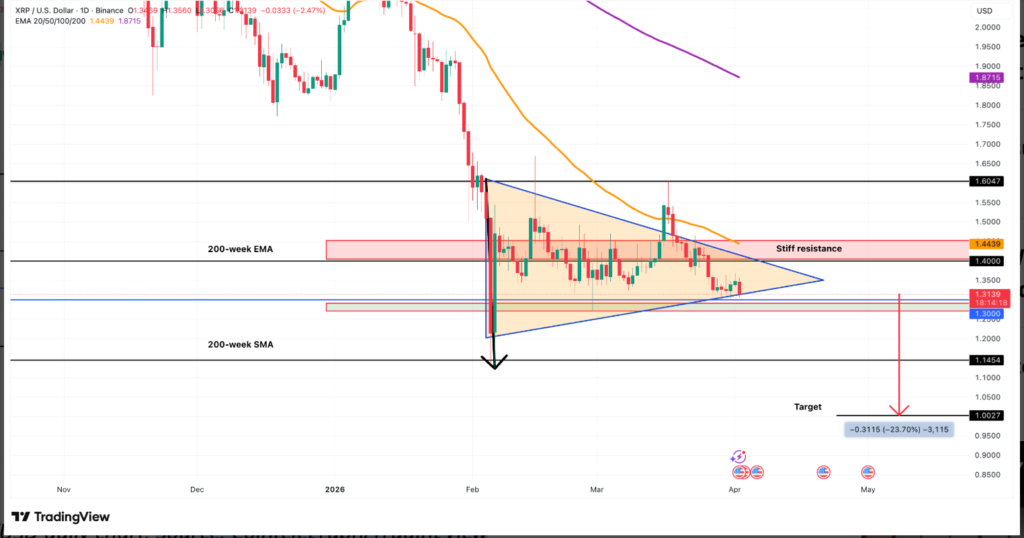
Despite the larger payments narrative, the XRP price continues to struggle on the chart. The token trades well below its multi-year peak and now sits near $1.30. More importantly, it remains trapped beneath a heavy resistance zone between $1.40 and $1.45. That region carries unusual importance because several technical signals converge there.
The upper boundary of a symmetrical triangle sits inside that area. The 200-week exponential moving average also meets that same zone. Additionally, the 50-day exponential moving average adds another ceiling just above current levels. When multiple barriers gather in one place, buyers often face a tougher path forward.
Source: TradingView
On-chain cost basis data adds more pressure to that region. Market participants acquired more than 1.1 billion XRP within the $1.40 to $1.45 band. Consequently, many holders may sell their shares as the price approaches breakeven. That behavior can stall rallies even when short-term sentiment improves. As a result, the XRP price needs strong volume to clear that overhead supply.
Recent trading has not shown that kind of strength. XRP opened near $1.3469, reached a session high near $1.3560, and later slid to $1.2999. That sequence reinforced a familiar pattern of lower highs and lower lows. Moreover, repeated rejection below moving-average resistance continues to weaken the broader structure.
Support at $1.30 Now Carries Outsized Importance
The $1.30 level now serves as the market’s immediate line in the sand. XRP value has begun to retest the bottom of the symmetrical triangle. When such support fails, then the existing downtrend may pick up. Technical objectives are then changed to the 200-week simple moving average around $1.14. Subsequently, the triangle objective target is measured and would be nearer to $1.00.
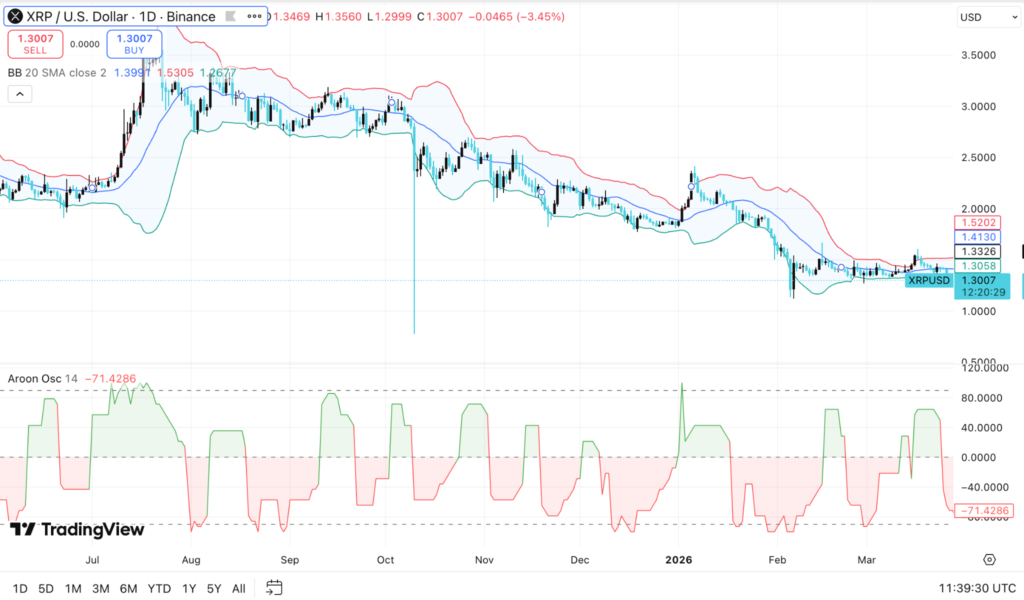
That negative risk has increased due to the fact that XRP price continues to trade under the 20-day Bollinger mid-band. The mid-band is now close to 1.4130, a long way above spot levels. In the meantime, the lower Bollinger Band is close to $1.3058, and XRP is close to short-term support. Nonetheless, the trading that is around the lower band tends to show persistent weakness, instead of strength of recovery.
The Aroon oscillator is also on the side of bearish. The value close to negative 71 is an indication that downside momentum remains in force. Importantly, that indicator implies that sellers are active even around support. As such, any recovery will have to regain 1.33 followed by 1.41. In the absence of those moves, the XRP price is prone to another leg down.
Source: TradingView
Other critics also cite the deeper levels of invalidation than the already existing levels. The larger bullish formation would only remain intact as long as XRP does not fall below $0.93. The level is still considerably below the market, though it is important to the long-term trend followers. XRP price is still squarely in the downfield till XRP prices have a stable base.
Network Activity Paints a Weaker Near-Term Picture
The basic trading on the XRP Ledger has also decelerated. The number of addresses per day has declined drastically since the highs in March and June 2025. Current readings hover near 48,000 to 50,000. That number is pale in comparison to previous stages of more intensive involvement. As a result, network usage loses a significant support of the XRP price.
The same can be said of daily transactions. The number of transactions decreased to approximately 1.5 million as compared to 3.4 million on March 21. That is a fall of about 44 percent. Reduced activity is usually an indicator of reduced network demand. In addition, less usage may restrict liquidity and confidence in dark market times.
This decline does not cancel the long-term goals of Ripple. But it does indicate that the adoption has not yet been converted into more vigorous activity of present-day chains. The significance of that gap lies in the fact that utility measures are closely monitored by the market players. Assuming that the use of XRPL will not gain momentum, the XRP price will not be able to gain momentum in the near future.
Institutional Appetite Also Looks More Cautious
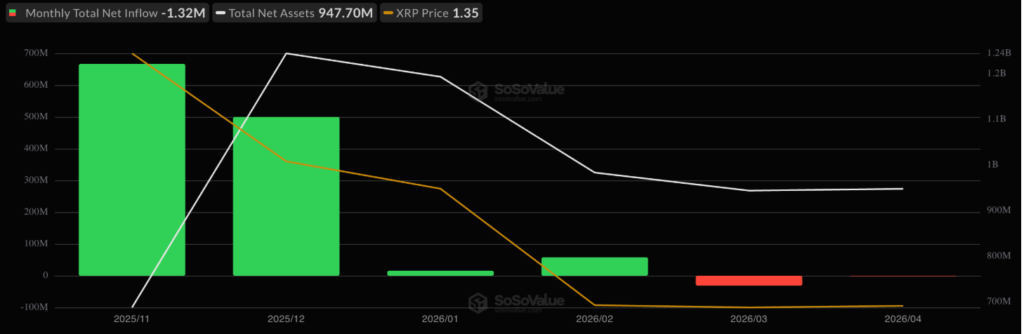
Another headwind comes from the spot XRP ETF market in the United States. Fund flows have turned weaker after a stronger launch period. March became the first negative month since those products began trading. Net outflows reached about $28 million, while assets under management also slipped.
Source: SoSoValue
At one point, total assets under management stood near $1.24 billion in early January. That figure has since fallen to roughly $947 million. Part of that drop reflects XRP’s own price decline during the first quarter of 2026. Still, zero inflows since late March suggest demand has cooled.
ETF flow data does not decide price direction on its own. Yet it helps shape broader sentiment around XRP price. When both on-chain activity and fund flows weaken together, recovery attempts usually face more resistance. Therefore, the market needs a clear catalyst before confidence can improve.
Ripple’s Treasury expansion gives the company a credible path into a huge global payments ecosystem. That story could become far more important over time. If Ripple successfully links treasury operations, bank connectivity, and XRPL settlement, XRP may gain stronger practical relevance. Moreover, broader enterprise use could eventually create a fresh demand base.


