




XRP is trading at $1.52 at the time of writing, down roughly 58% from its $3.65 cycle peak. Market cap sits at $92.59 billion on 24-hour volume of $5.18 billion, with the token posting a 9.36% gain over the past seven days, even as the 30-day return remains negative at -4.03%. The intraday price action tells a cleaner story: XRP bottomed near $1.47 on the morning of March 16, climbed steadily through the session, and touched $1.57 by the early hours of March 17 before pulling back slightly to current levels. The short-term momentum is constructive. But the more important question sits further back in the chart history.
Three Crashes. Three Recoveries. All above 1,000%.
Since 2017, XRP has dropped more than 60% from a cycle peak three separate times. The causes were different each time and the recovery timelines varied. The magnitude of the crashes ranged from 62% to 96%. One thing did not vary: every single crash was followed by a rally of at least 1,000% from the low.
Crash 1 (2017): $0.40 to $0.15, followed by a 2,460% rally. XRP opened 2017 at $0.006, ran to $0.40 on early banking partnership momentum, then pulled back 62% to $0.15 by June. Six months of sideways action followed. When Ripple announced a partnership with American Express and Santander in November 2017 and the broader market entered full mania, XRP ran from $0.15 to $3.84 by January 4, 2018. That is a 2,460% gain in eight months.
Crash 2 (2018-2020): $3.84 to $0.14, followed by a 1,300% rally. The 2018 crypto bust hit XRP harder than most. The token lost 96% of its value over two years, bottoming near $0.14 during the COVID-19 panic in March 2020. What followed is worth noting: XRP rallied 1,300% to $1.96 by April 2021 while the SEC lawsuit against Ripple was still fully active and the token was delisted from Coinbase.
Crash 3 (2021-2022): $1.96 to $0.29, followed by a 1,159% rally. The Terra/LUNA collapse in May 2022 pushed XRP down 85% to $0.29. The rally back came in stages: a brief jump to $0.81 on the July 2023 court ruling that exchange sales of XRP did not constitute securities transactions, then a larger move above $2 after the November 2024 election, and finally a peak at $3.65 as the SEC formally settled with Ripple in August 2025 and spot XRP ETFs launched in November 2025.
The Fourth Crash Looks Milder
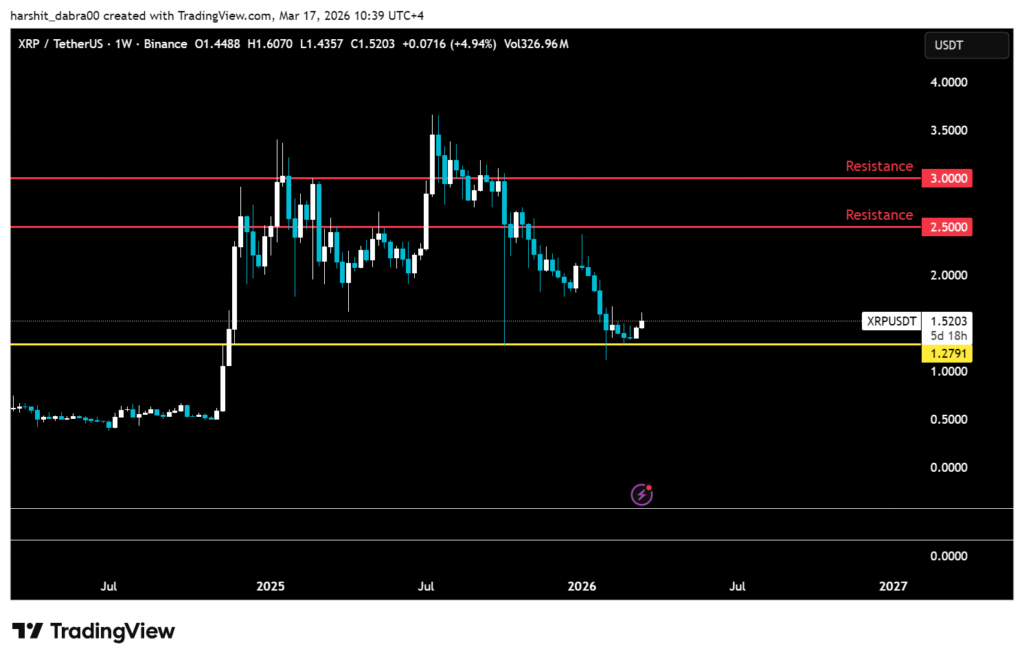
Price is currently holding above the $1.2791 support level after wicking below it, with the last weekly candle closing at $1.4487, suggesting buyers defended that zone. The immediate path higher faces two clear resistance walls at $2.50 and $3.00, both of which capped price during the 2025 cycle peak.
The current drawdown of approximately 58% from $3.65 is, by the standards of XRP’s own history, the least severe major pullback the token has experienced. The $1.47 to $1.57 range seen over the past 24 hours represents a market that is oscillating rather than collapsing. Volume has expanded alongside the price recovery, rising from $2.83 billion at 7:00 AM UTC on March 16 to $5.17 billion by 5:00 AM UTC on March 17. That volume pattern, rising into price strength, is not what a distribution top looks like.
The structural differences between this crash and the previous three are harder to dismiss than the price pattern alone.
Spot XRP ETFs launched in November 2025 and have accumulated $1.44 billion in institutional inflows since then. 13F filings confirm that Goldman Sachs, Jane Street, Citadel, and Millennium Management all hold XRP ETF positions. These are not retail buyers who are panic-selling at $1.47. Institutional holders who filed 13Fs have a cost basis tied to product entry, not emotional exits. That dynamic alone changes how supply is absorbed during a drawdown.
On the network side, daily transactions on the XRP Ledger reached 3 million as of mid-March 2026, triple the pace from mid-2025. Tokenized real-world assets on the ledger grew from $111 million in January 2026 to $1.5 billion. Ripple Prime, following the Hidden Road acquisition, joined the DTCC clearing directory on March 2, 2026, directly connecting Wall Street’s post-trade infrastructure to the XRP Ledger for the first time. None of the previous three crashes had this kind of structural adoption building in the background while the price was falling.
Ripple itself is now valued at $50 billion, following a $750 million share buyback. The company behind the network is not behaving like one that expects prolonged price depression.
The Catalysts Are in Queue
There are three recoveries and three ignition points. In 2017, Ripple secured cross-border banking deals with American Express and Santander. In 2021, broad market liquidity returned post-COVID while the SEC case was still ongoing. In 2023 and beyond, it was a federal judge ruling in Ripple’s favor, followed by a crypto-friendly election outcome and the eventual ETF approval in late 2025. The low price alone was never enough.
Three potential catalysts are visible from the current position. The CLARITY Act, if it clears the Senate, would classify XRP as a digital commodity and remove the last meaningful regulatory friction for banks and asset managers looking to build on the XRP Ledger. Kevin Warsh is scheduled to replace Jerome Powell as Fed Chair on May 15, and his monetary policy stance will significantly shape the risk appetite available to crypto assets in the second half of 2026. Bitcoin reclaiming $100,000 and triggering a broader altcoin rotation would historically pull XRP along with it.
All three catalysts have defined timelines. None are speculative in their existence, only in their outcome. At $1.52, XRP is trading 58% below its cycle high, against a backdrop of $92.59 billion in market cap, $5.18 billion in 24-hour volume, and a seven-day gain of 9.36% that suggests the downtrend may be entering in the cooldown phase. The institutional structure this time around is without precedent in XRP’s history.


