





The crypto market’s weekly performance was bleak, with top coins facing weekly losses despite major markets portraying a cautious optimism driven by upbeat U.S. growth prospects and hopes of more rate cuts from the Federal Reserve (Fed) in 2026.
The crypto market’s confidence dwindled even as the U.S. employment clues continue to favor a dovish bias surrounding the Fed, paying little heed to the upbeat U.S. third-quarter (Q3) Gross Domestic Product (GDP) figures.
Meanwhile, the year-end holiday season and Christmas holidays also contributed to the continuation of the downbeat performance of top crypto coins, especially when the Exchange-Traded Funds (ETFs) reported outflows.
Against this backdrop, Bitcoin (BTC) drops over 1.0%, while Ethereum (ETH) and Ripple (XRP) are both down nearly 2.0% and 3.0%, respectively. Meanwhile, the gold price (XAU/USD) posted its third consecutive weekly gain and refreshed its all-time high (ATH), whereas the U.S. equities ended the week with gains, and the U.S. Dollar Index (DXY) marked a weekly loss.
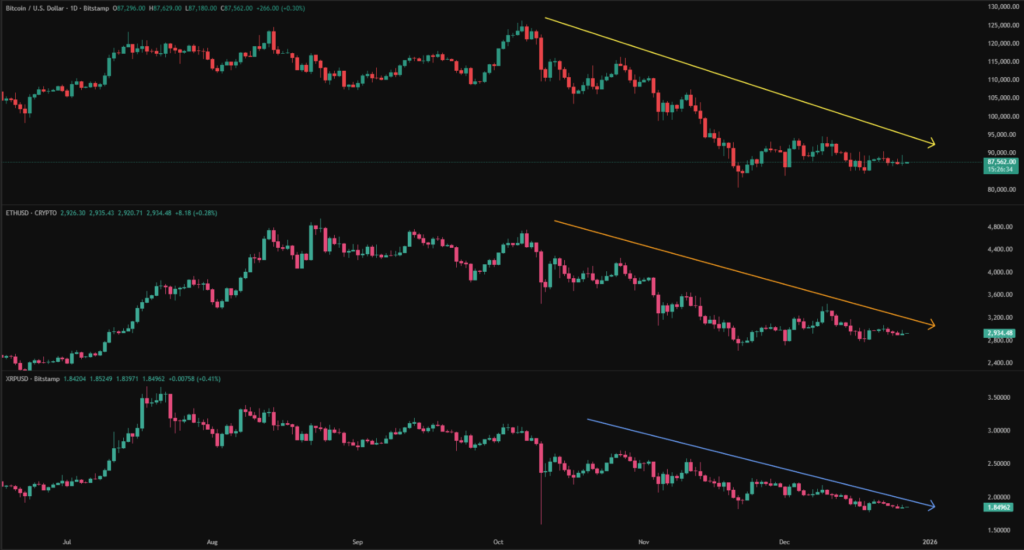
Bitcoin Drops: Bitcoin (BTC) remains sidelined around $87,500 by press time, down 1.20% on the week, as the digital asset looks almost set to face its first yearly loss in three.
Ethereum Posts Two-Week Downtrend: Ethereum (ETH) posts the second weekly loss in five, down 2.20% on the week, around $2,930 at the latest.
Ripple Slides for Fourth Straight Week: Ripple (XRP) posts the fourth weekly loss, despite lacking downside momentum, as sellers face a 3.70% downside for the week, close to $1.85 as we write.
The Weekly Moves
Key Macro Catalysts
Looking at the week’s major catalysts, the strongest U.S. Q3 GDP growth since late 2023 failed to inspire U.S. dollar buyers, as mixed statements from Fed officials suggested that the U.S. central bank may further cut rates in 2026. The dovish Fed bias weighed on the U.S. dollar, despite the late-week corrective bounce and the market’s discomfort with the geopolitical developments. The U.S. dollar allowed the gold price to benefit from market uncertainty, while U.S. equities ended the week mostly upbeat, heading into the year-end holiday season, despite sluggish momentum during the period.
The following are some of last week’s key data/news:
Starting with the data, the preliminary reading of the U.S. third-quarter (Q3) Gross Domestic Product (GDP) surprised markets with the strongest growth since late 2023. That said, the U.S. Q3 GDP growth rate (annualized) came in at 4.3% compared to 3.3% market forecasts and 3.8% prior.
Meanwhile, Durable Goods Orders for October hit a three-month low of -2.2%, versus the market expectations of -1.5% and the upwardly revised prior reading of 0.7%.
The U.S. ADP Employment Change 4-Week Average eased to 11.5K from 16.25K, whereas the preliminary readings of the Q3 Core Personal Consumption Expenditure (PCE) matched 2.9% market forecasts on a quarter-over-quarter (QoQ) basis, versus 2.6% prior. That said, the PCE prices also matched the 2.8% QoQ growth versus the 2.1% previous readings, while the Industrial Production for October reports a -0.1% Month-over-Month (MoM) outcome against the market consensus and previous readings of 0.1%.
Further, the U.S. Conference Board’s (CB) Consumer Confidence for December came in at 89.1 compared to 91.7 expected and 92.9 prior (revised), while the Richmond Manufacturing Index for the same month flashed a -7.0 mark versus the market forecasts of -8.0 and prior readings of -15.0. Additionally, the Chicago Fed National Activity Index for September improved to -0.21 from a revised prior figure of -0.31.
Initial jobless claims for the week ended on December 19 hit a three-week low of 214K, versus 224K expected and prior readings. The downbeat weekly employment claims also dragged the 4-week average to 216.75K from 217.5K. Meanwhile, the weekly Continuing Claims rose to 1.923 million from a revised down previous reading of 1.885 million.
Meanwhile, Federal Reserve Governor Stephen Miran reiterated his dovish bias during a Bloomberg TV interview while saying, “The need to dissent and push for another 50 basis point cut has diminished somewhat.”
On a geopolitical front, Israel raised concerns with U.S. President Donald Trump’s administration over recent Iranian missile activity, with the Islamic Revolutionary Guard Corps allegedly targeting Israel.
Although the U.S. data was mostly downbeat, apart from the GDP, the U.S. dollar faced a corrective bounce, especially due to mildly offered equity indices and the sluggish markets as traders prepare for the year-end holiday season.
Given the data, the White House Economic Advisor Kevin Hassett said the Gross Domestic Product (GDP) report is a “great Christmas present” for the American people, emphasizing the effectiveness of the Trump administration’s trade agenda and trade deficit reduction.
Elsewhere, U.S. President Donald Trump raised prospects of either selling or keeping the seized Venezuelan oil to escalate geopolitical tensions. On the same line, Israeli Prime Minister Netanyahu reaffirmed Iran’s military and nuclear activities as a significant threat, and U.S. Vice President JD Vance expressed doubts about a quick peace deal between Israel and Palestine.
The latest updates suggest that Ukrainian President Volodymyr Zelenskyy is ready to meet with U.S. President Donald Trump in Florida on Sunday. The Ukrainian leader looked slightly optimistic while saying they would aim to “finalize as much as we can.” Furthermore, Israeli Prime Minister Benjamin Netanyahu is also up for meeting U.S. President Trump on December 29. The buzz surrounding the U.S.-Israel ties to strike Iran gained attention of late, but there are few details to confirm that risk-negative news.
It’s worth observing that anxiety around Trump’s Fed Chairman announcement ahead of the widely discussed early January deadline and the U.S.-China trade tension failed to gain major attention amid thin market activity due to the year-end holiday mood.
Crypto Market News
In the crypto universe, Bitcoin (BTC) remained mildly offered, down nearly 1.0%, but Ripple (XRP) and Ethereum (ETH) posted consecutive weekly losses. That said, Aave (AAVE) slumped over 14% to grab the bear’s attention, while Midnight (NIGHT) bucked the downtrend with nearly 22% weekly gains.
Meanwhile, the crypto market capitalization (market cap) dropped 1.00% to $2.96 trillion, whereas the Bitcoin Dominance ticked up to 59.1% from 59.0% during the last week.
That said, some of the top crypto news are as follows, while more updates like this could be traced to our Coin Bytes.
Kaspersky, a global cybersecurity company, raised the market’s fears while warning about a new information-stealing program called Stealka. The malware was first identified in November and spreads through pirated Windows software and game modifications and is used to drain crypto wallets, hijack online accounts, and install a crypto-miner on victim machines.
Read More: Cybersecurity Company Kaspersky Warns Gamers and Crypto Users about Stealka!
The U.S. Federal Reserve (Fed) sought public opinion about a planned “payment account,” termed a “skinny master account,” which is appealing to fintechs and crypto firms because it would give access to the central bank without the requirement for traditional approvals.
Elsewhere, Indonesia’s Financial Services Authority (OJK) released a formal list of 29 certified cryptocurrency platforms that are legally permitted to operate in the nation. The list will serve as an authoritative reference for users to determine whether a provider is lawfully licensed before trading.
The world’s largest asset management company, BlackRock, named spot Bitcoin Exchange-Traded Fund (ETF) as one of the top three investing themes in 2025. The global investment firm, iShares Bitcoin Trust ETF (IBIT), has offered a negative return so far in 2025 but has attracted over $25 billion in net inflows this year.
The first country in the world to use Bitcoin as a legal tender, El Salvador, is making significant progress in its discussions about Bitcoin policy and economic reforms with the International Monetary Fund (IMF) for a $1.4 billion loan package. The IMF’s Mission Chief for El Salvador was quoted as saying, “The sale of the government e-wallet Chivo is well advanced, and discussions about the Bitcoin project continue, centered on enhancing transparency, safeguarding public resources, and mitigating risks.”
Ghana has made cryptocurrency trading legal after parliament approved a law that brings virtual asset activity under the direct oversight of the central bank. Bank of Ghana Governor Johnson Asiama said parliament had approved the Virtual Asset Service Providers Bill, opening the way for a licensing system for exchanges and other firms dealing in virtual assets and allowing the authorities to bring a fast-expanding market under formal supervision.
On the same line, the central bank of Russia rolled out a new regulatory framework aimed at expanding access to cryptocurrencies for both retail and professional investors, reflecting a shift in policy prompted by Western sanctions. Under the plan, non-qualified investors will be allowed to purchase the most liquid cryptocurrencies after passing a knowledge test, with an annual purchase cap of 300,000 rubles ($3,800).
Uniswap Governance passed the ‘UNIfication’ proposal that will trigger a 100 million token burn following a two-day time lock. That said, the vote activates a “fee switch,” diverting a portion of trading fees from liquidity providers to the protocol to buy and burn UNI.
Read Details: Uniswap Governance Passes Historic ‘UNIfication’ Proposal, Triggers 100M Token Burn
Trust Wallet suffered a $6.0 billion drain due to a hack that exposed a vulnerability in its browser extension (version 2.68). The Binance property wallet witnessed a fake “update” that was made available through the official Chrome Web Store, which allowed the stealing of funds and suggests that there is a malware vulnerability in the wallet’s software release process.
Also Read: Trust Wallet Hack: Extension Flaw Leads to More than $6 Million in Holiday Drains
An AAVE investor since 2022, Wintermute voted against the AAVE Governance Proposal by citing the lack of information. The Evgeny Gaevoy-led firm turned down the AAVE proposal, resulting in its broader rejection.
Position Liquidations
Crypto market position liquidation justifies the latest weakness of the major coins, with the higher long liquidations. That said, position liquidation is the forced closing of a trader’s positions by a broker due to insufficient margin. This data reveals whether long (buy) or short (sell) positions were closed, helping explain recent price movements. Typically, heavy long liquidations happen during a downtrend and suggest short-term bearish sentiment, and vice versa.

During the December 21 to 27 period, a total of $1.157 billion of positions were liquidated, per the CoinGlass data. Of this total, “Long Positions” contributed $700.43 million, while “Short Positions” accounted for $456.34 million, indicating a positive trend in long liquidations.
Bitcoin Drops, Equities Rise, while Gold Rallies
Bitcoin (BTC) remained under pressure, posting over a 1.0% weekly loss, as crypto market sentiment dwindles amid mixed clues and the year-end inaction, despite dovish Fed clues.
Meanwhile, major U.S. equity indices traded positively, with the Dow Jones Industrial Average (DJI) rising 1.20% on the week, while the S&P 500 (SPX) posted weekly gains of 1.40%, and the Nasdaq Composite (NQ100) gained 1.22% on the week. Notably, SPX is up over 17% for the year.
Elsewhere, the spot gold (XAU/USD) rallied 4.48% on the week, up for the third consecutive week, before ending a record-breaking performance around $4,535. It’s worth observing that gold faces a stellar 72% jump for 2025, while the silver price (XAG/USD) is up 175% and lured the bull’s attention.
Also read: Is Bitcoin New Digital Silver Now? Silver Jumps 130% this Year!
This casts doubt on the historical linear relationship between Bitcoin and equities and gold, leading to concerns about a potential recovery in the BTC price once the cryptocurrency markets stabilize.
To clearly visualize links among these key risk assets, let’s see the correlation chart from TradingView.
BTC, S&P 500, and Gold

With the recent doubts about the previous linear relations between Bitcoin, gold, and the U.S. equities, BTC traders should remain cautious while blindly following the price action of such assets.
BTC Price Action, ETF Flows Flag “Crypto Winter” Fears
Bitcoin’s (BTC) latest inaction could be tied to a sustained outflow from the U.S. spot BTC ETFs and positive news pushing traders towards extending the previous trend. Notably, fears of “Crypto Winter” also challenged optimism surrounding the Bitcoin price.
“Crypto Winter” is an industry term, like “bear market,” and signifies a prolonged period of downbeat cryptocurrency prices. The crypto market watchers also observed the historical crypto winters and highlighted low trading volume, as well as an overall indecision among investors, as additional catalysts.
Bitcoin Price during Crypto Winter
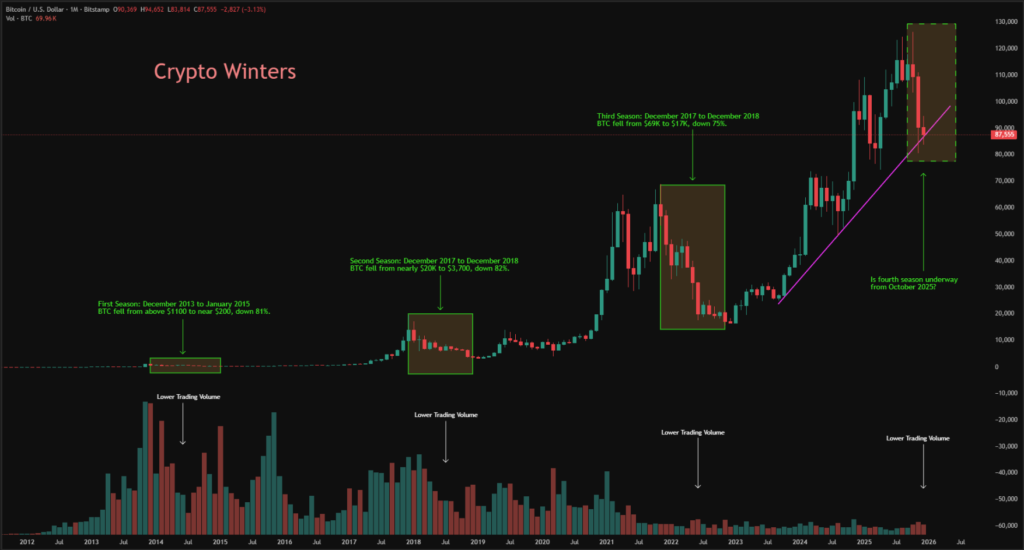
The cryptocurrency market watchers have so far identified three seasons of the crypto winter and are leaning towards considering BTC’s pullback from an all-time high in October as the start of the fourth season.
Notably, the first season started in December 2013 and ended in January 2015, wherein BTC fell from above $1100 to near $200, down 81%. In the second season, allegedly from December 2017 to December 2018, the Bitcoin price fell from nearly $20K to $3,700, down 82%. Moving on, the third season is said to have lasted from December 2017 to December 2018 and dragged BTC from $69K to $17K, down 75%.
It’s worth observing that the Bitcoin price saw more than 70% losses during each of the last three crypto winters, while its 2025 losses are less than or equal to 6%, raising doubts about the “Crypto Winter” confirmations. The market’s uncertainty will need strong negative catalysts, like an upbeat U.S. dollar, the market’s risk-off mood, and industry-negative policies from the major economies, to confirm the start of the crypto winter.
That said, the buzz surrounding Bitcoin’s return to the exchanges and the upbeat performance of whales, wallets holding more than 10,000 BTC, as well as the ETF outflows, could be linked to BTC’s latest losses.
Starting with the latest U.S. spot Exchange Traded Fund (ETF) data from SoSoValue, the Bitcoin (BTC) spot ETFs reported a four-day outflow pattern last week. That said, Friday’s softer daily outflows of $83.27 million could portray a grim picture of the institutional interest.
As a result, the spot BTC ETFs faced the biggest weekly outflow in five weeks, worth $589.39 million by the end of Friday. Notably, the below-mentioned chart from SoSoValue couldn’t update Friday’s daily outflow figures, and hence we needed to add the $83.27 figures from what’s shown.
It’s worth observing that August reported the first monthly outflow in five months, the biggest since March, but there were inflows in September and October, whereas the November outflows have been $3.48 billion by press time, the biggest since February. Meanwhile, December faces an outflow of $887.60 million.
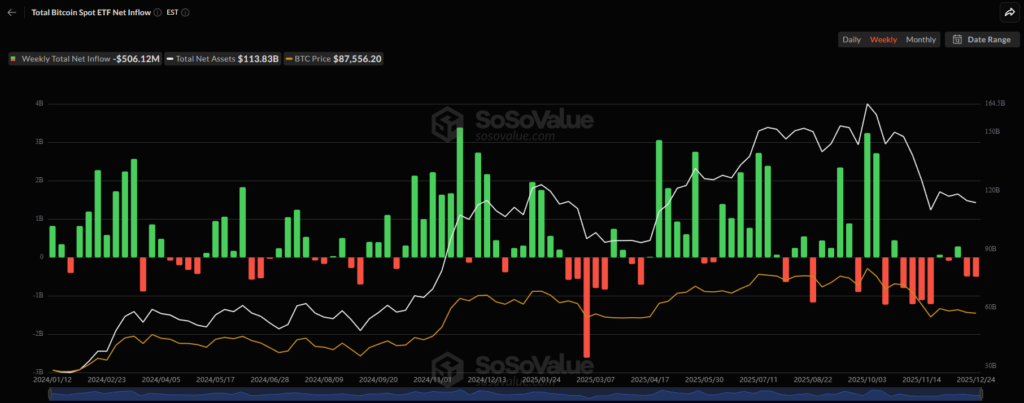
With a sustained magnitude of the ETF outflow for the week, as well as the previous heavy monthly outflows, the BTC optimists should remain cautious going forward.
Meanwhile, Onchain Lens marked the flow of Bitcoin back to exchanges, which is generally considered negative for the crypto price. The on-chain watcher reported that BlackRock deposited 2,292 BTC on Coinbase, while a whale wallet dormant for eight years deposited 400 BTC on OKX.
Elsewhere, Crypto Rover cites a spike in whale buying, from 1,350 to 1,440 in a short time span, to suggest buying from holders of more than 1K BTC.
Technical Analysis Tests Bitcoin Sellers
On a technical side, the Bitcoin price crosses a six-week-old descending trendline resistance, now support, even as the 14-day Relative Strength Index (RSI) and the Moving Average Convergence Divergence (MACD) momentum indicators flash mixed signals. Notably, BTC remains below the key Exponential Moving Averages (EMAs) and defends the early November’s downside break of a multi-month horizontal support to keep sellers optimistic.
Bitcoin Price: Daily Chart Suggests Consolidation
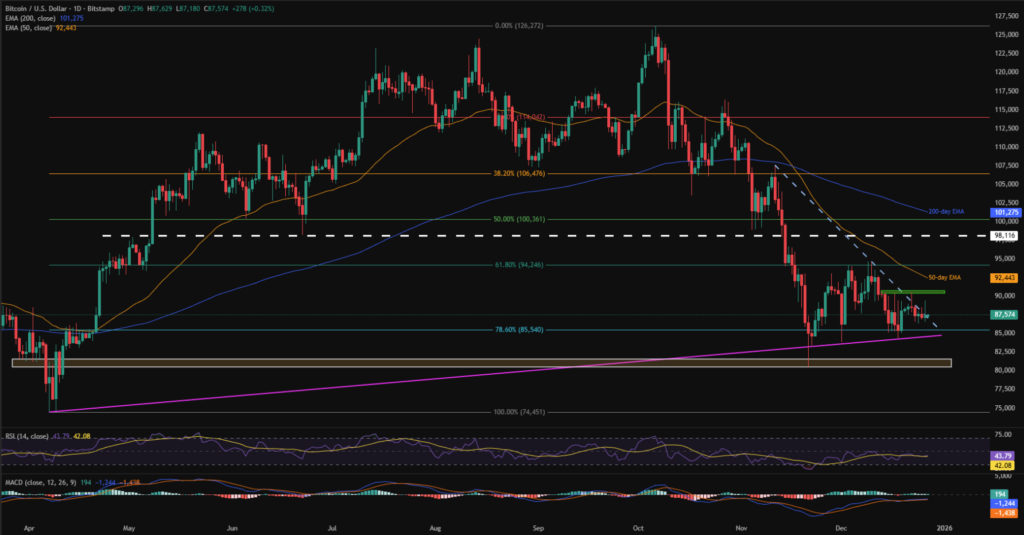
The Bitcoin price extends Friday’s corrective bounce to break a downward-sloping resistance line from November 11, now with immediate support near $87,100.
It’s worth observing that the RSI stays near the 50.00 neutral level and the MACD signals are sluggish (small green histogram), suggesting a lack of directional momentum and challenges for the current recovery moves.
As a result, BTC might approach a two-week-old horizontal resistance area surrounding $90,550-$90,650, a break of which could propel the Bitcoin price towards the 50-day EMA hurdle of $92,443.
However, the 61.8% Fibonacci retracement level of its April-October rise near $94,250, also known as the “Golden Fibonacci Ratio,” and previous support from May, close to $98K, could challenge the Bitcoin buyers afterward.
Above all, the 200-day EMA, close to $101,280, will be the last line of defense for the Bitcoin bears.
Alternatively, BTC’s downside break of the resistance-turned-support of $87,100 could drag it back to the 78.6% Fibonacci ratio of $85,500. However, an ascending trendline support from April, close to $84,500 at the latest, will be a tough nut to crack for the Bitcoin bears.
In a case where the crypto major breaks the $84,500 support, a broad support zone from late March, between $81,500 and $80,500, will act as the final line of defense for BTC buyers, a break of which could direct the Bitcoin price toward April’s yearly low of $74,451.
Ethereum Remains Weak on ETF Outflows
Ethereum (ETH) outplayed Bitcoin as it posted a 2.20% weekly fall to $2,930 at the latest.
When examining the major catalysts, we see that U.S. spot ETH ETFs experienced outflows similar to those of BTC; however, Ethereum whales—wallets holding between 1,000 and 1 million ETH—demonstrated accumulation.
ETH ETFs Report Outflows
As per the latest SoSoValue data, the U.S. Ethereum (ETH) spot ETFs reported the fourth weekly outflow pattern in the last six, suggesting a weakness in institutional demand.
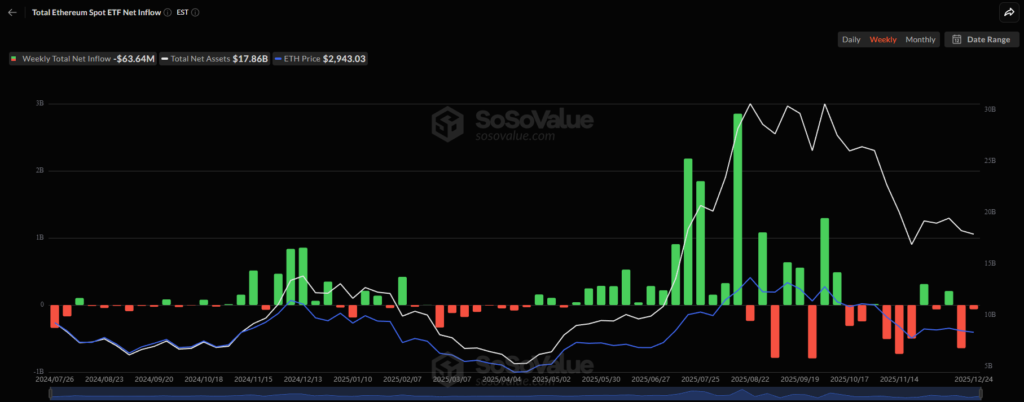
On December 26, the U.S. Spot ETH ETFs reported its third consecutive daily outflow, worth $16.58 million.
As a result, the second-largest coin posted a two-week outflow pattern, with last week’s total outflow of $80.22 million. Notably, the aforementioned chart from SoSoValue couldn’t update Friday’s daily outflow figures, and hence we needed to add the $16.58 figures from what’s shown.
Notably, the monthly figures also remained red after November posted the first monthly outflow since March, as well as the biggest monthly outflow on record, with the $1.42 billion outflow. Meanwhile, December’s outflows have been $580.84 million so far.
ETH Whales Suggests Accumulation
Contrary to the downbeat signals from the ETF fund flows, the ETH whale behavior looked positive.
As per the latest clues from CryptoQuant, the ETH whales have accumulated 4.8 million ETH, equaling 4% of the circulating supply since November 21, driving their holdings from 22.4 million to 27.2 million during that period.
Technical Analysis Keeps ETH Bears Hopeful
Ethereum’s technical analysis highlights the trader’s dilemma as it stays between a six-month ascending support line and the 21-day Exponential Moving Average (EMA). Bearish signals from the Directional Movement Index (DMI) momentum indicator and the lack of market activity during the year-end holiday season are making it tough for ETH traders, as the price continues to stay below the 200-day EMA.
Ethereum Price: Daily Chart Attracts Sellers

On the daily chart, the Ethereum price seesaws between an ascending support line from June and the 21-day EMA, currently between $2,798 and $2,993.
However, the quote’s early-month U-turn from the 200-day EMA and a downside break of the 50% Fibonacci retracement of June-August upside, as well as the bearish DMI clues, keep the ETH bears optimistic.
That said, the DMI’s Average Directional Index (ADX, red) line tops the Downmove (D-, orange) graph, and both the lines are stronger than the Upmove (D+, blue) line, highlighting a bearish directional momentum. Furthermore, the ADX and the D- lines are both above the 25.00 neutral level, while the D+ line is at 12.50, citing stronger downside momentum.
With this, the Ethereum price is likely to remain weak, highlighting an ascending support line from June, close to $2,798 at the latest.
Still, the year-end inaction, due to the holiday season and a lack of major catalysts, might restrict ETH’s further downside. If not, then the 78.6% Fibonacci ratio of $2,723 and November’s low of $2,622 could test the bears before directing them to June’s bottom near $2,116.
Alternatively, the Ethereum price recovery needs validation from the 21-day EMA hurdle of $2,993 to approach the 61.8% Fibonacci retracement level, also known as the “Golden Fibonacci Ratio,” close to $3,200.
Beyond that, the 200-day EMA level of $3,383, the monthly high of $3,447, and the 50% Fibonacci retracement level of $3,535 could offer breathing halts to the ETH bulls.
Ripple Falls Despite Institutional Optimism
Ripple (XRP) dropped the most among the major three cryptocurrencies, down over 3.70% on the week to $1.85 as we write, while posting the fourth consecutive weekly loss. In doing so, the altcoin ignores a sustained institutional interest in the XRP.
Strong weekly inflows into the U.S. Ripple (XRP) spot ETFs failed to favor the XRP buyers.
As per the latest SoSoValue data, the U.S. Ripple (XRP) spot ETFs reported a pause to the 28-day inflow pattern, with the latest daily figures being $0.00 million. Notably, the XRP’s weekly inflows were $64.00 million during a six-week inflow pattern.
Some on the crypto trading desks argue that a growing divergence of monetary policy outlook between the U.S. Federal Reserve (Fed) and the Bank of Japan (BoJ), with the Fed cutting the rates and the BoJ lifting them, could positively affect the XRP ETF demand. However, this seems unlikely due to the altcoin’s limited ability to celebrate the end of Ripple’s multi-year legal battle with the U.S. government, the introduction of spot ETFs, and the growth of the ecosystem.
XRP Technical Analysis Lures Sellers
The Ripple price extends recovery after snapping a five-day losing streak. Despite the rebound, XRP faces a fourth consecutive weekly loss, the third straight monthly downside, and the first yearly drop in three.
The altcoin’s latest gains could be linked to its U-turn from key horizontal support and cautious optimism among cryptocurrency traders. However, the year-end holiday mood’s lack of liquidity could pose a challenge to the XRP bulls as they monitor a month-old descending resistance line.
Apart from the sluggish trading participation, the Directional Movement Index (DMI) momentum indicator also flashes bearish signals and keeps the XRP optimism in check.
Ripple Price: Daily Chart Favor Bears
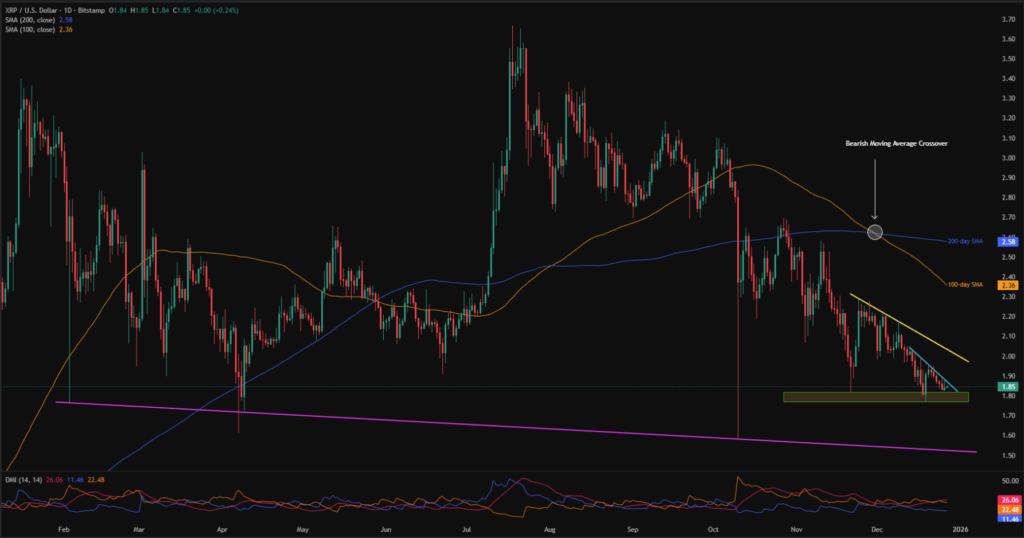
The Ripple price bounces off a horizontal support area comprising levels marked since November 21, between $1.77 and $1.82, amid the year-end consolidation of losses due to less liquid trading sessions and an absence of major positives for the U.S. dollar.
Notably, the DMI’s Average Directional Index (ADX, red) line tops the Downmove (D-, orange) line, and both lines are stronger than the Upmove (D+, blue) line, highlighting a bearish directional momentum. Furthermore, the ADX and the D- lines are both above the 25.00 neutral level, while the D+ line is at 11.46, citing stronger downside momentum.
Meanwhile, the 100-day Simple Moving Average (SMA) crossed the 200-day SMA from above during late November and portrayed the bearish moving average crossover.
As a result, a fortnight-old descending resistance line around $1.90 seems to be restricting the immediate Ripple price advance.
However, major attention is given to a downward-sloping resistance line from late November, close to $2.05, as a break of which can propel XRP toward the late November swing high around $2.30.
In a case where the Ripple price remains firmer past $2.30, the 100-day and 200-day SMAs, near $2.45 and $2.60, respectively, will act as the final line of defense for the bears.
On the flip side, a daily closing beneath the aforementioned $1.82-$1.77 support area could make the Ripple price vulnerable to dropping toward April’s low of $1.61. However, XRP bears may find it challenging to overcome a downward-sloping trendline from February, located near $1.50.
Another Holiday-Shortened Week Ahead
Given the Fed-linked uncertainty and a light calendar due to the New Year holiday, crypto traders will closely observe the Minutes of the December Federal Open Market Committee (FOMC) Monetary Policy Meeting for clear directions, along with weekly employment clues.
Meanwhile, China’s official Purchasing Managers Index (PMIs) for December and the final readings of the UK, Europe, and the U.S. S&P Global PMIs for December will also try to entertain the momentum traders amid a likely sluggish week.
Notably, major markets will be closed on January 01, but not the cryptocurrencies.
Also read: Is Bitcoin New Digital Silver Now? Silver Jumps 130% this Year!


