




Cryptocurrency Weekly Snapshot
Cryptocurrency weekly performance was surprisingly dicey as major coins dribbled despite the U.S. Federal Reserve’s (Fed) third straight rate cut, due to mixed on-chain clues and institutional demand.
The crypto market’s confidence dwindled as the December Federal Open Market Committee (FOMC) monetary policy meeting flashed unclear signals surrounding their future actions, repeating a “meeting-by-meeting” approach. Adding to the cryptocurrency traders’ woes were rumors about Binance and on-chain data suggesting a lack of optimism among key players, even as the Exchange-Traded Funds (ETFs) faced inflows.
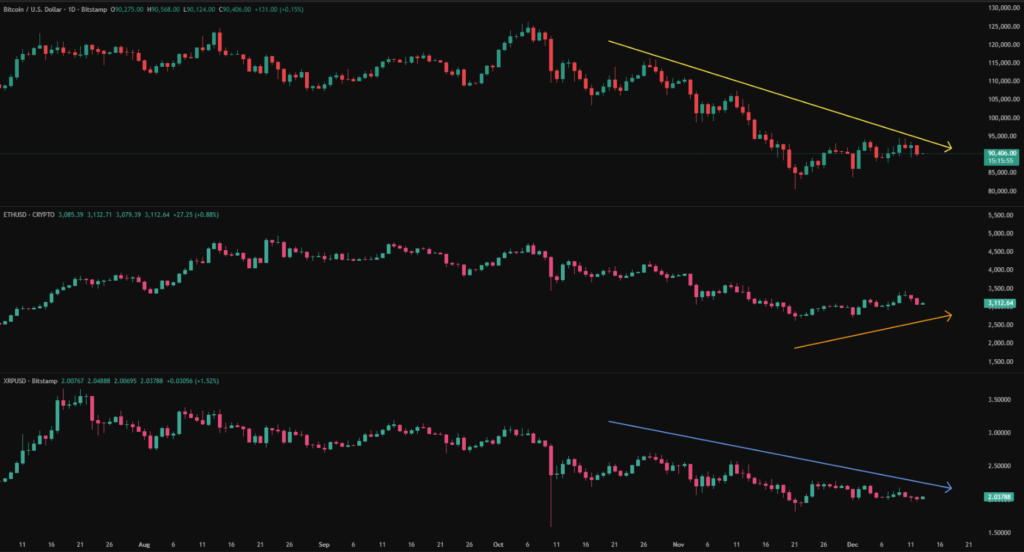
Against this backdrop, Bitcoin (BTC) and Ripple (XRP) both remain directionless, while Ethereum (ETH) rose for the third consecutive week, despite lacking upside momentum. Meanwhile, the spot gold (XAU) price posted a weekly gain, the U.S. equities are mixed, and the U.S. Dollar Index (DXY) dropped for the third consecutive week.
Bitcoin Dribbles: Bitcoin (BTC) remains sidelined for the second straight week, making rounds to $90,500 by press time, even as the digital asset is almost set to face its first yearly loss in three.
Ethereum Grinds Higher: Ethereum (ETH) is also on the brink of snapping its two-year uptrend despite rising for the third week in a row, up nearly 2.0% to $3,130 at the latest.
Ripple Suffers Modest Losses: Ripple (XRP) posts the second weekly loss, despite lacking downside momentum, as sellers eye a 0.30% downside for the week, close to $2.04 as we write.
The Weekly Moves
Key Macro Catalysts
If we take a look at the major catalysts, the Fed’s ‘dull’ rate cut was jostled with an uncertainty about the Fed’s politicizing, and unimpressive data could be witnessed. Notably, the strong Treasury bond yields challenged risk assets, while equities traded mixed, but gold cheered its traditional haven status to hit a seven-week high, and the U.S. Dollar Index (DXY) marked a three-week downtrend. The following are some of last week’s key data/news:
On Wednesday, the U.S. central bank matched the market forecasts by cutting the benchmark rate by 0.25%. However, the Fed’s upward revision to the growth forecasts and Chairman Jerome Powell’s “meeting by meeting” outlook, coupled with a slightly skewed dot plot, seemed to have favored traders expecting a pause in January before a gradual downward trend in rates.
Talking about the data, the U.S. Bureau of Labor Statistics (BLS) released JOLTS Job Openings for September and October. That said, the September figures came in at 7.658 million versus 7.2 million expected and 7.227 million prior, while the October figures reported the 7.67 million mark compared to the 7.20 million market forecasts.
U.S. ADP Employment Change, four-week average, came in at +4.75K compared to -13.5K prior. Notably, the monthly figures released last week showed -32K vs. a +10K estimate.
Meanwhile, the U.S. NFIB Small Business Optimism Index for November hit a three-month high of 99.00 versus 98.3 expected and 98.2 prior.
The U.S. Employment Cost Index (ECI) for the third quarter (Q3) hit a four-quarter low of 0.8% versus 0.9% expected and prior readings.
The U.S. Initial Jobless Claims for the week ended on December 06 rose to a three-month high of 236K versus 220K expected and 192K prior (revised). Meanwhile, the trade balance for September improved to -$52.8 billion from the -$63.3 billion estimate and -$59.3 billion prior.
On Friday, a slew of Fed policymakers crossed wires for the first time after a two-week silent period, as well as the Fed showdown, while marking uncertainty surrounding the U.S. central bank’s next action.
Among them, the Cleveland Fed President Beth Hammack cited the challenge in balancing both sides of the Fed’s mandate, while Chicago Fed President Austin Goolsbee showed readiness to wait for more data before terming the current inflation transitory. Further, Kansas City (State of Missouri) Fed President Jeffrey Schmid mentioned “too hot” inflation while trying to challenge the rate cut bias.
Elsewhere, White House Economic Advisor Kevin Hassett, the frontrunner for the next Federal Reserve (Fed) Chairman position, said that there is more room than a 25 basis point cut.
On a different page, U.S. President Donald Trump spoke on a slew of topics ranging from Venezuela to Ukraine and the Fed while allegedly trying to restore his approval ratings. An indirect threat to Venezuelan Leader Nicolás Maduro and his associates, a citation of good relationships with the Chinese and Japanese leaders, has gained major attention. Meanwhile, Trump also showed readiness to solve the Ukraine issue and pushed the Fed for more rate cuts.
Crypto Market News
In the crypto universe, Bitcoin (BTC) and Ripple (XRP) remained mostly unchanged for the week, but Ethereum (ETH) posted its third consecutive weekly increase.
That said, Zcash (ZEC) rallied over 30% to gain the bull’s attention, while Story (IP) fell almost 13% during the last week.
Meanwhile, the crypto market capitalization (market cap) improved 0.65% to $3.08 trillion, whereas the Bitcoin Dominance improved to 58.7% from 58.6% during the last week, aptly portraying the market’s inaction.
That said, some of the top crypto news are as follows, while more updates like this could be traced to our Coin Bytes.
An X post from DeFiTracer spread fears among the BTC traders a few hours before the FOMC Interest Rate Cut by citing the massive $100 million Bitcoin selling within an hour by Binance.
Read Here: https://x.com/DeFiTracer/status/1998729471478657480
Michael Saylor-led Strategy bought 10,624 Bitcoin in its latest purchase, boosting the total BTC reserves to 660,624. This development raised doubts about the previous concerns that Strategy is rethinking its Bitcoin Treasury plan.
Italy’s market regulator Consob warned Virtual Asset Service Providers (VASPs) by stressing that the VASPs registered with the “Organismo Agenti e Mediatori” will only be allowed to operate until 30 December 2025.
Also Read: Italy Warns VASPs to Meet MiCA Rules or Exit Market by Year-End 2025
Binance announced readiness to pause deposits and withdrawals of all tokens on the Neutron network as of 5:00 PM on December 10 to support the network’s upgrade.
Circle, the issuer of the USDC stablecoin, recently secured a license from the Abu Dhabi Global Market’s regulatory authority, namely the Financial Services Permission (FSP), marking a boost to the crypto industry in the Middle East.
Strategy’s Executive Chairman Michael Saylor advocated for Bitcoin-backed high-yield bank accounts to attract global capital during his appearance at Bitcoin MENA 2025 in Dubai.
Read Details: Bitcoin MENA 2025: Key Trends in Innovation Across the UAE Become Focal Point For Discussions
Abu Dhabi Global Market (ADGM) approved Tether’s USDT stablecoin to be recognised as an Accepted Fiat-Referenced Token (AFRT) on several blockchains. Among them, notable ones are Aptos, Celo, Cosmos, Kaia, Near, Polkadot, Tezos, TON, and Tron.
Polygon rolled out the much-hyped Madhugiri hardfork upgrade on the Polygon PoS mainnet at around 10 am UTC on December 9. The upgrade will increase the Polygon’s block gas limit from 30 million units (M) to 45M, allowing more transaction data per block, as well as suggesting 33% more capacity.
Global asset manager Invesco files the Form 8-A with the U.S. Securities and Exchange Commission (SEC) for a Solana Exchange-Traded Fund (ETF).
Meanwhile, U.S. SEC Chair Paul Atkins said on Tuesday that several Initial Coin Offerings (ICOs) should be outside the agency’s purview. The policymaker was speaking at the Blockchain Association’s fourth annual policy summit in Washington, DC.
State Street Investment Management and Galaxy Asset Management partnered to launch the State Street Galaxy On-chain Liquidity Sweep Fund (SWEEP). That said, Ondo Finance will invest $200 million in the 24/7 on-chain liquidity fund.
Read More: Galaxy Digital Gained $200 Million in Funding, Stock Up 15% this Week!
Elsewhere, Crypto.com and 21shares join hands to introduce a private trust and a future exchange-traded fund (ETF) linked to the Cronos (CRO) ecosystem.
Circle, the issuer of USDC stablecoin, introduced a privacy-focused version of USDC, namely the USDCx, built on the Aleo blockchain to cater to institutions requiring confidentiality of financial transactions.
YouTube is up for allowing the U.S. producers to receive payments in PayPal’s PYUSD stablecoin. While the video platform isn’t likely to get directly involved in the crypto payment process, it will use PayPal’s payout system.
Standard Chartered and Capital A of AirAsia look set to test a stablecoin backed by the Ringgit in Malaysia’s regulatory sandbox. The aim of anchoring the token in Malaysia’s own currency is to provide security and stability in online transactions. The experiment’s success might open the door for regulated stablecoins to be used more widely in the future.
Position Liquidations
Crypto market position liquidation justifies the latest inaction of the major coins, ex-ETH, with unimpressive differences between the long and the short liquidations. That said, position liquidation is the forced closing of a trader’s positions by a broker due to insufficient margin. This data reveals whether long (buy) or short (sell) positions were closed, helping explain recent price movements. Typically, heavy long liquidations happen during a downtrend and suggest short-term bearish sentiment, and vice versa.
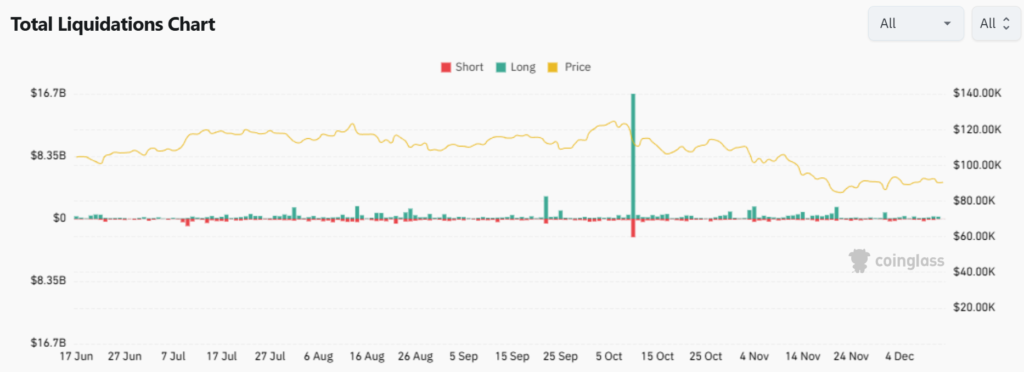
During the December 6–13 period, a total of $2.184 billion in positions were liquidated, per the CoinGlass data. Of this total, “Long Positions” contributed $1.270 billion, while “Short Positions” accounted for $914.29 million, indicating a slight increase in long liquidations.
Bitcoin Stalls, Equities Trade Mixed, But Gold Rallies
Bitcoin (BTC) remained lackluster for the second straight week while staying on the way to posting the first yearly loss in three, showing the lack of optimism among the digital asset buyers in 2025 despite the Fed’s rate cuts.
Meanwhile, major U.S. equity indices traded mixed, with the Dow Jones Industrial Average (DJI) gaining 1.05% on the week, while the S&P 500 (SPX) and Nasdaq Composite (NQ100) both snapped their two-week uptrend by posting 0.63% and 1.62% weekly losses, respectively. Notably, SPX is up over 17% for the year.
Elsewhere, spot gold (XAU) rallied 2.40% on the week, hitting a seven-week high before ending a stellar performance around $4,300. It’s worth observing that gold faces a stellar 60% jump for 2025 and lured the bull’s attention.
This raises doubts about Bitcoin’s historical linear relationship with equities and gold, favoring concerns of a probable recovery in the BTC price once the U.S. equities and gold extend their broad bullish trend.
To clearly visualize links among these key risk assets, let’s see the correlation chart from TradingView.
BTC, S&P 500, and Gold
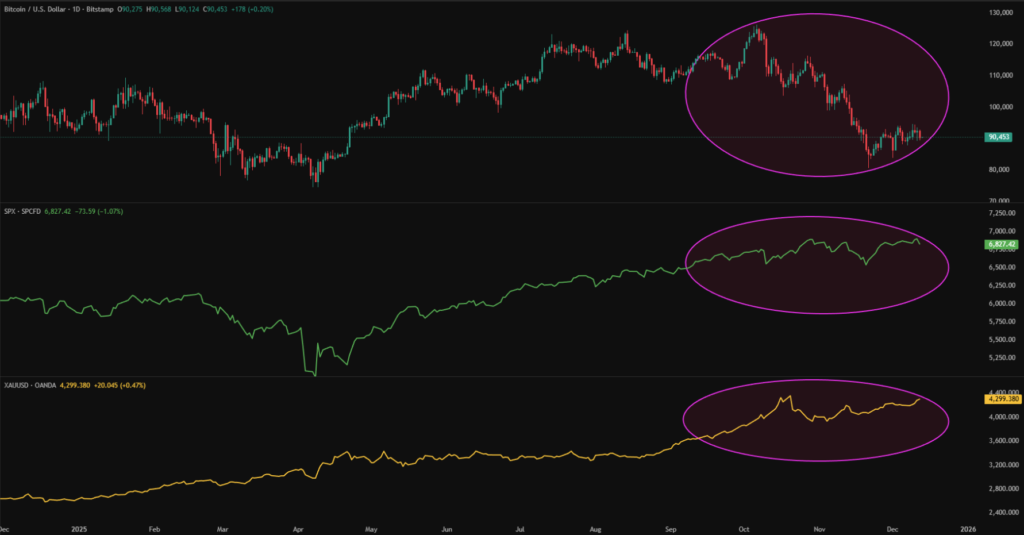
With the recent doubts about the previous linear relations between Bitcoin, Gold, and the U.S. equities, BTC traders should remain cautious while blindly following the price action of such assets.
BTC ETF and On-Chain Data Flash Mixed Signals
A plethora of mixed signals from the ETF, news, and on-chain sources may have contributed to Bitcoin’s recent inaction.
That said, buzz surrounding a heavy offload by Binance, just ahead of the FOMC, triggered notable selling in BTC despite the Fed’s rate cut.
Meanwhile, upbeat whale buying, addresses holding between 10 and 10,000 BTC, contradicts a pause in retail buying, wallets with less than 0.01 BTC.
Furthermore, a decline in the growth of the BTC network and the number of active addresses attracted the attention of sellers, while a positive inflow of ETFs attempted to attract bulls.
Starting with the latest U.S. spot Exchange Traded Fund (ETF) data from SoSoValue, the Bitcoin (BTC) spot ETFs repeated last week’s three-day inflow pattern. That said, Friday’s softer daily inflows of $49.16 million could portray a rosy picture about the institutional interest.
With this, the spot BTC ETFs faced the biggest weekly outflow in seven weeks, worth $286.60 million by the end of Friday.
It’s worth observing that August reported the first monthly outflow in five months, the biggest since March, but there were inflows in September and October, whereas the November outflows have been $3.48 billion by press time, the biggest since February. Meanwhile, December faces a modest inflow of $198.84 million.
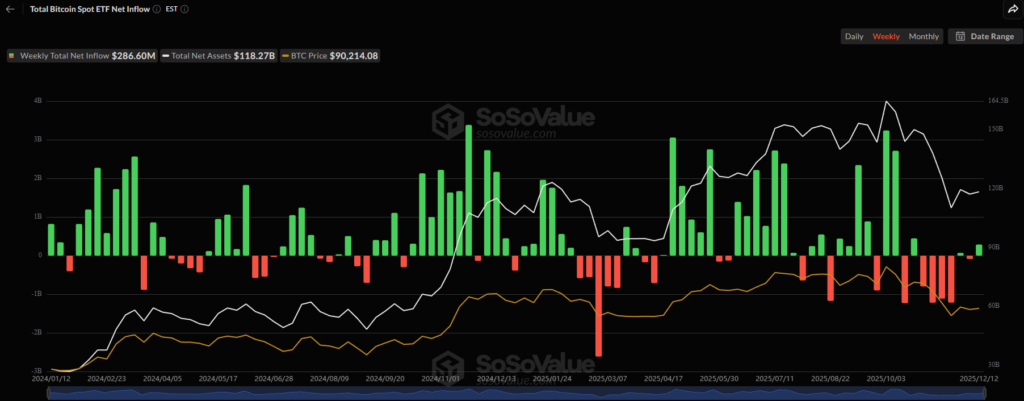
With a noticeable magnitude of the ETF inflow this week versus the previous heavy monthly outflows, BTC optimists should remain cautious going forward.
Meanwhile, Santiment cites an accumulation pattern from the Bitcoin whales, wallets holding 10 to 10K BTC, following weeks of selling by major players. The data provider also cited an accumulation of holdings from small investors’ wallets with 0.01 BTC.
“Wallets holding 10 to 10,000 BTC began accumulating after Nov. 30th, following a massive sell-off that started Oct. 8th,” said Santiment, while also adding that the small wallets (with less than 0.01 BTC) have been steadily increasing their holdings since the October all-time high, even as prices have fallen.
Apart from that, Santiment also cited downbeat on-chain signals to raise doubts about Bitcoin’s performance in 2026. The data provider highlights a 35% slump in the daily active addresses on the Bitcoin network from the all-time high marked in May 2021, as well as a fall in the network growth and token circulation.
On the flip side, a $3.7 billion BTC options expiry also troubled the crypto traders with mild signals. Notably, the maximum pain price, the strike price at which option holders (buyers) lose the most money and options writers (sellers) profit the most, was at $92,240, up from Friday’s close near $90K. Meanwhile, put options (the right to sell) accounted for 52% of the total market share and demonstrated a lack of market confidence in potential upward moves. Such behavior could be considered a slightly negative sign for BTC.
Technical Analysis Teases Bitcoin Buyers
On a technical side, the Bitcoin price keeps its November recovery momentum from an eight-month-old ascending support line, despite repeated failures to cross the 61.8% Fibonacci retracement level of its April-October rise, also known as the “Golden Fibonacci Ratio.”
The steady increase in BTC is also backed by positive signs from the 14-day Relative Strength Index (RSI), which is bouncing back from the 30.00 oversold level, and encouraging signals from the Moving Average Convergence Divergence (MACD) momentum indicator (green histograms), attracting
Bitcoin Price: Daily Chart Suggests Gradual Recovery
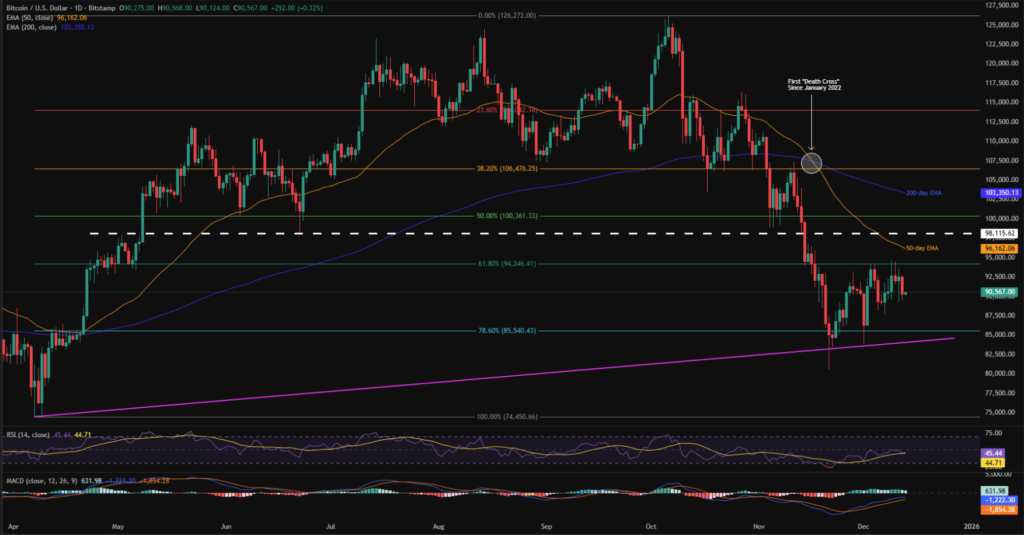
The Bitcoin’s failure to cross the 61.8% Fibonacci retracement level, also known as the “Golden Fibonacci Ratio,” close to $94,250, isn’t a bearish signal for the traders as long as the price stays beyond the ascending support line from April, close to $84,050 by the press time.
On the contrary, BTC’s first “Death Cross” since January 2022, a bearish moving average crossover wherein the 50-day Exponential Moving Average (EMA) crosses the 200-day EMA from above, pokes the buyers.
Therefore, for Bitcoin bulls to maintain control, they must ensure a daily closing above the 61.8% Fibonacci retracement level near $94,250.
Beyond that, the 50-day EMA of $96,160 and a seven-month-old previous support line, now resistance near the $98,000, could test the BTC recovery before directing buyers to the $100K.
In a case where the Bitcoin price remains firmer past $100K, the 200-day EMA of $103,350 could test the BTC bulls before giving them control.
Alternatively, the 78.6% Fibonacci retracement level of $85,500 and an ascending support line from April, near $84,050, are immediate support levels for the sellers to watch.
Below that, November’s low of $80,537 will be a decisive level to follow, as a downside break of the same could direct prices to April’s yearly low of $74,434.
Ethereum Edges Higher On ETF, DEX Interest
Ethereum (ETH) outplayed Bitcoin and Ripple’s XRP, not to mention Binance Coin (BNB) and Solana (SOL), as it posted a 2.0% weekly jump to $3,130 at the latest, while others are facing a sluggish week.
If we look at the major catalysts, the U.S.-listed ETH ETFs faced inflows similar to BTC, and trading volume on the Decentralized Exchanges (DEX) was in favor of Ethereum.
ETH ETFs Report a Return of Inflows
As per the latest SoSoValue data, the U.S. Ethereum (ETH) spot ETFs reported the second weekly inflow pattern in the last six, reversing the previous weekly outflow, suggesting a steady accumulation in institutional demand.
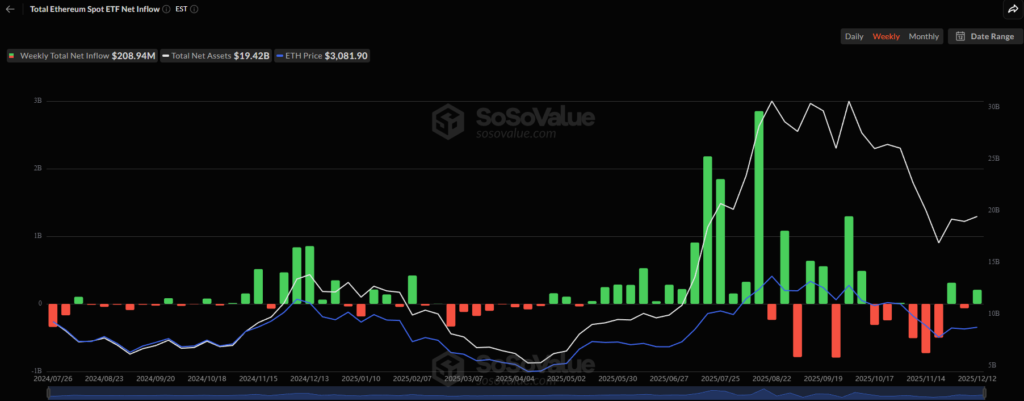
On December 12, the U.S. Spot ETH ETFs reported its second daily outflow of the week, worth $19.41 million.
Even so, the second-largest coin reversed the previous weekly ETH ETF outflow pattern, with last week’s total inflow of $208.94 million.
Notably, the monthly figures also turned green after November posted the first monthly outflow since March, as well as the biggest monthly outflow on record, with the $1.42 billion outflow. Meanwhile, December’s inflows have been $143.35 million so far.
A Bullish Shift in the ETH’s DEX Trading Volume
Ethereum posted the second-largest DEX volume on Thursday, following Solana (SOL), with the daily figure of $1.916 billion.
BlackRock’s filing of the Staked Ethereum ETF Also Lured ETH Bulls
Earlier in the last week, BlackRock, the world’s biggest asset manager, filed for a staked Ethereum ETF. The staked ETH ETF optimism also takes clues from a leadership change at the Securities and Exchange Commission (SEC), as the newly appointed Chair, Paul Atkins, advocates for staking benefits.
Technical Analysis Tests ETH Bulls
Ethereum’s technical analysis highlights the trader’s dilemma as it defends the key Fibonacci support and prior breakout of a multi-week bearish trend channel. However, negative signals from the Directional Movement Index (DMI) momentum indicator, a bearish candlestick pattern, and continued trading below the important Exponential Moving Averages (SMAs) challenge the buyers.
Ethereum Price: Daily Chart Portrays Trader’s Confusion
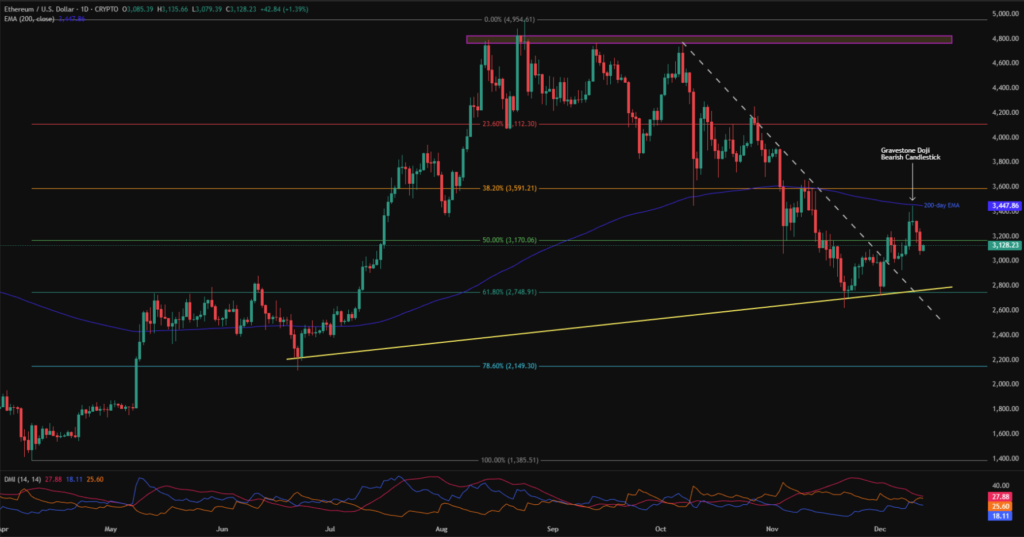
On the daily chart, the Ethereum price challenges the prior U-turn from the 200-day EMA and the “Gravestone Doji” bearish candlestick at a multi-day high.
However, the DMI indicator highlights downside momentum bias, as its Average Directional Index (ADX, red) line tops the Downmove (D-, orange) line and the Upmove (D+, blue) line, in that order. That said, the ADX and D- are both closer to the 25.00 neutral level, suggesting a notable presence of the downside momentum.
This highlights the 50% Fibonacci retracement of the April-August upside, $3,170, as the key immediate resistance for the ETH buyers.
Beyond that, a convergence of the monthly high and the 200-day EMA, close to $3,447-$3,450, will be crucial to watch.
In a case where the Ethereum price remains firmer past $3,450, it defies the bearish candlestick formation and can aim for multiple resistances around $3,700 and the $4,000 psychological magnet before approaching the 23.6% Fibonacci retracement level of $4,112.
On the flip side, an ascending support line from late June, near $2,775; the 61.8% Fibonacci ratio of $2,748; and a previous resistance line from early October, close to $2,660, could restrict short-term ETH declines.
If the Ethereum price breaks the $2,660 support, the odds of witnessing a slump toward the 78.6% Fibonacci ratio of $2,150 can’t be ruled out.
Ripple Keeps Ignoring ETF Optimism
Ripple (XRP) dropped the most among the major three cryptocurrencies, down over 0.30% on the week to $2.04 as we write, while posting the second consecutive weekly loss. In doing so, the altcoin ignores a sustained institutional interest in the XRP.
Strong inflows into U.S. Ripple (XRP) spot ETFs failed to favor XRP buyers. As per the latest SoSoValue data, the U.S. Ripple (XRP) spot ETFs reported a consecutive 19 days of inflow, with the latest daily figures being $20.17 million. Notably, the XRP’s weekly inflows were $77.15 million during a five-week inflow pattern.
On the same line, Grayscale’s XRP Trust ETF launch gained major accolades among the crypto bulls. However, we have yet to witness the actual results.
Technical Analysis Suggests XRP Consolidation
On the technical side, Ripple price portrays consolidation while staying within a two-month-old symmetrical triangle, despite facing the second weekly loss in a row.
Ripple Price: Daily Chart Suggests Bearish Consolidation
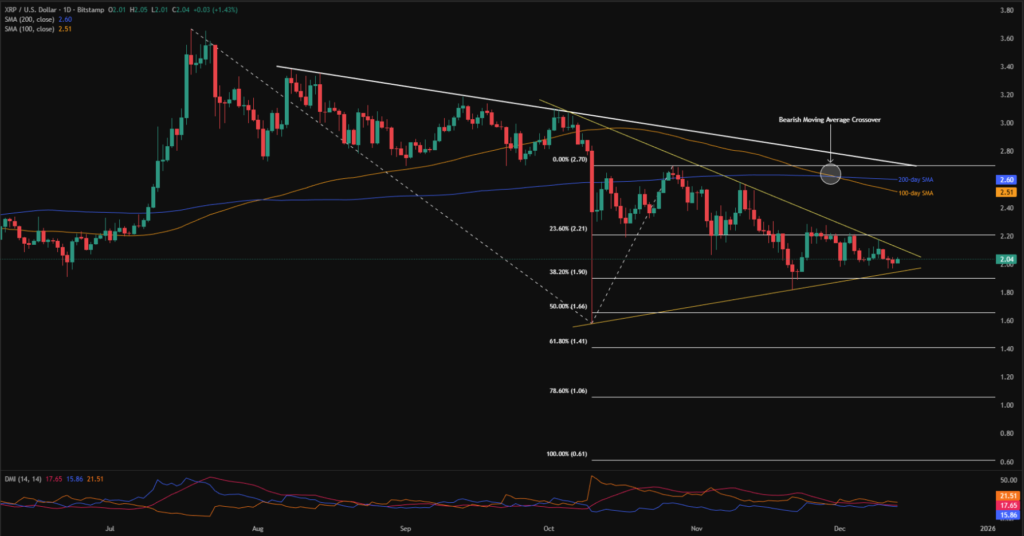
Ripple price portrays a corrective bounce from a three-week low while keeping the previous pullback from the aforementioned triangle’s top. However, downbeat signals from the DMI and bearish moving-average crossover tease the downside bias, challenging XRP’s latest rebound.
That said, the DMI’s Downmove (D-, orange) tops the Average Directional Index (ADX, red) line and the Upmove (D+, blue) lines, with the D- being closer to the 25.00 neutral limit and hence portraying a slightly bearish directional momentum.
Meanwhile, the 100-day Simple Moving Average (SMA) crossed the 200-day SMA from above during late November and portrayed the bearish moving average crossover.
Still, the XRP sellers need a daily closing beneath the triangle’s bottom line, close to $1.95 by press time, to convince sellers.
Following that, the quote’s south run towards October’s low of $1.58 can’t be ruled out, with the 38.2% and 50% Fibonacci Extension (FE) levels of its July-October moves of $1.90 and $1.66 likely offering intermediate halts.
In a case where the Ripple price remains weak past $1.58, the 61.8% and 78.6% FE levels, close to $1.41 and $1.06, as well as the $1.00 psychological magnet, could attract the sellers.
Alternatively, an upside clearance of the stated triangle’s top and the 23.6% FE, near $2.11 and $2.21, can convince the XRP bulls.
Should the XRP manage to offer a daily closing beyond $2.21, the 100-day and 200-day SMA levels, close to $2.51 and $2.60 in that order, could flash on the buyer’s radar ahead of the late October swing high of $2.69.
Above all, the XRP remains on the bear’s list as long as the price stays below a downward-sloping resistance line from early August, near $2.74 as we write.
A Busy Week Ahead
Given the Fed-linked uncertainty, crypto traders will closely observe a slew of U.S. data scheduled for release during the week. Among them, preliminary readings of the U.S. S&P Global Purchasing Managers Index (PMI) for December will join October’s monthly employment report and retail sales, as well as November’s Consumer Price Index (CPI), which will be crucial to follow.
Meanwhile, China’s industrial production and retail sales, as well as the monetary policy meetings of the Bank of England (BoE) and the European Central Bank (ECB), will also contribute to offering an active week.


