





Cryptocurrency Weekly Summary
- Cryptocurrency weekly performance extends losing streak amid Fed rate cut doubts, U.S. shutdown woes, and Sino-American trade jitters.
- Bitcoin, Ethereum, and Ripple post a two-week downtrend, Zcash bucks the trend with a rally, while Solana slumps.
- Wall Street snaps three-week rally amid tech rout, while Gold slips for the third week with modest losses.
- Multiple Fed policymakers showed cautious remarks, raising doubts on the previously confirmed December rate cut.
- U.S. government shutdown turns historical, pressuring policymakers to end the deadlock soon.
- U.S.-China struggle to perform on Trump-Xi trade promises, raising doubts on future ties.
- Bitcoin whales continue selling, XRP network growth hints at bottom, while BTC/ETH ETF outflows stretch.
- Potential end to U.S. government shutdown could restore market confidence and unlock key data to determine next moves.
Cryptocurrency Weekly Snapshot
Cryptocurrency weekly outlook turned red for the second straight time amid uncertainty surrounding the U.S. Federal Reserve’s (Fed) December rate cut and the reopening of the government shutdown, as well as mixed U.S.-China trade news.
Multiple Fed officials crossed wires last week, and a few U.S. data also released, but none of them could tame the latest buzz that the Federal Open Market Committee (FOMC) might pause its rate cut cycle in December.
Elsewhere, the U.S. government shutdown turned historically long last week, stopping the headline monthly employment data for the second time in a row, and raising grave concerns about the aviation and food supply.
Additionally, the U.S. and Chinese policymakers show restraint in performing Trump-Xi promises, flagging future trade woes.
Meanwhile, mixed news surrounding Russia, Gaza, and Venezuela also soured the market’s sentiment, along with a rout in the technology stocks, and helped yields, as well as the Dollar, to remain firmer.
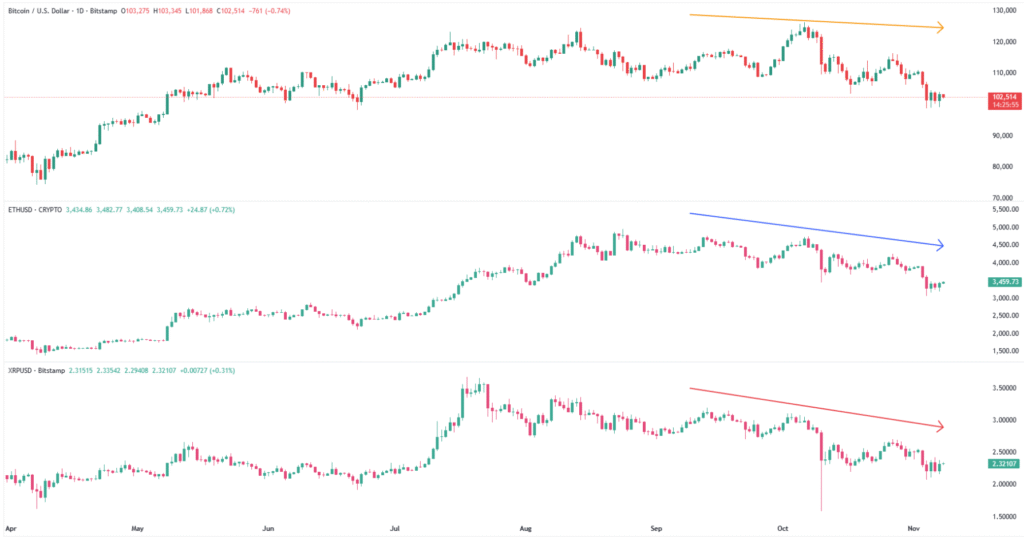
Against this backdrop, Bitcoin (BTC), Ethereum (ETH), and Ripple (XRP) all posted their second straight weekly loss, while Solana led the losers amid the major coins, but Zcash bucked the trend with over 30% rally.
Bitcoin Drops: Bitcoin (BTC) extends the previous weekly loss, despite Friday’s corrective bounce, down over 7.0% weekly to $102,500 by press time. Notably, Bitcoin cracked the $100K threshold for a bit before ending Friday’s trading on a positive note.
Ethereum Looks Weaker: Ethereum (ETH) supersedes BTC while posting close to 11.0% weekly loss, to $3,450 at the latest. The ETH’s latest slump adds to the second weekly negative for the altcoin.
Ripple Slides: Ripple (XRP) traces other major cryptos, extending last week’s losses with an 8.1% weekly loss to $2.32 by press time.
The Weekly Moves
Key Macro Catalysts
Among the key catalysts, buzz around the Fed’s status quo in December and growing discomfort from the historical shutdown gained major attention and fueled the Treasury bond yields, as well as the Dollar, which in turn weighed on the risk assets like the cryptocurrencies.
Various officials crossed wires last week, and most of them sounded cautious about further rate cuts, underpinning the market’s anxiety over the U.S. central bank’s next move and weighing on the risk assets, but favoring Gold.
Fed Vice Chairman Philip Jefferson said, “Given the point in the economic cycle we’re at, it is appropriate that there is a diversity of views”.
Another Fed Vice Chair, Michael Barr, said inflation progress continues but remains incomplete.
New York Fed President John Williams noted the natural rate of interest is difficult to define, estimating it near 1%, and highlighted the importance of considering the effective lower bound in policy setting.
Chicago Fed President Austan Goolsbee expressed reluctance to extend the rate-cutting cycle, citing uncertainty in inflation data and a still-resilient labor market.
Cleveland Fed President Beth Hammack reiterated that inflation is still the top concern, saying policy remains only “barely restrictive.”
St. Louis Fed President Alberto Musalem said tariffs and fiscal deficits continue to fuel inflation, but predicted growth will rebound in 2026 after a soft fourth quarter.
Fed Governor Lisa Cook described the December meeting as “live” for a possible rate cut but not guaranteed.
San Francisco Fed President Mary Daly was also open to further cuts, but warned that reaching 2% inflation at the cost of millions of jobs would be a negative outcome.
Fed Governor Stephen Miran, appointed by U.S. President Donald Trump, pushed for deeper cuts and highlighted the risk of overly restrictive policies.
Apart from the mixed Fed talks, the U.S. data was also mixed, as the U.S. ADP Employment Change for October rose to 42K, versus 32K market forecasts and -39K previous readings, pushing back the previous fears about the job conditions. Following that, the ISM Services PMI for October also rose past 50.8, expected and 50.0 prior figures, to 52.4, hitting an eight-month high.
On Thursday, the U.S. Challenger Job Cuts for October rallied, reversing the employment market optimism following Wednesday’s ADP data.
Meanwhile, the preliminary readings of the University of Michigan’s (UoM) Consumer Sentiment Index (CSI) and the Consumer Inflation Expectations (CIE) for November came in weaker-than-expected. That said, the CSI marked a 50.3 figure, versus 53.2 expected and 53.6 prior, marking the lowest level since June 2022, while the CIE for one year rose to 4.7% from 4.6%. However, the CIE for five years eased to 3.6% from 3.9%.
That said, the implied odds of a December Fed cut fell to 60% from over 70% in late October.
Apart from the Fed concerns, mounting pressure about the U.S. government shutdown also weighs on the sentiment as Transportation Secretary Sean Duffy said operations at 40 major airports would be reduced by up to 10% due to unpaid air-traffic controllers and security agents. A court ordered President Donald Trump to resume food-aid payments, though he is appealing the decision.
Meanwhile, Vice President JD Vance warned Americans would soon face “very real consequences” from the ongoing shutdown. Notably, U.S. President Donald Trump recently seemed inclined to reopen the government, but is likely having reservations.
On Friday, Senate Republican leader John Thune mentioned, per Reuters, that he is willing to give Democrats everything they’re asking for in order to pass the government reopening bill. The offer comes with a caveat, “If they reopen it first.”
On a trade front, discrepancies have emerged in the recent U.S.-China understanding over rare earth exports, challenging the trade deal ‘framework’ announced last week. Also, reports confirmed the White House will block Nvidia’s sale of scaled-down artificial intelligence chips to China. That said, Washington claimed progress on easing restrictions, but Beijing has not confirmed participation despite showing an easy rare earth export policy.
Talking about geopolitics, the New York Times reported that the Trump administration is considering military action against Venezuela and potential seizures of its oil fields. However, Trump’s following comments seemed too modest. Further, Trump recently said that he is in talks with Hungary and they’re talking about a potential meeting with Russian President Vladimir Putin, mostly about ending the war in Ukraine.
Elsewhere, the U.S. Supreme Court heard arguments on presidential tariff powers, where several Republican-appointed justices expressed skepticism about the legality of President Donald Trump’s tariffs.
For more macro updates like this, please check our news section here!
Crypto Market News
In the crypto universe, Bitcoin (BTC), Ethereum (ETH), and Ripple (XRP) all stretched the previous weekly loss.
Notably, Zcash (ZEC) was a top performer with over 30% weekly jump, despite negative social sentiment, while Solana (SOL) slumped the most among major altcoins, down over 14% week-over-week.
Meanwhile, the crypto market capitalization (market cap) dropped 7.25% to $3.45 trillion, whereas the Bitcoin Dominance remained mostly unchanged near 59.1%, versus 59.2%, during the last week.
That said, some of the top crypto news are as follows, while more updates like this could be traced to our Coin Bytes.
The Bank of England (BOE) will unveil the UK’s stablecoin regulatory framework on November 10, eyeing to follow the U.S. footsteps. According to Bloomberg, the UK’s crypto framework will focus on “systemic” stablecoins while smaller issuers will come under lighter oversight from the Financial Conduct Authority.
Also Read: UK to Unveil Stablecoin Framework on November 10, Keeping Step with U.S.
Tether, issuer of the world’s largest stablecoin USDT, has signed a Memorandum of Understanding (MoU) with the People’s Committee of Da Nang City to promote blockchain-based digital infrastructure and modern governance models in one of Vietnam’s fastest-growing technology hubs.
Also read: Vietnam Goes Web3: Tether Partners with Da Nang to Drive Digital Governance and Innovation
Tron (TRX) founder Justin Sun executes $154.5 million Ethereum (ETH) staking move to take a contrarian stand amid the market’s latest retreat. With this, the crypto czar’s total ETH holdings to $534 million, surpassing his $519 million TRX position.
Also Read: Justin Sun Bets Big: Stakes $154M in Ethereum, Now Holds More ETH Than TRX
Japan’s Metaplanet Co. Ltd. drew a $100 million loan, backed by part of its 30,823 Bitcoin reserve, to strengthen liquidity and expand its crypto-related operations.
Read Details: Metaplanet Draws $100 Million Bitcoin-Backed Loan to Expand Crypto Operations
Canada’s 2025 Federal Budget unveils fresh regulations for fiat-backed stablecoins, requiring reserves, redemption rights, and data safeguards. The Western nation also allocates C$1.3 billion for AI and quantum investments to modernize government infrastructure and strengthen technological competitiveness.
For More: Canada Targets Emerging Tech in 2025 Budget, Regulates Stablecoins & Invests Nearly C$1 Bn in AI
Global crypto leader nation El Salvador begins securing official records on the Bitcoin Blockchain, starting with CUBO+ graduation certificates. The tech-savvy nation highlights a sharp reduction in data use while eyeing blockchain use for all government records and deepening its crypto strategy.
Read Details: El Salvador Expands Bitcoin Use, Begins Securing Public Records on Bitcoin Blockchain
The U.S. Treasury Department imposed sanctions on eight individuals and two associated firms from North Korea for their central role in a worldwide crypto laundering scheme. The news also quotes Under Secretary John K. Hurley saying, “(These actors) directly threaten U.S. and global security” by generating revenue for Pyongyang’s nuclear weapons program through stolen digital assets.
More Here: U.S. Treasury Sanctions North Korean Bankers in Global Crypto Laundering Crackdown
A decentralized finance platform, Stream Finance, announced the suspension of all deposits and withdrawals on the X, after bearing a $93 million loss in its assets by an external fund manager.
A decentralized exchange, Balancer suffered one of 2025’s largest hacks, amounting to over $120 million, as an attacker targeted the V2 Composable Stable Pools despite multiple security audits. Blockchain analytics company, Lookonchain, reported the theft was 7,838 WETH ($29 million), 6,341 osETH ($24.8 million), and 4,260 uniETH ($67.8 million).
Also Read: Balancer Exploit Drains $120M in Major DeFi Security Breach
Elsewhere, MicroStrategy (STRE) doubles down on its Bitcoin acquisition strategy in Europe by offering €350 million worth of perpetual preferred shares.
For More Details: STRE Stock: MicroStrategy’s €350M Gambit to Double Down on Bitcoin
A stablecoin startup Zerohash gained approval from the European Union’s (EU) Markets in Crypto-Assets Regulation (MiCA) to offer stablecoin and cryptocurrency solutions to financial technology firms, payment platforms, and banking institutions within the 30 nations.
The United Arab Emirates’ (UAE) second biggest telecom provider du launches a Bitcoin cloud mining service for local residents.
Meanwhile, Telegram CEO Pavel Durov unveiled a decentralized AI network, Cocoon, built on the TON blockchain. Details suggest that the Graphics processing unit (GPU) owners can earn TON tokens by contributing computational power to the network.
Read More: Telegram Launches Decentralized AI Network Cocoon on TON Blockchain
Position Liquidations
Crypto market position liquidation flashed bearish signals, with long liquidations justifying the weakness in the major coins. That said, position liquidation is the forced closing of a trader’s positions by a broker due to insufficient margin. This data reveals whether long (buy) or short (sell) positions were closed, helping explain recent price movements. Typically, heavy long liquidations happen during a downtrend and suggest short-term bearish sentiment, and vice versa.
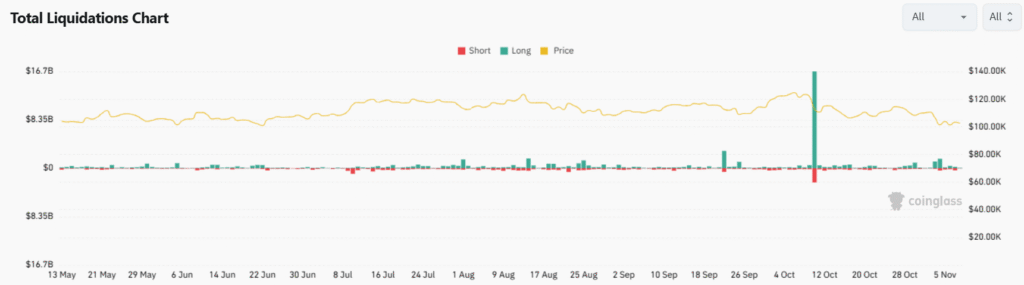
During the November 02 to 08 period, a total of $5.130 billion of positions were liquidated, per the CoinGlass data. Out of which, “Long Positions” contributed $3.78 billion, whereas “Short Positions” accounted for $1.35 billion, suggesting a bigger flow of long liquidations.
Bitcoin, Equities Slide, Gold Drifts Lower
Bitcoin (BTC) posted the fifth weekly loss in six, barring the late October rebound, as risk aversion fueled the U.S. Treasury bond yields and the Dollar, down nearly 7.0% near $102,500 as we write.
The sour sentiment also weighed on the S&P 500 (SPX) to snap a three-week uptrend, down 1.63% on a week to 6,728 by the end of Friday.
Meanwhile, the spot Gold (XAU) dropped for the third consecutive week, but lacks downside momentum as it posted a meagre 0.04% weekly loss to $4,001 by press time.
This highlights Bitcoin’s historical linear relationship with equities and Gold. Santiment cites this as an early bullish sign, as Bitcoin buyers could portray the Fear of Missing Out (FOMO) once the market’s risk profile improves.
To clearly visualize links among these key risk assets, let’s see the correlation chart from TradingView.
BTC, S&P 500, and Gold
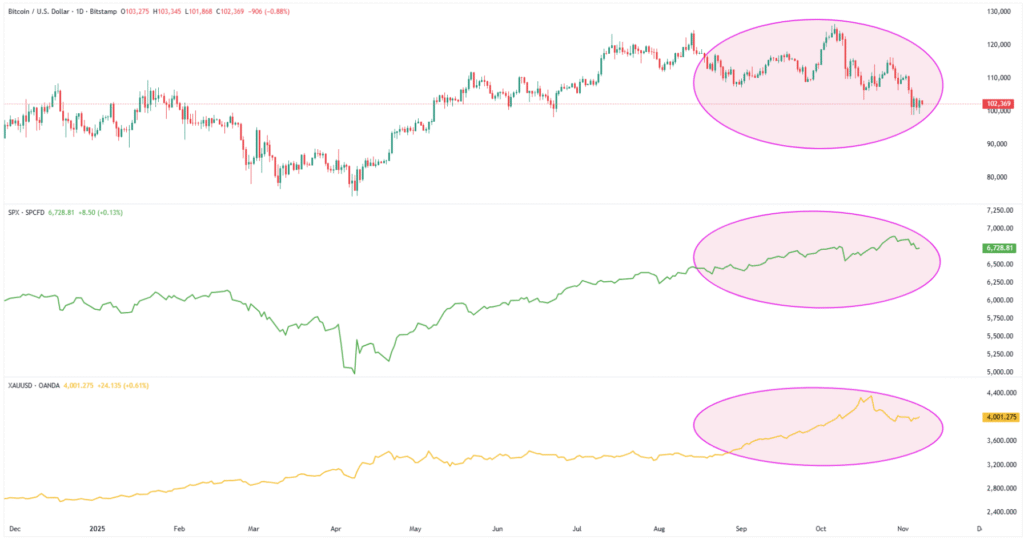
With the clearly linear relations between Bitcoin, Gold, and the U.S. equities on a broader timeframe, the BTC traders should be optimistic if the market remains positive, which is likely during the next week, with the potential U.S. government reopening.
BTC ETF, Whale Moves, and Options Market Flash Mixed Signals
Bitcoin’s (BTC) latest weakness justifies the ETF outflows and selling from whale wallets, addresses holding between 10 and 10,000 BTC, apart from the broadly firmer U.S. Treasury bond yields and the Dollar. However, the options market suggests a slight recovery in prices, which could be justified late Friday as the BTC bounced off $99,190 to $103,275.
Starting with the latest U.S. spot Exchange Traded Fund (ETF) data from the SoSoValue, the Bitcoin (BTC) spot ETFs reported the biggest daily slump since August 01 on Tuesday, as well as reported a four-day outflow pattern over the last week, with Friday’s daily outflow of $558.44 million.
With this, the spot BTC ETFs marked the second consecutive weekly outflow, worth $1.22 billion by the end of Friday.
It’s worth observing that August reported the first monthly outflow in five months, the biggest since March, but there were inflows in September and October, whereas the November Outflows have been $1.22 billion by press time, the biggest since February.
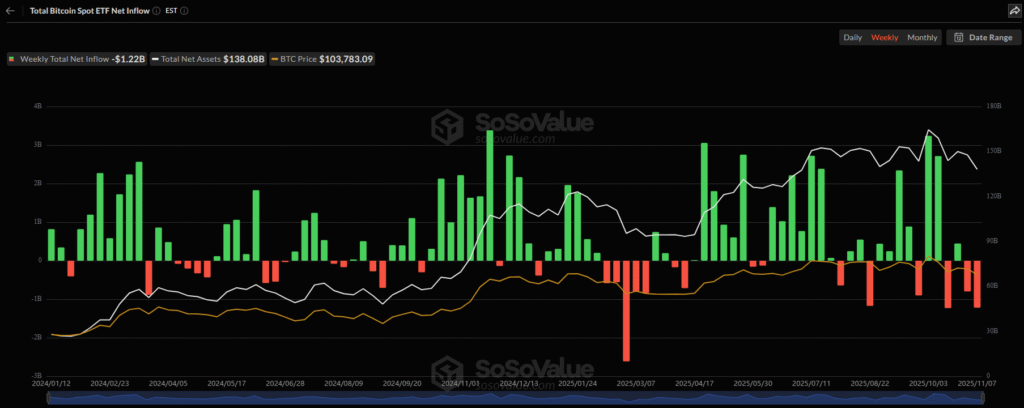
With this magnitude of surprise from the ETF flows every week, the BTC bulls should remain cautious going forward.
Alternatively, Whale Wallets, addresses holding between 10 and 10,000 BTC, also flashed a negative signal, according to Santiment. “Bitcoin whales have sold approximately 32,500 BTC since October 12,” per the crypto data platform. Santiment also mentioned that retail traders, wallets holding between 0 to 0.01 BTC, have been actively buying, which is historically considered a bearish sign.
On the flip side, a $4.5 billion options expiry challenged the Bitcoin bears, despite the downbeat sentiment and the firmer USD. That said, the total number of weekly options expiring was $4.5 billion on Friday, the day of expiry. Notably, the maximum pain price, the strike price at which option holders (buyers) lose the most money and options writers (sellers) profit the most, was at $108,000, up from Friday’s slump to $100K. This could be considered a pullback sign for the BTC.
Also read: Crypto Options: Bitcoin Options Prepares For $4.5B Weekly Expiry
Technical Analysis Suggests BTC Consolidation
Bitcoin price remains under pressure after breaking the 200-day Exponential Moving Average (EMA) earlier in the week. Adding to the downside bias were bearish signals from the Moving Average Convergence Divergence (MACD) and the Directional Movement Index (DMI) momentum indicators.
With this, the BTC is likely to extend the latest weakness towards the six-month horizontal support, a break of which can challenge the broad bullish trend. However, the 14-day Relative Strength Index (RSI) conditions are the most oversold in a year, suggesting a consolidation in the prices before the next south-run.
Bitcoin Price: Daily Chart Signals Consolidation
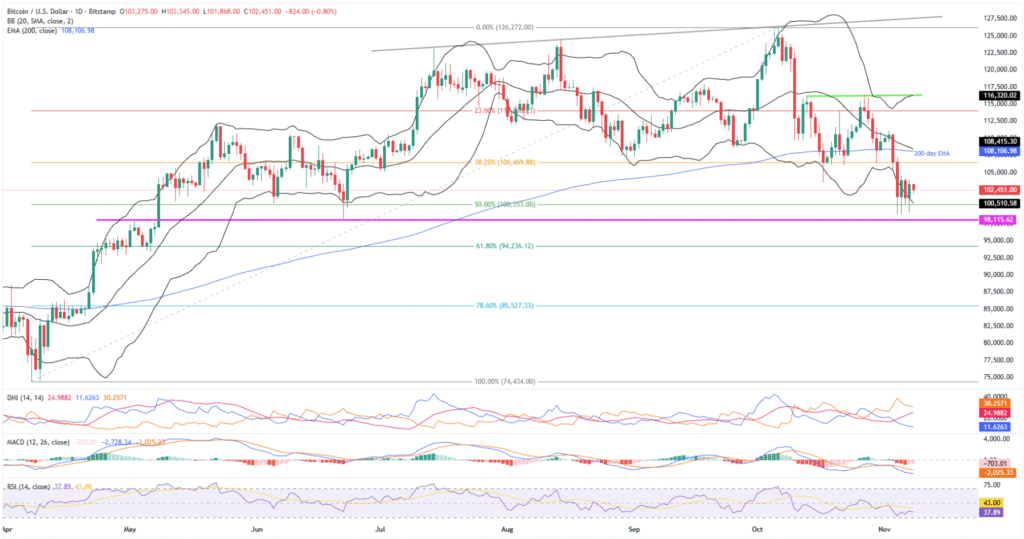
Bitcoin’s sustained trading beneath the 200-day EMA gains support from the bearish MACD signals (red histograms) as it pokes the lower Bollinger Band (BB) of $100,520. Further, the DMI indicator cites the presence of a bearish momentum and offers extra strength to the south-run. However, the overheated RSI signals suggest a potential consolidation in prices.
That said, the DMI’s Downmove (D-, Orange) line is near 31.00, way beyond the 25.00 neutral level, suggesting strong downside momentum. Further, the Average Directional Index (ADX, red) line is just beneath the orange line, and the Upmove (D+, Blue) line is at the bottom, citing very weak upside bias.
Hence, the BTC bears look set to smash the immediate support of $100,520 and poke the $100K threshold.
However, a horizontal support from early May, close to $98,000, will be a tough nut to crack for the Bitcoin sellers.
It’s worth noting that Bitcoin’s clear downside break of $98K could challenge the broad bullish trend by highlighting $91,000, $88,000, and April’s low near $74,400 support levels.
Alternatively, BTC rebound can aim for 38.2% Fibonacci retracement of April-October upside, at $106,470, but the 200-day EMA of $108,110, and the middle BB of $108,420, can challenge the buyers afterward.
Beyond that, a convergence of the upper BB and a three-week resistance line surrounding $116,320, followed by the $120K threshold, will act as the final defense of the bears, a break of which will highlight a rising resistance line from mid-July, close to $127,600 as we write.
Ethereum Slumps!
Ethereum (ETH) nosedived 11.0% on the week, currently around $3,450, while being the biggest loser among the top-five cryptocurrency coins. With this, the altcoin posted its second consecutive weekly gain after turning down the ‘Uptober’ hopes.
Notably, the ETH’s latest fall justifies the strong weekly outflow of the U.S. spot ETH ETFs.
ETH ETFs Report Biggest Weekly Outflow in Six
As per the latest SoSoValue data, the U.S. Ethereum (ETH) spot ETFs reported their biggest weekly outflow since late September, reversing the previous week’s inflow and adding more.
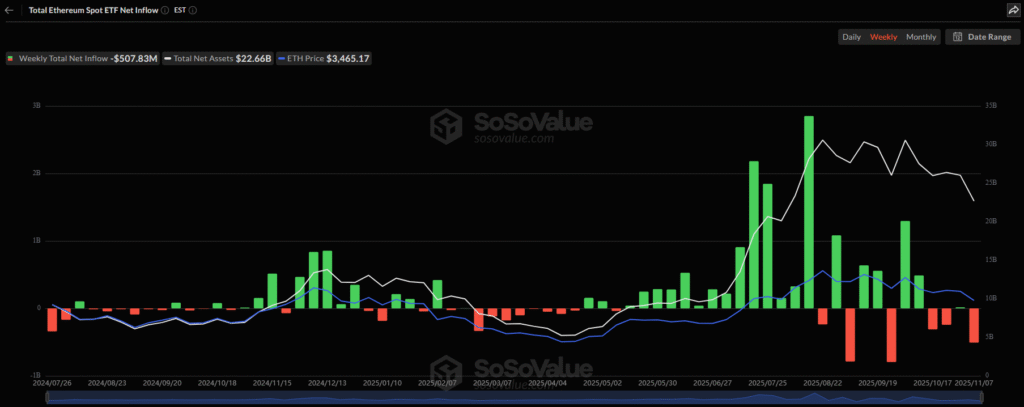
On November 07, the U.S. Spot ETH ETFs reversed the previous daily inflow, with the fourth daily outflow of the week, comprising a $46.62 million figure.
With this, the second-largest coin reversed the previous weekly ETH ETF inflows, with a total of $507.83 million.
Notably, the daily and weekly outflows currently push the ETH ETF Outflows toward the first monthly outflow since March, with the latest figures for November being $507.83 million.
Ethereum Technical Analysis Teases Sellers
Ethereum’s clear downside break of a seven-month support, an ascending trendline from mid-July, and the 200-day Simple Moving Average (SMA) triggered the early-week slump in price to the lowest in four months.
However, the 14-day Relative Strength Index (RSI) flashed oversold signals and triggered the ETH’s following rebound from the 50% Fibonacci retracement of its April-August rise, recently allowing buyers to edge higher past the 200-day SMA.
Still, bearish MACD signals and the early-week breakdown of multi-month supports, now resistances, keep ETH sellers hopeful.
Ethereum Price: Daily Chart Keeps Sellers Hopeful
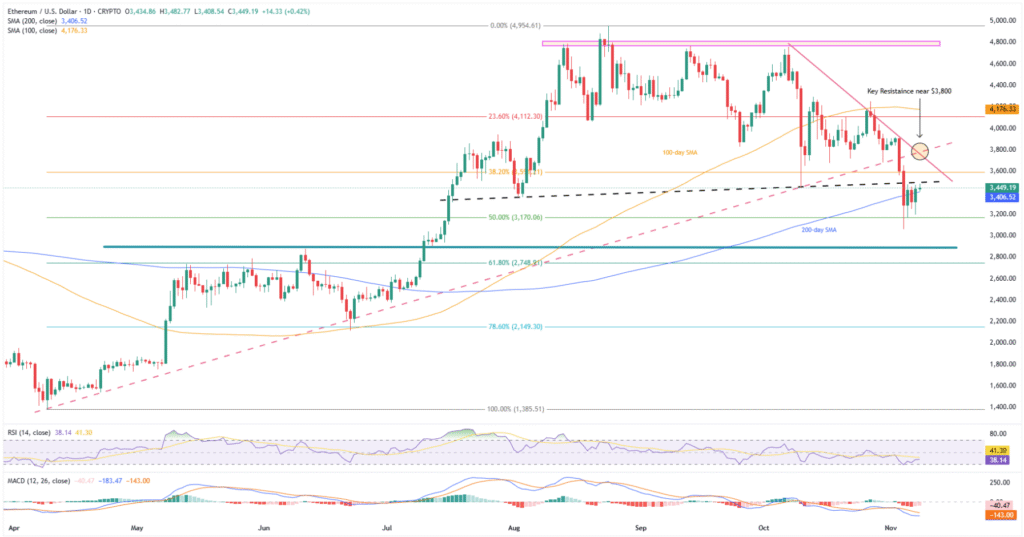
Despite the latest rebound, Ethereum price remains sidelined within a four-day trading range, struggling to extend a corrective bounce from the 50% Fibonacci retracement level near the 200-day SMA, especially when the RSI nears the 30.00 oversold limit.
That said, a daily close beneath the 50% Fibonacci ratio of $3,170 becomes necessary for witnessing the second-largest cryptocurrency’s further fall toward a horizontal support from mid-July, close to $2,900-$2,880.
Should ETH price break $2,880 support, it could defy the broad bullish trend, making it vulnerable to slump toward the 78.6% Fibonacci retracement of its April-August rise, near $2,150, and then to April’s bottom of $1,385.
During the anticipated fall, the 61.8% Fibonacci ratio surrounding $2,748, also known as the “Golden Fibonacci Ratio”, can test the Ethereum bears.
Alternatively, the previous support line from mid-July near $3,510 restricts short-term Ethereum price recovery.
Though major attention is on the $3,800 mark, comprising a month-old descending trendline and previous support line from April, a break of which could trigger the ETH’s rally targeting the $4,000 round figure and then the 100-day SMA hurdle of $4,178.
Ripple Fails To Justify Network Growth…
Ripple (XRP) traces other major crypto coins while posting its second consecutive weekly loss. In doing so, the altcoin ignores solid network growth. That said, the XRP dropped around 8% over a week to $2.32 by press time.
According to Santiment’s analysis, XRP faced the second-largest spike in the network growth for 2025. The report also cites this as a turnaround signal as the altcoin formed a top the last time creation of new addresses jumped.
Furthermore, Santiment also mentioned a heavy spike in the XRP traders’ fears, per the social media commentary, which is also considered an early clue for the price to form a bottom.
Ripple Technical Analysis Looks Bearish
Ripple price hit a three-week low earlier in the week, but failed to offer a daily close beneath the lower Bollinger Band (BB), close to $2.18 by press time.
The altcoin’s following rebound, however, failed to cross a support-turned-resistance from April and called the XRP sellers back, keeping prices between the lower BB and the previous support line.
Apart from the altcoin’s failure to cross the support-turned-resistance, its sustained trading beneath the 200-day Simple Moving Average (SMA) and a multi-month horizontal resistance also reinforce the downside bias, even as the oversold stochastic line tests its immediate fall.
Ripple Price: Daily Chart Suggests Further Weakness
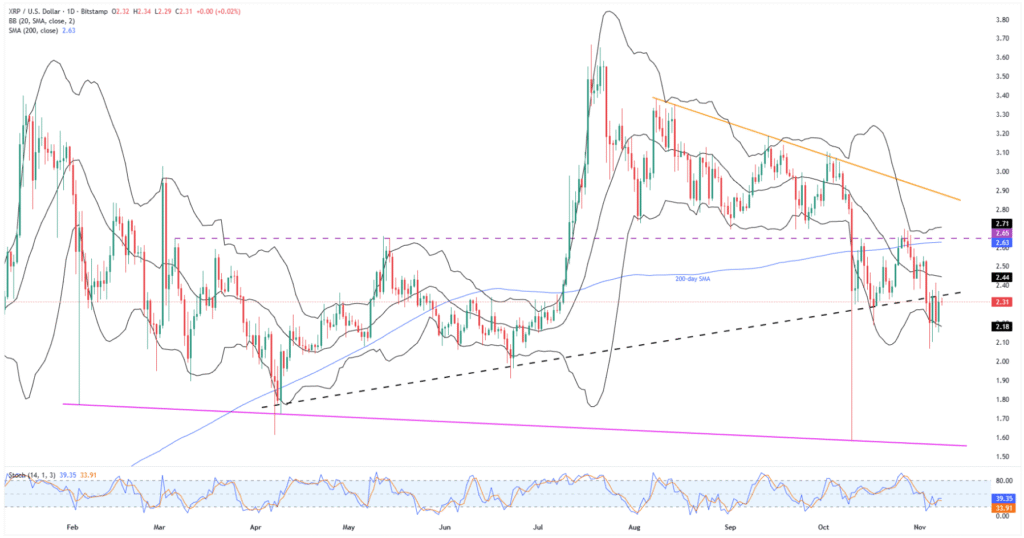
With this, the XRP’s further fall toward the monthly low of $2.07 and then to the $2.00 threshold hinges on a clear downside break of the lower BB support of $2.18.
Additionally, June’s low of $1.91 and a descending support line from early February, close to $1.56, will be tough nuts to crack for the Ripple sellers afterward.
Meanwhile, the seven-month previous support guards the immediate XRP rebound near $2.35 ahead of the middle BB hurdle of $2.44.
Beyond that, the $2.63-$2.65 region comprising the 200-day SMA and a horizontal resistance from early March, followed by the upper BB of $2.71, could challenge the XRP buyers before giving them control.
In that case, a falling trendline from early August, close to $2.90, and the $3.00 threshold, will act as the final line of defense for the Ripple bears.
Conclusion
The latest weakness in the crypto market stems from the fading chances of a December Federal Reserve (Fed) rate cut, mixed trade and geopolitical news, and updates from Exchange-Traded Funds (ETFs). However, growing buzz that the sooner the U.S. government reopens seems to have recently challenged the cryptocurrency bears.
Hence, the odds of witnessing a cryptocurrency weekly recovery, led by Ripple’s XRP due to upbeat on-chain signals, are high if the U.S. shutdown ends.
Still, a slew of key data, including the U.S. Consumer Price Index (CPI) and Retail Sales for October, as well as two sets of the pending U.S. employment monthly report, will amplify the market’s uncertainty about the Fed, challenging the crypto optimists.
Also Read: Top 5 Fastest Growing Blockchains in 2025


