





Cryptocurrency Weekly Summary
- Cryptocurrency weekly showdown attracted bearish bias amid Fed doubts, economic uncertainty after the U.S. reopened, and Michael Saylor buzz.
- Bitcoin, Ethereum, and Ripple post a three-week downtrend, with BTC hitting a six-month low and breaking the $100K mark.
- U.S. policymakers ended the historical shutdown, but the cost and data-linked uncertainty surrounding the same haunts optimists.
- A slew of Fed officials crossed wires, flashing mixed signals and raising the odds of a December rate cut.
- Wall Street closed mixed as Dow Jones and S&P 500 posted modest weekly gains, but Nasdaq dropped for the second consecutive week.
- On-chain metrics, whale performance, and ETF clues flash mixed signals, challenging buzz around the market’s bottom.
- Top-tier U.S. data, global PMIs will occupy the weekly calendar, but risk news is the key to determining the crypto market’s next move.
Cryptocurrency Weekly Snapshot
Cryptocurrency weekly outlook turned red for the third straight time amid concerns over the U.S. shutdown’s cost, uncertainty ahead of upcoming economic data releases, and mixed comments from the Federal Reserve (Fed) officials. Adding to the crypto bear’s strength was the buzz surrounding MicroStrategy’s leader, Michael Saylor’s Bitcoin selling.
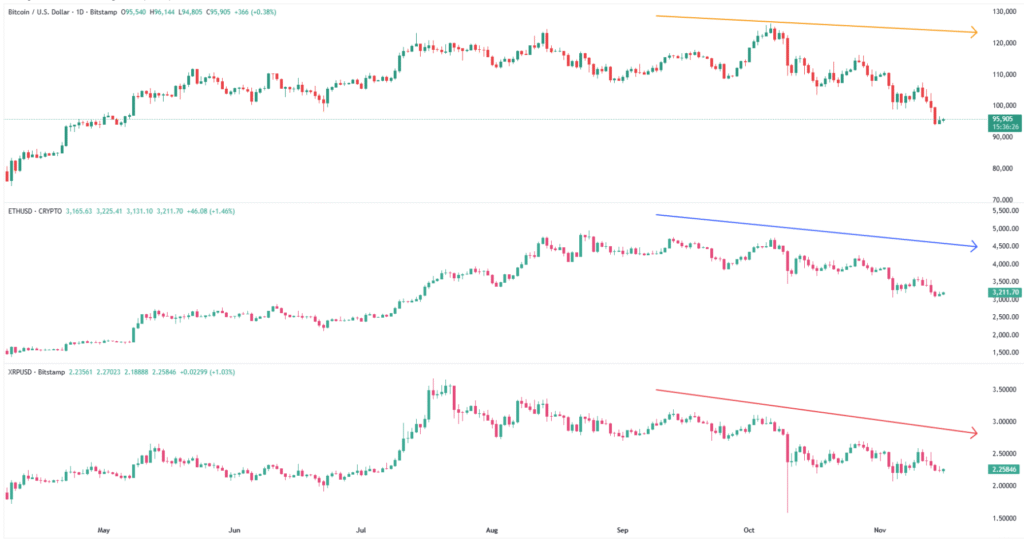
Against this backdrop, Bitcoin (BTC), Ethereum (ETH), and Ripple (XRP) all posted their third weekly loss in a row, even as Wall Street ended the week on a mixed note, and the spot Gold (XAU) price snapped a three-week downtrend.
Bitcoin Shatters: Bitcoin (BTC) hit a six-month low, after falling four consecutive days in the last week, down nearly 8.0% on a week to $96,100 by press time. Notably, Bitcoin cracked the $100K threshold and flagged concerns about heavy selling in the near future, despite mixed on-chain signals.
Ethereum Plummets: Ethereum (ETH) supersedes BTC while posting close to 10.0% weekly loss, to $3,200 at the latest. The ETH’s latest slump adds to the third weekly negative for the altcoin, raising concerns about the sustainability of the altseason talks.
Ripple Slides, But Slowly: Ripple (XRP) traces other major cryptos, posting a third consecutive weekly loss of around 4.5% to $2.25 by press time. The launch of XRP Exchange Traded Funds (ETF), with a symbol XRPC, seemed to have limited the quote’s fall last week.
The Weekly Moves
Key Macro Catalysts
Among the key catalysts, buzz around the economic cost of the U.S. shutdown, as it ended after a historical stretch of 43 days, gained major attention. Also important was a reduction in the market’s expectations of December Fed rate cuts, despite mixed comments from a slew of Fed officials. Furthermore, buzz around controversial wallet activity linked to MicroStrategy’s leader, Michael Saylor, also contributed to the cryptocurrency weekly pessimism.
Notably, the risk aversion weighed on the digital assets and a bit on the technology stocks, but favored Gold in posting the first weekly gain in four.
Although the U.S. policymakers managed to end the historical shutdown, until January 30, 2026, the following actions from decision-makers weren’t optimistic and flagged fears about the economic burden of the government shutdown.
Among them, comments from White House Economic Advisor Kevin Hassett gained major attention as he raised concerns that the shutdown could subtract 1.5% from the fourth quarter (Q4) U.S. Gross Domestic Product (GDP) growth. Also, the Trump administration showed readiness to back down on some tariffs to lower food prices, suggesting more hidden pain from the shutdown than it looks.
Elsewhere, various officials crossed wires last week, and most of them sounded cautious about further rate cuts, underpinning the market’s anxiety over the U.S. central bank’s next move and weighing on the risk assets. It’s worth noting, however, that the probability of a December rate cut by the Fed dropped from 66% during the early week to 40% by the end of Friday. Still, the U.S. Dollar Index (DXY) dropped for the second consecutive week.
- Dallas Fed President Lorie Logan said that she would have preferred to hold rates steady in October.
- Kansas City Fed President Jeff Schmid mentioned that further rate cuts won’t patch job market cracks.
- St. Louis Fed President James Bullard reiterated his support for rate cuts to protect the labor market but noted limited room for easing without becoming overly accommodative.
- Minneapolis Fed President Neel Kashkari also expressed concern about high inflation and signs of labor market pressure.
- San Francisco Fed President Mary Daly said risks were balanced but added that that was too early to decide on a rate cut for December.
- Boston Fed President Susan Collins said that keeping rates on hold for a while is likely appropriate due to inflation concerns.
- Cleveland Fed President Beth Hammack mentioned persistently high inflation and flagged no rate cuts.
- Atlanta Fed President Raphael Bostic also commented that the current policy is too restrictive.
- New York Fed President John Williams suggested it won’t be long before the Fed needs to act again.
Elsewhere, the U.S. Labour Secretary Lori Chavez said that the administration is unsure if the Bureau of Labour Statistics (BLS) will be able to release the October CPI, amplifying uncertainty about the incoming data and weighing on the sentiment.
In the case of the published U.S. data, the U.S. NFIB Small Business Optimism Index for October eased to 98.2 from 98.8, versus 98.3 expected, close to the 52-week average of 98.00. More importantly, the Uncertainty Index hit the lowest reading of 2025 by 12 points from September’s reading to 88.00 for October. Furthermore, the U.S. Automatic Data Processing (ADP’s)latest series of Weekly Employment Change flashed downbeat figures, namely -11,250 a week in the four weeks ending October 25.
On the geopolitical side, Ukraine’s drone attack on Russia and mixed U.S. trade deal updates also kept market volatility high, mostly toward the negative side.
That said, Chinese Vice Premier He Lifeng expressed optimism about U.S.-China trade relations, though uncertainties remain. The policymaker also stated that both countries have significant potential for cooperation. Still, talks are loud reports that China is allegedly a “validated end-user” export system to accelerate rare-earth shipments to civilian buyers while restricting U.S. military access. This could challenge the earlier optimism surrounding the Sino-American trade ties as Trump pushes Beijing for rare earth exports.
In Europe, the Financial Times reported that the EU plans to tighten limits on cheap Chinese parcels, and is working on a draft plan to secure broader tariff relief from the U.S.
Crypto Market News
In the crypto universe, Bitcoin (BTC), Ethereum (ETH), and Ripple (XRP) all stretched the previous weekly loss while posting a three-week downturn.
That said, popular on-chain analysts from Santiment cited social media chatter to highlight an emerging narrative about the “95k market bottom” for BTC, especially after Bitcoin faced the biggest network realized loss day in at least six months. However, the on-chain details are mixed, and hence traders need to remain cautious while eyeing the bottom-picking.
Meanwhile, the crypto market capitalization (market cap) dropped 4.95% to $3.26 trillion, whereas the Bitcoin Dominance slid to 58.7% from 59.3% during the last week.
That said, some of the top crypto news are as follows, while more updates like this could be traced to our Coin Bytes.
The chatter about a major 47,000 Bitcoin wallet transaction connected to Michael Saylor, Chairman of the strong institutional BTC buyer Strategy (previously ‘MicroStrategy’), fueled cryptocurrency market fears. Saylor, however, defied the rumors publicly, but his response gained mixed reactions and less credibility. “We are buying. We’re buying quite a lot, actually, and we’ll report our next buys on Monday morning. I think people will be pleasantly surprised,” Saylor told CNBC, according to The Block.
Canary Capital’s fund becomes the first U.S. spot XRP Exchange-Traded Fund (ETF) with a 0.50% management fee to get the US SEC approval. That said, the approval follows an auto-effective Securities and Exchange Commission (SEC) process, with trading starting November 13 under ticker XRPC.
Read Details: Spot XRP ETF Listing Approved: First U.S. Fund Begins Trading on Nasdaq Nov 13
U.S. Attorney Jeanine Pirro announced a New Scam Center Strike Force that will unite the Department of Justice (DOJ), Federal Bureau of Investigation (FBI), and Secret Service against crypto fraud. Notably, Southeast Asian scam compounds have stolen nearly $10 billion from Americans in 2024. That said, the task force has already seized $401 million in crypto, targeting $80 million more.
Read More: U.S. Launches Scam Center Strike Force to Combat $10B Crypto Fraud Epidemic
China alleges the U.S. involvement in the 2020 LuBian mining pool hack of 127,000 BTC worth $13 billion. The funds remained dormant until the 2024 transfers, while Washington seized the BTC in October 2025, claiming legitimate asset forfeiture.
Also Read: China Accuses U.S. of Orchestrating LuBian Mining Pool Hack Worth $13B
Two U.S. Senators put forward a bill proposing to shift cryptocurrency oversight from the U.S. Securities and Exchange Commission (SEC) to the Commodity Futures Trading Commission (CFTC). The move gained industry accolades and may become the law, considering U.S. President Donald Trump’s favor for the same.
Elsewhere, the U.S. Department of the Treasury and the Internal Revenue Service (IRS) introduced a tax safe harbor to allow the crypto Exchange-Traded Products (ETPs) to stake assets without triggering corporate tax treatment, flashing positives for the crypto market.
Prediction market platform Polymarket and UFC announced the industry’s first sports-tech partnership. Polymarkets and UFC announce a multi-year, exclusive partnership for the integration of prediction markets. That said, a Real-time Fan Prediction Scoreboard will debut on UFC broadcasts, showing evolving fight probabilities.
Also Read: Polymarkets and UFC Forge Historic Partnership to Fuel Fan Engagement
JPMorgan Chase has begun deploying its JPM Coin to institutional clients, allowing dollar-denominated transfers on Coinbase’s Base blockchain within seconds. Unlike stablecoins, deposit tokens sit on a bank’s balance sheet and can pass deposit interest directly to holders, preserving both liquidity and yield within the banking system.
More Details: JPMorgan Launches Deposit Token JPM Coin on Base Network: Here’s 5 Things to Know
On a developmental side, Oman’s National Digital Economy Program, aligned with Oman Vision 2040, eyes to increase the digital economy’s share of GDP from around 3% this year to 10% by 2040.
Also Read: Oman Steps Up Efforts To Grow Digital Economy, Targets 10% Of GDP Under Vision 2040
The UK’s National Crime Agency (NCA) undertook a unique initiative called the Crypto Investment Fraud Protection to protect investors from scams. Under the program, the NCA will educate potential investors on how to spot warning signs.
Read Details: UK Launches First-Ever Crypto Investment Fraud Protection Campaign Targeting Men Under 45
Elsewhere, Japan’s Financial Services Agency (FSA) has approved the first pilot under its Payment Innovation Project, a national blockchain initiative, taking the first step toward testing a blockchain-based payment system involving the country’s largest banks.
Read More: Japan FSA Approves First Megabank-Led Stablecoin Under National Blockchain Initiative
That said, Italian banks have expressed support for the European Central Bank’s (ECB) plan to introduce a digital euro but are urging that implementation costs be spread over time to avoid pressure on their balance sheets.
Also Read: Italian Banks Back Digital Euro But Warn of Trouble Ahead; What’s Going On?
Position Liquidations
Crypto market position liquidation flashed bearish signals, with long liquidations justifying the sustained weakness in the major coins. That said, position liquidation is the forced closing of a trader’s positions by a broker due to insufficient margin. This data reveals whether long (buy) or short (sell) positions were closed, helping explain recent price movements. Typically, heavy long liquidations happen during a downtrend and suggest short-term bearish sentiment, and vice versa.
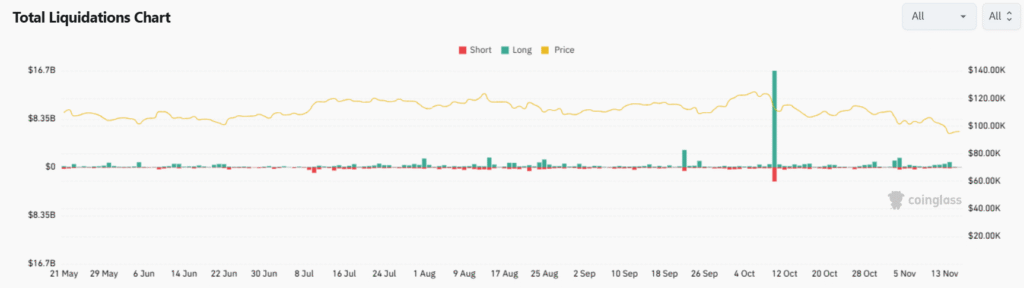
During the November 09 to 15 period, a total of $3.661 billion of positions were liquidated, per the CoinGlass data. Out of which, “Long Positions” contributed $2.68 billion, whereas “Short Positions” accounted for $980.53 million, suggesting a bigger flow of long liquidations.
Bitcoin Slumps, Equities Dribble, But Gold Recovers
With the latest slump in prices to a six-month low, Bitcoin (BTC) posted the sixth weekly loss in seven, barring the late October rebound, as risk aversion amplified, causing the BTC to slump nearly 8.0% on a week to $96,100 by press time.
The sour sentiment also weighed on equities, but the reaction was mixed as the Dow Jones Industrial Average (DJI) and the S&P 500 (SPX) both posted mild losses by the week’s end, but the tech-heavy Nasdaq Composite (NQ100) bucked the trend with a second weekly loss. That said, the U.S. market’s risk barometer SPX gained 0.08% on a week to 6,734 by the end of Friday.
Meanwhile, the spot Gold (XAU) posted the first weekly gain in four, with 2.11% week-over-week gains to $4,085, amid a rush to risk-safety.
This challenges Bitcoin’s historical linear relationship with equities and Gold. Santiment said that this decoupling is significant because Bitcoin’s most powerful bull runs in history occurred when it was moving independently of the stock market.
To clearly visualize links among these key risk assets, let’s see the correlation chart from TradingView.
BTC, S&P 500, and Gold
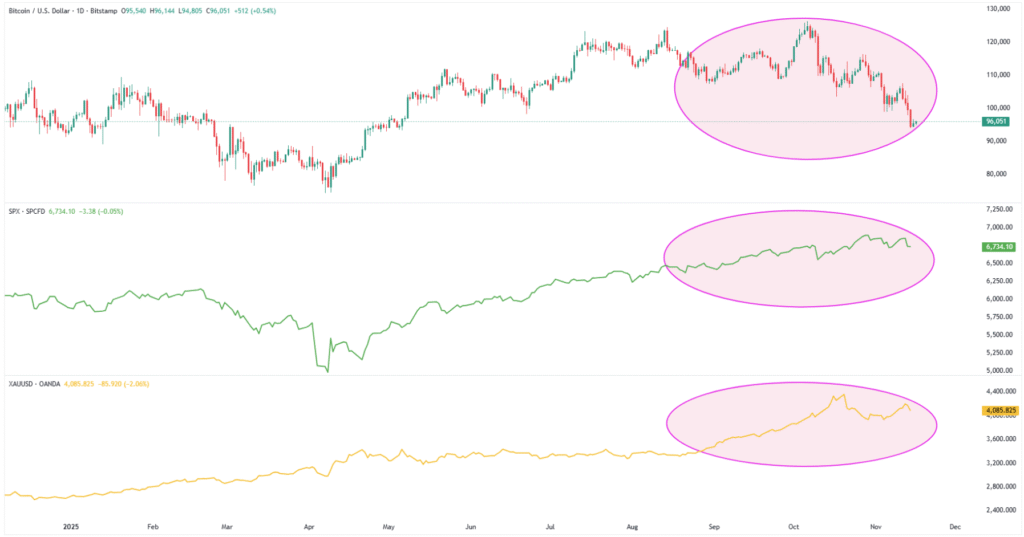
With the clear challenge to previously linear relations between Bitcoin, Gold, and the U.S. equities, the BTC traders should remain cautious while finding the recently lower prices attractive for bottom-picking.
BTC ETF, On-Chain, and Options Market Flash Mixed Signals
Bitcoin’s (BTC) latest weakness justifies the ETF outflows and selling from whale wallets, addresses holding between 10 and 10,000 BTC, apart from the broadly downbeat. However, a few on-chain catalysts and the options market data suggested a slight recovery in prices, which could be justified late Friday and on Saturday, as BTC bounced off $93,961 to end the week near $95,500.
Starting with the latest U.S. spot Exchange Traded Fund (ETF) data from the SoSoValue, the Bitcoin (BTC) spot ETFs reported the biggest daily slump since February 25 on Thursday, as well as reported a three-day outflow pattern over the last week, with Friday’s daily outflow of $492.11 million.
With this, the spot BTC ETFs marked the third consecutive weekly outflow, worth $1.11 billion by the end of Friday, posting the second straight weekly outflow of over $1.0 billion.
It’s worth observing that August reported the first monthly outflow in five months, the biggest since March, but there were inflows in September and October, whereas the November Outflows have been $2.33 billion by press time, the biggest since February.
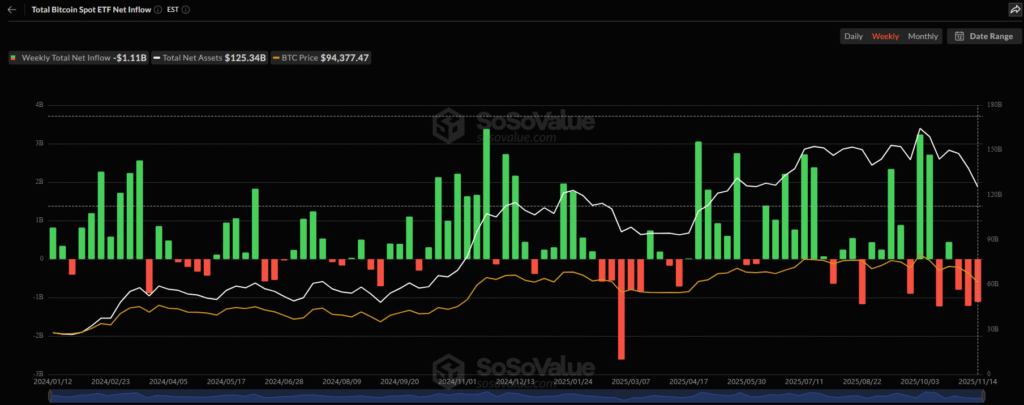
With this magnitude of outflow from the ETF every week, the BTC optimists should remain cautious going forward.
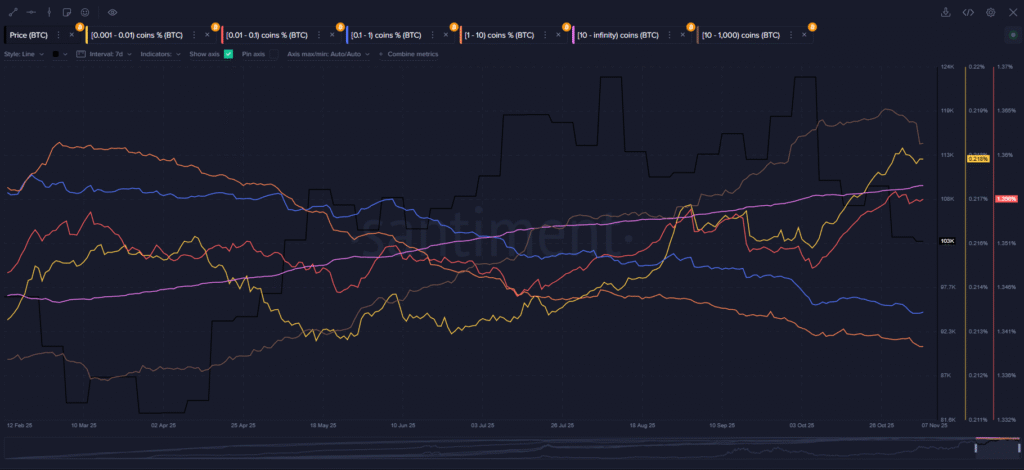
Alternatively, Whale Wallets, addresses holding between 10 and 10,000 BTC, continue to flash negative signals, according to Santiment. “Wallets holding 10 to 10,000 BTC have offloaded over 0.4% of the total Bitcoin supply since the all-time high in October,” per the crypto data platform.
Notably, the following chart from Santiment also signalled that retail traders, wallets holding between 0 to 0.01 BTC, have been actively buying, which is historically considered a bearish sign.
On the flip side, a $4.03 billion options expiry challenged the Bitcoin bears, despite the downbeat sentiment. That said, the total number of weekly options expiring was $4.03 billion on Friday, the day of expiry. Notably, the maximum pain price, the strike price at which option holders (buyers) lose the most money and options writers (sellers) profit the most, was at $106,000, up from Friday’s slump to around $93K. This could be considered a pullback sign for the BTC.
Also read: Crypto Options: Bitcoin below $98K ahead of $4 Billion Weekly Expiry
Meanwhile, data from Santiment suggests that the MVRV (Market Value to Realized Value) ratio, which compares the current price to the average cost basis of holders, also known as the holder profitability, flashes mixed signals. That said, the 30-day MVRV for Bitcoin hit an eight-month low of -10%, which historically corresponded with lower-risk buying zones.
Santiment also highlighted an important characteristic surrounding a popular emerging narrative of the “95k market bottom” for (BTC). This suggests many traders believe the worst is over, which their analyst Brian viewed as a “caution flag”.
Technical Analysis Suggests BTC Consolidation
Bitcoin price remains under pressure after breaking the 200-day Exponential Moving Average (EMA) and a horizontal support from early May.
However, the quote’s rebound from the 61.8% Fibonacci retracement of its April-October upside, also known as the “Golden Fibonacci Ratio”, near $94,230, joined oversold conditions of the 14-day Relative Strength Index (RSI) to back a corrective bounce.
Meanwhile, bearish signals from the Moving Average Convergence Divergence (MACD) momentum indicator and the quote’s sustained trading beneath the 200-day EMA keep the BTC sellers hopeful, barring some consolidation, as long as the price stays below $107,500.
Bitcoin Price: Daily Chart Highlights Seller’s Exhaustion
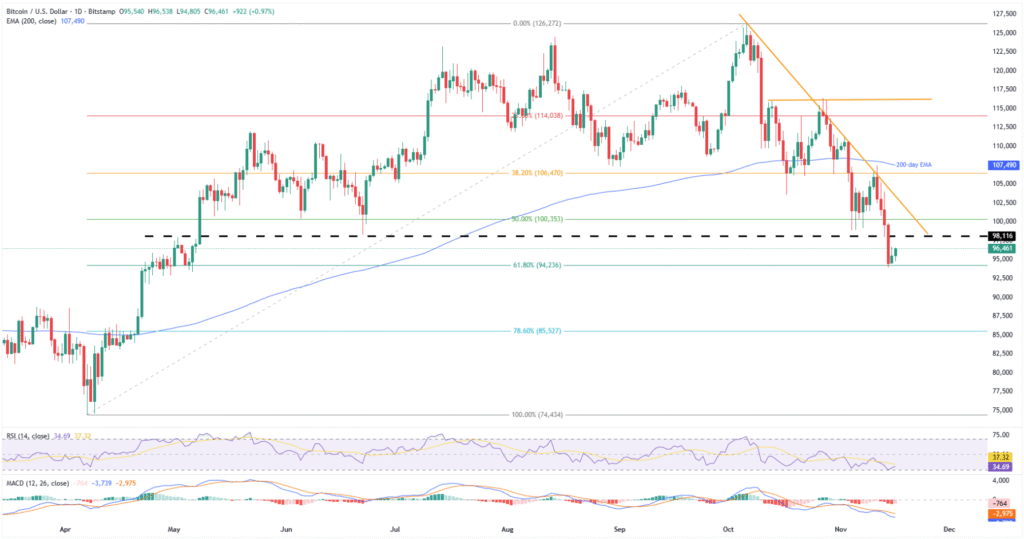
Bitcoin’s sustained trading below the 200-day EMA, a five-week resistance line, and downside break of a six-month horizontal support, now resistance, join bearish MACD signals (red histograms), to attract sellers.
However, the oversold RSI defends the quote’s recent bounce off the 61.8% Fibonacci ratio to suggest a short-term consolidation in the Bitcoin price.
Even if the quote breaks 61.8% Fibonacci retracement near $94,230, the late March swing high near $88,800 and the 78.6% Fibonacci ratio of $85,527 can test the bears before directing them to April’s yearly low near $74,430.
Alternatively, Bitcoin’s corrective bounce needs a daily closing beyond the previous horizontal support from May, now resistance near $98K.
Also acting as short-term key resistance for the BTC buyers is the seven-week descending trendline and the 200-day EMA, close to $103,500 and $107,500.
In a case where the Bitcoin price remains firmer past $107,500, the bullish trend gets restored, directing buyers toward a month-old horizontal resistance area near $116,300.
Above all, the $120K psychological magnet, multiple tops near $123,500-$123,600, and October’s all-time high of $126,270, as well as the $130K round figure, could flash on the bull’s radar past $116,300.
Ethereum Bears Keep the Reins!
Ethereum (ETH) nosedived 10.0% on the week, currently around $3,200, while being the biggest loser among the top-five cryptocurrency coins. With this, the altcoin posted its third consecutive weekly gain after turning down the ‘Uptober’ hopes.
Notably, the ETH’s latest fall justifies the strong weekly outflow of the U.S. spot ETH ETFs and the broad risk-off mood.
ETH ETFs Report Biggest Weekly Outflow in Seven
As per the latest SoSoValue data, the U.S. Ethereum (ETH) spot ETFs reported their biggest weekly outflow since late September, adding to the previous week’s outflow.
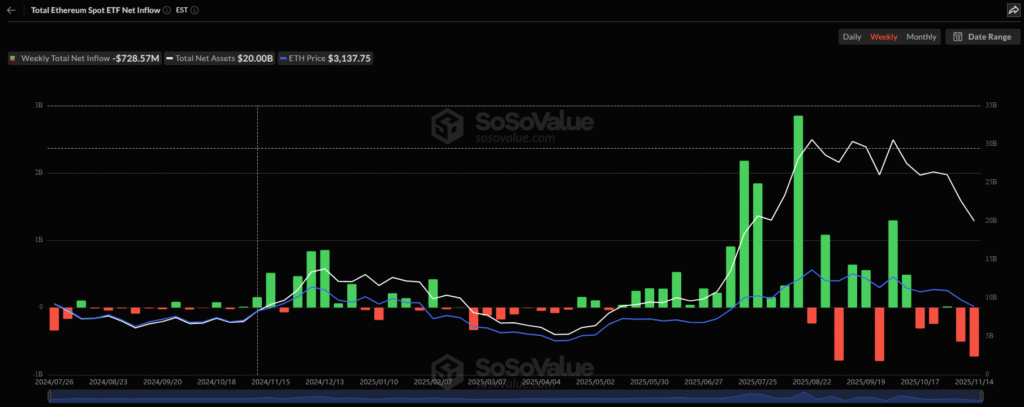
On November 10, the U.S. Spot ETH ETFs reported $0.0 daily net flow, followed by the four consecutive daily outflows in the week. Notably, Thursday marked the biggest daily outflow in a month, comprising a $259.72 million figure, followed by Friday’s daily outflow figures of -$177.90 million.
With this, the second-largest coin added to the previous weekly ETH ETF outflows, with last week’s total of $728.57 million.
Notably, the daily and weekly outflows currently push the ETH ETF Outflows toward the first monthly outflow since March, as well as the biggest monthly outflow, with the latest figures for November being $1.24 billion.
Ethereum Technical Analysis Teases Sellers
Ethereum’s sustained trading beneath the 200-day Simple Moving Average (SMA) keeps the sellers optimistic.
Further, bearish signals from the Moving Average Convergence Divergence (MACD) and the Directional Movement Index (DMI) momentum indicators also facilitate the ETH sellers as they face a three-month downtrend.
Still, the lower Bollinger Band (BB) and a horizontal support since July act as the last line of defense for bulls before giving control to the sellers.
Ethereum Price: Daily Chart Keeps Sellers Hopeful
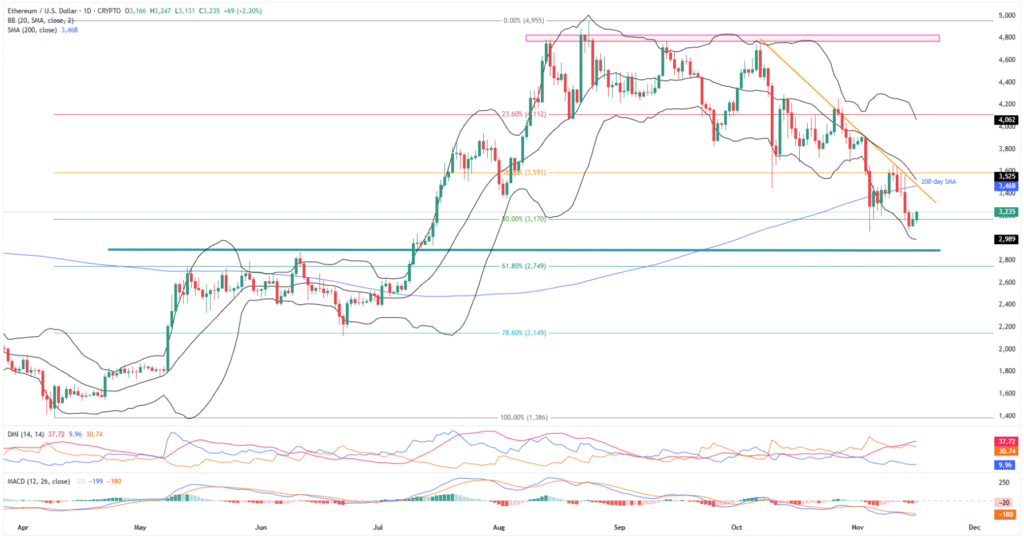
On the daily chart, Ethereum challenges the breakdown of a 200-day SMA, as well as a pullback from a five-week resistance, amid bearish MACD signals (red histograms).
Additionally, the DMI’s Average Directional Index (ADX, red) line is at the top, followed by the Downmove (D-, Orange) line, while both stay well beyond the 25.00 neutral level, suggesting downside momentum. Further, the Upmove (D+, Blue) line is at the bottom, with the 10.00 print, citing very weak upside bias.
With this, the ETH is likely to witness a pullback and poke the lower BB support surrounding $2,990, but its further downside appears a difficult as a horizontal support since July, near $2,910-$2,880, acts as the final line of defense for the bulls.
Notably, Ethereum’s downside past $2,880 will defy the broad bullish trend, making it vulnerable to slump toward the 78.6% Fibonacci retracement of its April-August rise, near $2,150, and then to April’s bottom of $1,385. During the anticipated fall, the 61.8% Fibonacci ratio surrounding $2,748, also known as the “Golden Fibonacci Ratio”, can test the Ethereum bears.
Alternatively, a convergence of the 200-day SMA and a descending trend line from early October, close to $3,470, restricts short-term Ethereum price recovery.
Beyond that, the middle Bollinger Band (BB) of $3,525, the $4,000 threshold, the 23.6% Fibonacci ratio of $4,112, and the upper BB of $4,060, could lure the ETH bulls.
Above all, a three-month horizontal resistance area near $4,780-$4,830 holds the spotlight for Ethereum buyers.
Ripple Justifies ETF Optimism
Ripple (XRP) traces other major crypto coins while posting its third consecutive weekly loss. However, the altcoin benefited from the latest XRP ETF launch and hence dropped lesser compared to the BTC and the ETH, marking nearly 5% weekly loss to $2.25 by press time.
According to Santiment’s analysis, the first-ever spot XRP ETF (ticker: XRPC) had a record-breaking first day of trading volume, worth $58.6 million.
Ripple Technical Analysis Looks Bearish
Ripple price hit a one-week low before bouncing off $2.19, well beyond the lower Bollinger Band (BB) of $2.14.
The altcoin’s following rebound, however, lacks support from the momentum indicators like the 14-day Relative Strength Index (RSI) and the Moving Average Convergence Divergence (MACD).
Also keeping the XRP sellers hopeful is a bearish signal from the 50-day and 200-day Exponential Moving Average (EMA) and a sustained breakdown of a five-week support, now resistance.
That said, the bearish MACD signals (red histograms) and the steady conditions of the 14-day RSI line lure Ripple sellers as the 50-day EMA stays beneath the 200-day EMA, defending the early-November “Death Cross” bearish moving average crossover. Notably, the “Death Cross” bearish signal is formed when the short-term moving average pierces the long-term moving average from above.
Ripple Price: Daily Chart Suggests Limited Recovery
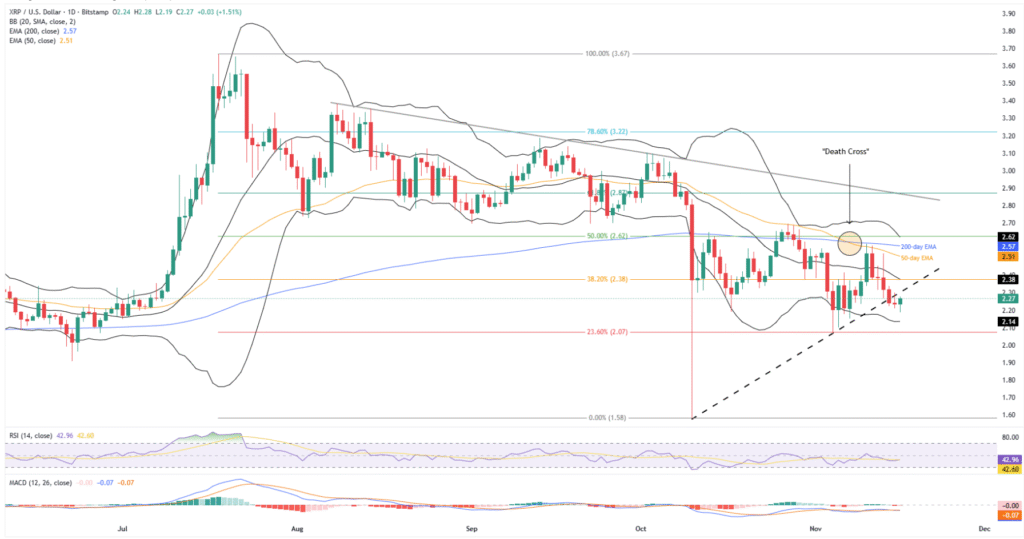
With this, the XRP price remains on the bear’s radar as long as the “Death Cross” holds, highlighting the $2.57 hurdle comprising the 200-day EMA.
Beyond that, a convergence of a three-month resistance line and 61.8% Fibonacci Retracement, also known as the “Golden Fibonacci Ratio”, around $2.87, will be the final line of defense for the bears before giving control to the buyers.
In that case, tops marked in September and August, near $3.19 and $3.38, as well as July’s yearly high of $3.67, will gain the market’s attention.
Notably, the five-week-old support-turned-resistance guards the XRP’s immediate upside near $2.31.
Alternatively, the 23.6% Fibonacci ratio of $2.08 and the $2.00 can lure the short-term XRP sellers.
Should the quote remain bearish past $2.00, June’s bottom of $1.91 and October’s low of $1.58 could attract the sellers.
Conclusion
Cryptocurrency weekly performance was surprisingly bearish as the U.S. government ended the historic 43-day shutdown. The market’s pessimism could be linked to the economic fears of the government deadlock and uncertainty in making the macro decisions, as well as a decline in the odds of December Fed rate cuts.
However, the official release has confirmed publication of the U.S. employment report for September on November 20, as well as other activity data afterward. This could help the market sentiment to improve and challenge the latest bearish bias surrounding the risk assets, encompassing cryptocurrencies.
Still, Thursday’s U.S. Nonfarm Payrolls (NFP), Unemployment Rate, and Average Hourly Earnings will precede Friday’s preliminary PMIs for November, and hence optimists should remain careful.
Should the incoming data highlight employment problems, the latest buzz around the Fed’s inaction during the December monetary policy meeting will gain momentum. The same can allow the U.S. Dollar to stop its two-week downtrend, along with the late November consolidation, and can exert additional downside pressure on the cryptocurrencies.
Notably, on-chain signals for Bitcoin raise doubts on the crypto major’s further weakness, which in turn can allow the BTC to surprise traders if the U.S. data backs the December Fed rate cut.
On the same line, Ripple (XRP) could also face a notable rise if the crypto market optimism returns, backed by the XRP ETF inflows.
Also Read: Top 5 Fastest Growing Blockchains in 2025


