





Cryptocurrency Weekly Summary
- Cryptocurrency weekly performance portrays extreme pessimism among traders amid receding hopes of a December Fed rate cut.
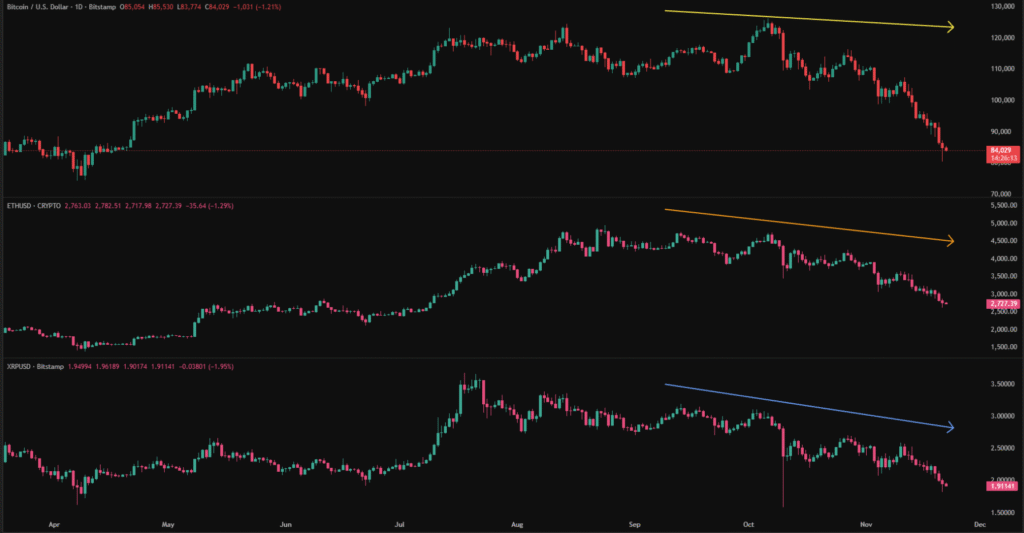
- Bitcoin, Ethereum, and Ripple post a four-week downtrend, with BTC hitting a seven-month low, and ETH falling to the lowest since July.
- U.S. data, FOMC talks, and positioning of the U.S. BLS release fueled buzz around no Fed rate cut in December.
- Stellar Nvidia earnings, Google’s Gemini 3 failed to inspire optimism as all three Wall Street benchmarks closed in the red.
- Cryptocurrencies ignored progress on the Crypto Market Structure Bill, industry positives from the U.S. government, and Franklin Templeton’s Spot XRP ETF launch.
- Extreme pessimism on social media, trading pattern of retail versus whales, and MVRV data trigger ‘accumulation’ hopes.
- U.S. data, Fed talks eyed before FOMC policymakers slip into ‘blackout’ period.
Cryptocurrency Weekly Snapshot
Cryptocurrency weekly outlook remained grim for the fourth consecutive week, actually the most in 2025, as uncertainty surrounding the U.S. Federal Reserve’s (Fed) December rate cut spread across major financial markets and damped the sentiment. The risk aversion was strong enough to trigger key technical levels of the top-tier cryptocurrencies, challenge equities and gold price, while helping the U.S. Dollar to face the biggest weekly jump in six weeks.
Against this backdrop, Bitcoin (BTC), Ethereum (ETH), and Ripple (XRP) all posted their fourth weekly loss in a row, Wall Street benchmarks ended the week on a negative note, and the spot Gold (XAU) price marked a modest fall for the week.
Bitcoin Triggers Market Panic: Bitcoin (BTC) hit a seven-month low, after falling four consecutive days in the last week, down nearly 10.0% on a weekly basis to $84,000 by press time. Notably, Bitcoin cracked the $81K threshold and flagged concerns about heavy selling in the near future, despite mixed on-chain signals.
Ethereum Slumps: Ethereum (ETH) supersedes BTC while posting close to 12.0% weekly loss, to $2,730 at the latest. The ETH’s latest slump adds to the fourth weekly negative for the altcoin, raising concerns about the sustainability of the altseason talks.
Ripple Plummets: Ripple (XRP) traces other major cryptos, posting a fourth consecutive weekly loss of around 13.00% to $1.90 by press time. The launch of Franklin Templeton’s Spot XRP Exchange Traded Funds (ETF), with a symbol XRPZ, failed to limit the quote’s fall last week.
The Weekly Moves
Key Macro Catalysts
Among the key catalysts, a reduction in the market’s expectations of December Fed rate cuts, despite mixed comments from a slew of Fed officials and unclear U.S. data, gained major attention.
Notably, the risk aversion weighed on the digital assets, the technology stocks, and Gold in posting the weekly losses.
Although the U.S. policymakers managed to end the historical shutdown, until January 30, 2026, the following actions from decision-makers weren’t optimistic and flagged fears about the economic burden of the government shutdown.
Elsewhere, multiple Federal Open Market Committee (FOMC) officials crossed wires last week, and most of them sounded cautious about further rate cuts, underpinning the market’s anxiety over the U.S. central bank’s next move and weighing on the risk assets. It’s worth noting that the FOMC Meeting Minutes were also slightly hawkish and raised the bar for the U.S. central bank’s further rate cuts.
Additionally, the U.S. employment and activity data also lacked major negatives, despite a higher Unemployment Rate, and strengthened the odds of the Fed’s hawkish move.
Above all, an update from the U.S. Bureau of Labor Statistics (BLS) challenged the market’s optimism about the Fed rate cut. That said, the BLS cancelled the October jobs report, as well as delayed the November release to December 16. The stated timeline falls after the December FOMC meeting, which in turn raised concerns that the policymakers will have less data to act and may adhere to a pause in rate cuts.
It’s worth noting, however, that the probability of a December rate cut by the Fed dropped from 61% last week to 29% by the end of Friday, per the CME Group’s FedWatch Tool.
- Fed Governor Stephen Miran remains alone in pushing for a more forward-looking stance, while most policymakers say the path back to 2% is long.
- Fed Vice Chair Philip Jefferson supported last month’s quarter-point cut due to rising labor risks but urged caution as policy approaches neutral, citing easing upside inflation risks and mixed labor signals.
- Fed Governor Christopher Waller said he firmly supports another quarter-point cut at the December 9–10 meeting, arguing the labour market has weakened enough.
- Cleveland Fed President Beth Hammack said that cutting rates risks prolonging high inflation, sounding hawkish alarms.
- New York Fed President John Williams said, “The Fed can still cut rates in the near term, given current policy is moderately restrictive.”
- Boston Fed President Susan Collins also retreated from her previous comments of “Leaving rates steady would be appropriate for now,” while saying, September jobs data was mixed.
- Dallas Fed President Lorie Logan said that (Fed should hold rates ‘for a time’ to assess.
- Chicago Fed President Austan Goolsbee noted inflation has stalled at 3%, still above the 2% target.
- Further, Fed Governor Lisa Cook said not all market volatility is harmful, whereas Philadelphia Fed President Anna Paulson stressed the need to balance weakening labor momentum with lingering inflation risks.
Talking about the data, preliminary readings of the U.S. Purchasing Managers Index (PMI) for November flashed mixed signals. That said, the headline S&P Global Manufacturing PMI came in at 51.9 versus 52.0 expected and 52.5 prior, while the Services PMI rose to 55.00 compared to the market forecasts of reprinting the 54.8 figures. With this, the Composite PMI inched up to 54.8 from 54.6.
The U.S. Real Weekly Earnings for September came in -0.1% Month-over-Month (MoM) versus -0.3% prior. The Year-over-Year (YoY) figures also improved to 0.8% from 0.7% prior.
Nonfarm Payrolls (NFP) for September jumped to +119K versus +50K expected, compared to a revised down -4K prior, while the Unemployment Rate rose to the highest since November 2021, to 4.4% for the same month, compared to 4.3% expected and prior. Additionally, Average Hourly Earnings matched the revised 3.8% prior on a Year-over-Year (YoY) basis, but hit a three-month low of 0.2% for September, versus 0.3% expected and 0.4% prior (revised).
Meanwhile, the U.S. Initial Jobless Claims for the week ended on October 25 eased to 220K from 228K prior (revised), versus 227K market forecasts. Further, the Philadelphia Fed Manufacturing Survey Index for November improved to -1.0 from -12.8, compared to analysts’ estimation of -3.1.
The 4-Week Average of the ADP Employment Change until November 01 came in -2500 compared to -11,250 prior. Furthermore, the U.S. Empire State Manufacturing Index for November hit a year’s high, rising to 18.7 from 10.7, versus 6.0 market forecasts.
Notably, buzz surrounding an end to the Russia-Ukraine war failed to fuel the market sentiment. Earlier in the week, U.S. media reported that President Donald Trump quietly approved a Ukraine-Russia peace plan earlier this week, following an Axios report that the U.S. is secretly drafting a new plan. Recently, Trump said that Ukraine is losing land, while adding, “Thursday is an appropriate deadline for the Ukraine plan.” Meanwhile, Russian President Vladimir Putin said that he has received the US plan for peace, but also mentioned that Russia is ready for a peaceful resolution, but the details of the plan need to be discussed. On the other hand, Ukrainian President Volodymyr Zelenskyy said he agreed to work on a U.S. draft peace plan.
Elsewhere, the China-Japan tensions escalate, and U.S. President Donald Trump said he would be “OK” with bombing Mexico to stop drug trafficking. Additionally, China’s state-owned grain trader COFCO marked the largest purchase of U.S. soybeans since the summit between U.S. President Trump and his Chinese counterpart, Xi Jinping.
Crypto Market News
In the crypto universe, Bitcoin (BTC), Ethereum (ETH), and Ripple (XRP) all stretched the previous weekly loss while posting a four-week downturn.
That said, popular on-chain analysts from Santiment cited social media chatter to highlight an emerging narrative about the “accumulation buy zone.” However, the on-chain details are mixed, and hence traders need to remain cautious while eyeing the bottom-picking.
Meanwhile, the crypto market capitalization (market cap) dropped almost 12% to $2.87 trillion, whereas the Bitcoin Dominance slid to 58.4% from 58.8% during the last week.
That said, some of the top crypto news are as follows, while more updates like this could be traced to our Coin Bytes.
U.S. Senator Tim Scott, the top Republican on the Senate Banking Committee, signaled that U.S. lawmakers are jostling over the Crypto Market Structure Bill, targeting the legislation’s push to the Senate floor early next year.
More Details: U.S. Crypto Bill Moves Forward With Senate Vote Planned for Early Next Year; Will It Pass?
Franklin Templeton launched the XRP ETF, with the XRPZ ticker, on Wednesday, November 19. It’s worth observing that market players are more excited about the XRPZ than the Canary XRP ETF (XRPC), considering Franklin Templeton’s substantial $1.5 trillion in assets under management (AUM).
Read More: Ripple News: XRP reverses Franklin ETF Buzz Rally on These Catalysts, $2.07 Eyed!
World Liberty Financial (WLFI), a crypto project backed by members of the Trump family, faced controversy after freezing the wallets of several users and preparing a transfer of funds to new accounts. The WLFI’s action raised questions about how much authority the project holds over user assets, even when the firm justified the move as an attempt to safeguard funds from phishing.
Also Read: Trump-Linked Crypto Project WLFI Faces Fresh Heat Over Wallet Freezes; Here’s What Happened
Two Democratic Senators urged the Justice Department and the Treasury Department to review World Liberty Financial (WLFI). Allegations on the crypto venture created and largely controlled by Trump family members grew after reports suggested that token sales reached traders tied to North Korea and Russia.
For More: Trump Affiliated Crypto Company Draws Political Heat Over Suspected Token Sales to Sanctioned Actors
U.S. policymaker from Ohio, Rep. Warren Davidson, proposed a Bitcoin for America Act in Congress, which will allow Americans to pay tax obligations in Bitcoin. The proposal suggests that all Bitcoin tax payments would fund the U.S. Strategic Bitcoin Reserve, aiming to accumulate 2.6 million BTC through voluntary taxpayer contributions.
Read Details: Americans to Pay Taxes in Bitcoin Under New Congressional Proposal
The world’s largest digital asset firm by market share and the issuer of the USDT stablecoin, Tether, takes a strategic stake in a Canada-based firm offering bitcoin-backed loans, Ledn, as part of its broader push into real-world financial infrastructure.
Read Details: Tether Backs Bitcoin Lender Ledn Amid Surge in Crypto-Backed Loans; What to Expect?
Africa targets doubling intra-African trade by 2035 and adding more than $70 billion in yearly trade value via the ADAPT blockchain initiative. The African Continental Free Trade Area (AfCFTA), the IOTA Foundation, the World Economic Forum, and the Tony Blair Institute together undertake the continent’s most ambitious attempts to bring its fragmented trade systems into the digital era.
Also Read: Africa Targets $70 Billion Trade Boost with ADAPT Blockchain Initiative.
Ethereum Foundation proposes the Ethereum Interop Layer (EIL) that unifies Layer 2 (L2) user experience by eliminating the need for bridges, relayers, and manual chain switching. That said, the EIL is built on ERC-4337 account abstraction and trustless manifesto principles.
For More: Ethereum Interop Layer (EIL) Proposal Aims to Unify Fragmented L2 Ecosystem
Global payment giant MasterCard partners with Polygon to replace complex wallet addresses with verified usernames, bridging traditional finance and decentralized identity. Mercuryo handles user verification, while Polygon provides instant settlement infrastructure.
More Details: Mastercard Crypto Credential Expands to Self-Custody Wallets via Polygon
The blockchain analytics platform, DappRadar, shuts down operations effective November 17, 2025, ending a seven-year saga. The platform monitored decentralized applications (dApps) across hundreds of networks, and announced its closure due to ongoing financial challenges that made continued operations unsustainable. Following the announcement, the RADAR token crashed 38%
Read Details: DappRadar Shuts Down After 7-Year Run, Token Plummets 38%
A Swiss-regulated banking group, Amina, becomes the first international firm to offer comprehensive crypto trading and custody services to Hong Kong’s professional investors. Crypto Bank AMINA receives Securities and Futures Commission (SFC) Type 1 license uplift for institutional crypto services.
For More: Crypto Bank AMINA Secures Hong Kong License for Institutional Trading Expansion
Zand Bank received approval from the UAE Central Bank to issue the country’s first AED-backed stablecoin on public blockchains. The stablecoin, Zand AED, is fully backed by dirham reserves, held in segregated, regulated accounts, and supported by audited smart contracts.
Read Details: Zand Bank Secures Green Light to Issue UAE’s 1st AED-Backed Stablecoin
Details of the Bank of England’s (BoE) stablecoin plan suggest a full regulatory regime for systemic stablecoins, tightening rules on backing, capital, redemptions, and operational resilience. The proposal replaces the earlier “all central-bank deposits” model and looks clearer.
Read More: Inside the Bank of England’s Stablecoin Plan: The Rules, Safeguards and Systemic Tests Explained
Meanwhile, Telegram’s latest partnership with blockchain analytics firm Elliptic offers enhanced compliance for Telegram Wallet’s 100M+ users.
For Details: Compliance for Telegram Wallet & its +100M Users Get Major Boost Through Elliptic Partnership
Position Liquidations
Crypto market position liquidation flashed bearish signals, with long liquidations justifying the sustained weakness in the major coins. That said, position liquidation is the forced closing of a trader’s positions by a broker due to insufficient margin. This data reveals whether long (buy) or short (sell) positions were closed, helping explain recent price movements. Typically, heavy long liquidations happen during a downtrend and suggest short-term bearish sentiment, and vice versa.
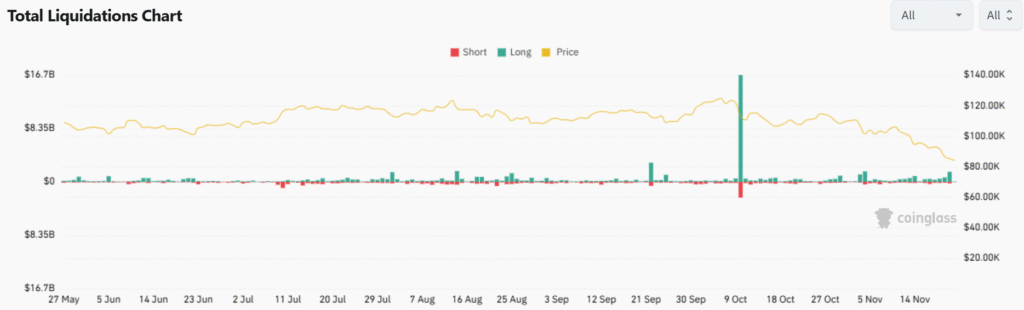
During the November 16 to 22 period, a total of $5.235 billion of positions were liquidated, per the CoinGlass data. Out of which, “Long Positions” contributed $4.014 billion, whereas “Short Positions” accounted for $1.221 billion, suggesting a bigger flow of long liquidations.
Bitcoin Sinks, Equities Drop, and Gold Slips
With the latest slump in prices to a seven-month low, Bitcoin (BTC) posted the seventh weekly loss in eight, barring the late October rebound, as risk aversion amplified, causing the BTC to slump nearly 10.0% on a week to $84,000 by press time.
The sour sentiment also weighed on equities, as the Dow Jones Industrial Average (DJI)and the S&P 500 (SPX) both dropped almost 2.0% on the week, but the tech-heavy Nasdaq Composite (NQ100) posted a third weekly loss with over 3.0% weekly fall. That said, the U.S. market’s risk barometer SPX slid 1.95% over a week to 6,602 by the end of Friday.
Meanwhile, the spot Gold (XAU) posted mild losses, reversing the previous week’s corrective bounce, with a 0.51% week-over-week loss to $4,065.
This restores Bitcoin’s historical linear relationship with equities and Gold, raising concerns of a probable recovery in the BTC price once the U.S. equities and Gold extend their broad bullish trend.
To clearly visualize links among these key risk assets, let’s see the correlation chart from TradingView.
BTC, S&P 500, and Gold
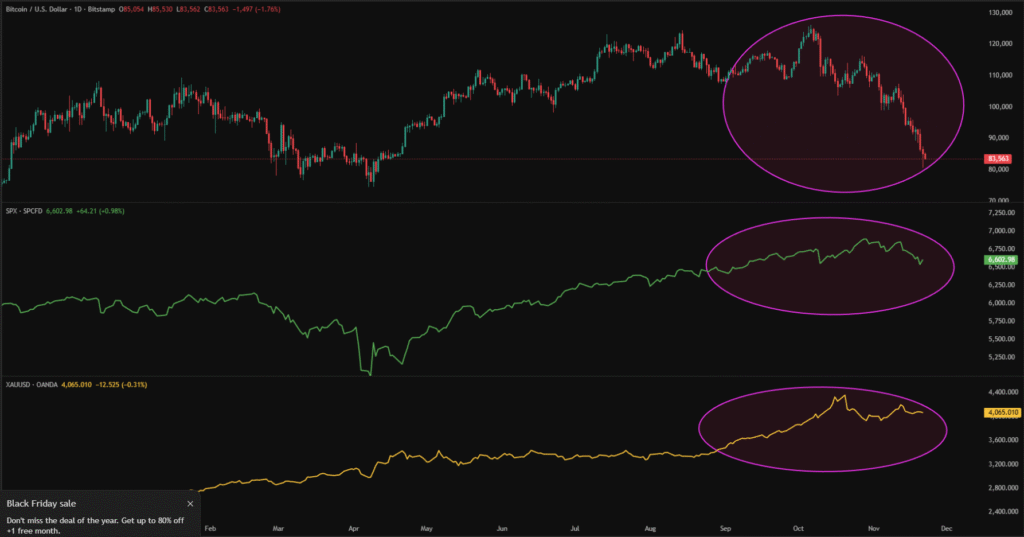
With the clear linear relations between Bitcoin, Gold, and the U.S. equities, the BTC traders shouldn’t be too pessimistic while finding the recently lower prices attractive for bottom-picking.
BTC ETF, On-Chain, and Options Market Flash Mixed Signals To Test Bears
Bitcoin’s (BTC) latest weakness faces mixed signals amid the ETF outflows and consolidation from whale wallets, addresses holding between 10 and 10,000 BTC, apart from the broadly downbeat sentiment. However, a few on-chain catalysts and the options market data suggested a slight recovery in prices, which could be justified late Friday, as BTC bounced off $80,537.
Starting with the latest U.S. spot Exchange Traded Fund (ETF) data from the SoSoValue, the Bitcoin (BTC) spot ETFs reported the biggest daily jump in inflow since November 11 on Friday, with the daily inflow of $238.47 million.
Still, the spot BTC ETFs marked the fourth consecutive weekly outflow, worth $1.22 billion by the end of Friday, posting the third straight weekly outflow of over $1.0 billion.
It’s worth observing that August reported the first monthly outflow in five months, the biggest since March, but there were inflows in September and October, whereas the November Outflows have been $3.55 billion by press time, the biggest since February.
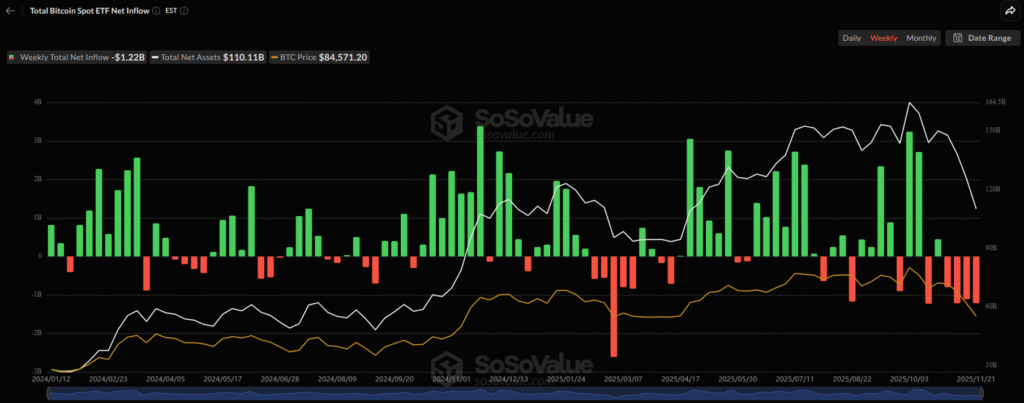
With this magnitude of outflow from the ETF every week, the BTC optimists should remain cautious going forward.
Alternatively, Whale Wallets, addresses holding between 10 and 10,000 BTC, showed an accumulation behaviour, following multiple weeks of selling, while small wallets (less than 0.01 BTC) are decreasing holdings, according to Santiment.
On the flip side, a $3.73 billion options expiry challenged the Bitcoin bears, despite the downbeat sentiment. That said, the total number of weekly options expiring was $4.03 billion on Friday, the day of expiry. Notably, the maximum pain price, the strike price at which option holders (buyers) lose the most money and options writers (sellers) profit the most, was at $100,000, up from Friday’s slump to around $80K. This could be considered a pullback sign for the BTC.
Also read: Crypto Options: Bitcoin Falls Under $90K Ahead of $3.73B Weekly Expiry.
Meanwhile, data from Santiment suggests that the MVRV (Market Value to Realized Value) ratio, which compares the current price to the average cost basis of holders, also known as the holder profitability, flashes mixed signals. That said, the 30-day MVRV is at -16.5%, and the long-term MVRV is at -20%. Santiment said that both figures are deep inside the “opportunity zone,” indicating that average traders are holding significant losses, while adding, “Historically, such low MVRV levels have preceded strong recovery rallies.”
Santiment also highlighted an important characteristic surrounding a popular emerging narrative of the “accumulation buy zone” for (BTC).
Technical Analysis Tests BTC Bears
Bitcoin’s latest weakness could be linked to a sustained downside break of multi-month support levels, the first bearish moving average crossover since January 2022, and market fears.
However, oversold conditions of the 14-day Relative Strength Index (RSI) and the BTC’s proximity to short-term supports challenge the bears targeting the yearly low.
Meanwhile, bearish signals from the Moving Average Convergence Divergence (MACD) momentum indicator and the quote’s sustained trading beneath the key EMAs keep the BTC sellers hopeful.
Bitcoin Price: Daily Chart Highlights Seller’s Dilemma
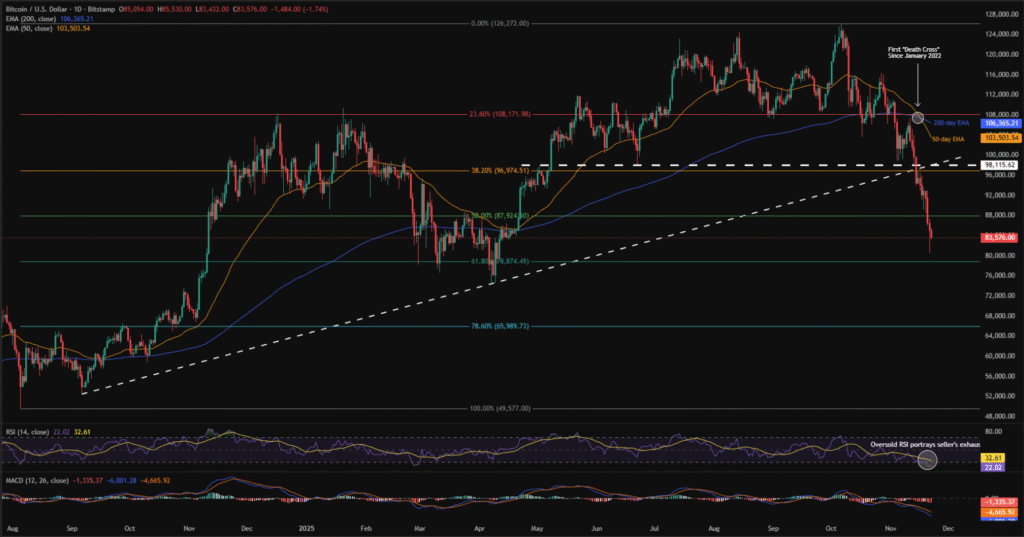
Bitcoin’s sustained trading below the horizontal support from May and an ascending trendline from September 2024, now resistance, joins the bearish signals from the MACD momentum indicator (red histograms) to favor bears.
Adding strength to the downside bias is the first “Death Cross” since January 2022, a bearish moving average crossover wherein the 50-day Exponential Moving Average (EMA) crosses the 200-day EMA from above.
Still, oversold RSI highlights the 61.8% Fibonacci retracement level of BTC’s rise from August 2024 to October 2025, also known as the “Golden Fibonacci Ratio”, close to $78,875 as we write.
Below that, the yearly low of $74,434 and the 78.6% Fibonacci retracement level of $65,990 could gain Bitcoin sellers’ attention ahead of the late 2024 bottom near $52,500.
Alternatively, Bitcoin price recovery remains elusive below the $98,000 hurdle, comprising a convergence of the multi-month previous horizontal support and an ascending trendline.
Even so, the $100K, the 50-day EMA of $103,510, and the 200-day EMA around $106,370 could test the bulls before giving them control.
Ethereum Bears Dominate!
Ethereum (ETH) slumped 12.0% on the week, currently around $2,730, while being the second-biggest loser among the top-five cryptocurrency coins, following XRP. With this, the altcoin posted its fourth consecutive weekly loss after turning down the ‘Uptober’ hopes.
Notably, the ETH’s latest fall justifies the strong weekly outflow of the U.S. spot ETH ETFs and the broad risk-off mood.
ETH ETFs Report Sustained Outflows
As per the latest SoSoValue data, the U.S. Ethereum (ETH) spot ETFs reported the third consecutive weekly outflow pattern, suggesting a steady deterioration in institutional demand.
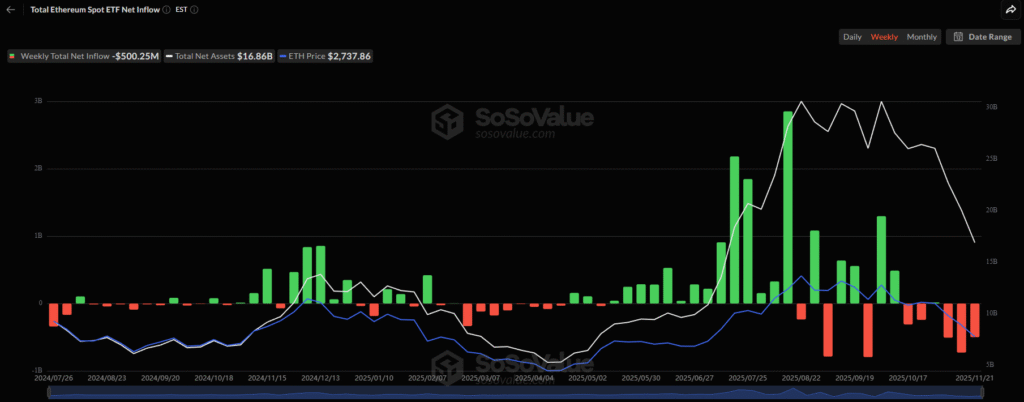
On November 21, the U.S. Spot ETH ETFs reported the first daily inflow since November 06, worth $55.71 million.
However, the second-largest coin still added to the previous weekly ETH ETF outflow pattern, with last week’s total outflow of $500.25 million, the third straight weekly outflow.
Notably, the weekly outflows currently push the ETH ETF Outflows toward the first monthly outflow since March, as well as the biggest monthly outflow on record, with the latest figures for November being $1.74 billion.
Ethereum Technical Analysis Teases Sellers
Ethereum’s downside break of a 5.5-month horizontal support and the 61.8% Fibonacci retracement of its April-August upside joins the bearish MACD signals to keep ETH bears in the driver’s seat. However, nearly oversold conditions of the 14-day RSI momentum indicator suggest a consolidation in the prices before the next round of fall.
Ethereum Price: Daily Chart Tests Sellers
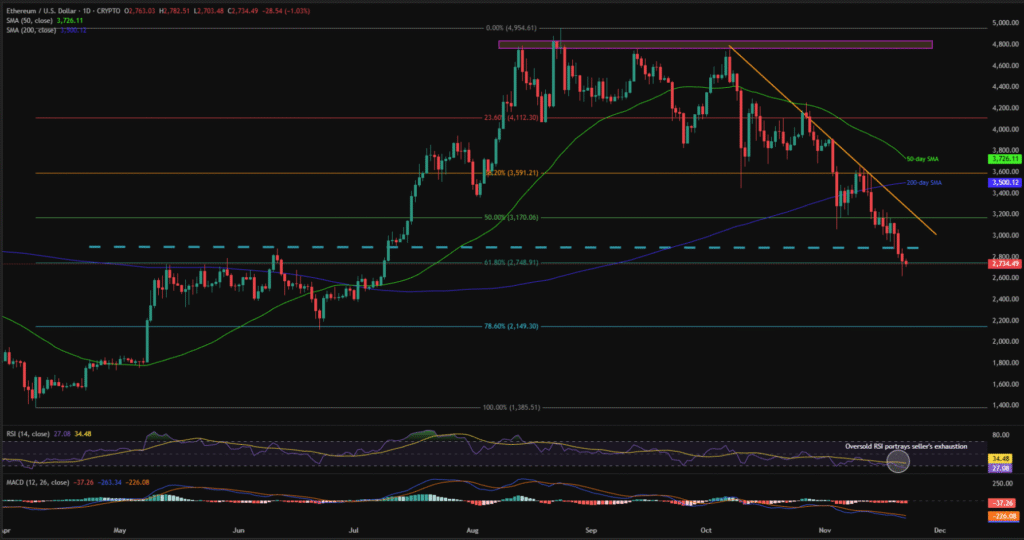
On the daily chart, Ethereum breaks a five-month horizontal support surrounding $2,880, as well as the 61.8% Fibonacci ratio surrounding $2,748, also known as the “Golden Fibonacci Ratio”.
The ETH’s downside also gains support from the MACD’s bearish signals (red histograms), a sustained trading below the key Simple Moving Averages (SMAs), and a six-week resistance line to keep sellers hopeful.
With this, the Ethereum price may approach the 78.6% Fibonacci retracement level of $2,150, if it manages to offer a daily closing beneath $2,748.
Below that, the $2,000 threshold may act as an intermediate halt during the quote’s anticipated slump toward April’s bottom of $1,385.
Alternatively, the ETH’s failure to offer a daily closing beneath $2,748 could trigger a corrective bounce targeting the multi-month horizontal resistance, previous support near $2,880.
However, the 50% Fibonacci ratio and a descending resistance line from early October, respectively near $3,170 and $3,255, could challenge the buyers afterward.
More importantly, Ethereum bears can keep the reins as long as the price stays beneath the 200-day and 50-day SMAs, close to $3,500 and $3,730 in that order.
In a case where Ethereum price remains firmer past $3,730, the $4,000 threshold, and the 23.6% Fibonacci ratio of $4,112 might attract the ETH bulls before highlighting the three-month horizontal resistance area near $4,780-$4,830.
Ripple Fails to Justify ETF Optimism…
Ripple (XRP) drops a staggering 13% to become the biggest loser among the top-five cryptocurrencies, down for the fourth consecutive week around $1.90 at the latest. In doing so, the altcoin failed to benefit from the latest XRP ETF launches and a sustained inflow into the ETFs.
After the XRPC, the launch of XRPZ, the Franklin Templeton-backed XRP ETF, failed to boost the ETF inflows, despite generating broad optimism surrounding Ripple’s famous coin.
As per the latest SoSoValue data, the U.S. Ripple (XRP) spot ETFs reported a consecutive six-day and a second weekly inflow pattern. However, the total amount of inflows eased from $243.05 million during the first week of launch to $179.60 million during the last week, suggesting a softening bias of investors amid broad crypto pessimism.
Ripple Technical Analysis Suggests Consolidation
Ripple price remains pressured at a six-week low as it extends the downside break of the 50% Fibonacci retracement of its run-up from November 2024 to July 2025. Still, oversold conditions of the stochastic momentum indicator join a multi-month horizontal support to flag fears for the XRP bears.
Ripple Price: Daily Chart Challenges Bears
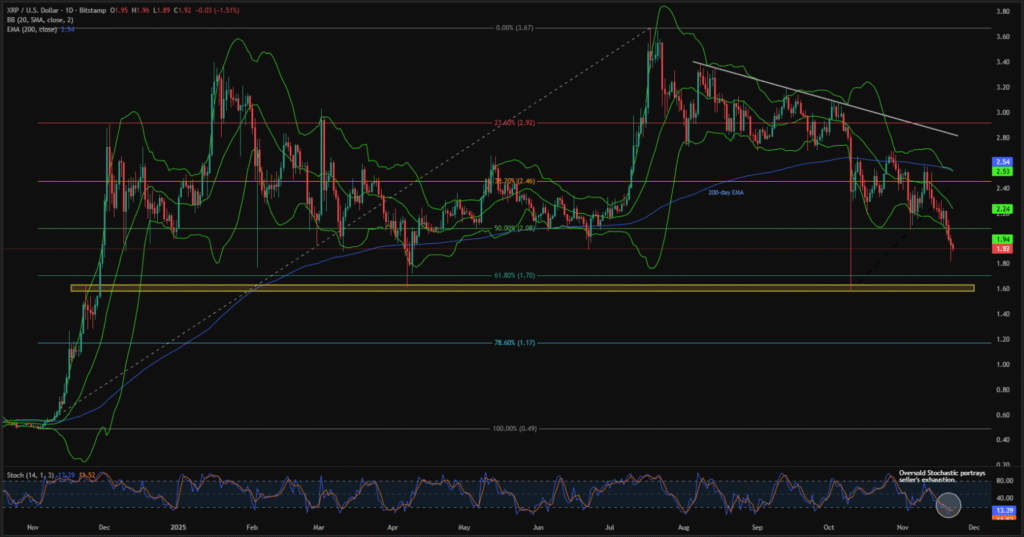
Ripple’s first daily closing beneath the 50% Fibonacci retracement since June joined broad cryptocurrency market woes to drag the quote to a multi-week low.
However, the lower BB support of $1.94 can join the oversold stochastic, well beneath the overheated limit of 20.00, to suggest a pause in the altcoin’s further downside.
Even if the XRP manages to offer a daily closing beneath $1.94, the 61.8% Fibonacci retracement, also known as the “Golden Fibonacci Ratio”, could challenge the bears near $1.70.
Above all, a horizontal area including multiple levels marked since November 2024, near $1.63-$1.58, looks like a tough nut to crack for the Ripple bears, a break of which could make the altcoin vulnerable to refresh its yearly low by targeting the 78.6% Fibonacci ratio of $1.17 and the $1.00 threshold.
Conversely, the XRP’s daily closing beyond the $1.94 support, comprising the lower BB, can trigger a corrective bounce targeting the 50% Fibonacci retracement level of $2.08 and then the middle BB of $2.24.
Beyond that, the Ripple buyers may keep their eyes on the $2.53-$2.54 resistance zone comprising the 200-day Exponential Moving Average (EMA) and the upper BB, a break of which highlights the resistance line from August near $2.85, the last line of defense for bears.
Conclusion
Cryptocurrency weekly performance was convincingly bearish amid a decline in the odds of December Fed rate cuts and steady ETF outflows.
However, the crypto market is in a panic mode as Bitcoin hit the $80K mark, which in turn could join the extremely negative on-chain BTC details to trigger a corrective bounce in prices.
While a consolidation in the major cryptocurrencies looks overdue, it all depends on the next week’s U.S. data and chatter surrounding the Federal Reserve.
Notably, the weekly U.S. economic calendar has Gross Domestic Product (GDP), Durable Goods Orders, Retail Sales, and Core Personal Consumption Expenditure (PCE) Price Index (also known as the Fed’s favorite inflation gauge). Additionally, a slew of FOMC policymakers are also scheduled for speeches, and they will be important as the ‘pre-Fed blackout’ period of FOMC officials starts from Friday, following which they’re restricted by the law to speak on monetary policy.
Should the incoming data highlight inflation problems, the latest buzz around the Fed’s inaction during the December monetary policy meeting will gain momentum. The same can allow the U.S. Dollar to extend its latest rise, and can exert additional downside pressure on the cryptocurrencies.
Notably, on-chain signals for Bitcoin raise doubts on the crypto major’s further weakness, which in turn can allow the BTC to surprise traders if the U.S. data backs the December Fed rate cut.
On the same line, Ripple (XRP) could also face a notable rise if the crypto market optimism returns, backed by the XRP ETF inflows.
Also Read: Top 5 Fastest Growing Blockchains in 2025


