




Cryptocurrency Weekly Summary
- Cryptocurrency weekly performance turned negative and defied the ‘Uptober’ hopes as growing doubts on December Fed rate cuts fuel the U.S. Dollar.
- Bitcoin, Ethereum, and Ripple all reverse the previous weekly gains, ending October on a negative note for the first time in years.
- Wall Street posts three-week uptrend despite mid-week pullback, while Gold dropped for the second straight week.
- Fed announced a 0.25% rate cut, as expected, but officials showed resistance to further reduction in benchmark rates.
- Trump-Xi trade talks, upbeat crypto industry developments, and firmer U.S. equities failed to propel digital assets.
- U.S. spot BTC ETFs see weekly outflows, but ETH ETFs record first inflow in three weeks.
- U.S. industry reports on activity and employment will be key to confirm hawkish Fed bias amid government shutdown.
Cryptocurrency Weekly Snapshot
Cryptocurrency traders witnessed a volatile week, despite the ongoing U.S. government shutdown, as U.S. Federal Reserve (Fed) concerns joined trade talks between U.S. President Donald Trump and Chinese President Xi Jinping.
Although the Fed announced a 0.25% rate cut, the policymakers’ restraint in confirming the December rate reduction raised chatter about an end to the U.S. central bank’s easy-money policy. That said, challenges to the dovish Fed bias fueled U.S. Treasury bond yields and the Dollar, while weighing on risk assets.
The Fed chatter superseded positive updates from Trump-Xi talks in South Korea and upbeat third-quarter (Q3) earnings reports from major U.S. corporations to tame the risk-on mood.
Additionally, mixed news surrounding Russia, Gaza, and Venezuela also soured the market’s sentiment and helped yields, as well as the Dollar, to remain firmer.
Against this backdrop, Bitcoin (BTC), Ethereum (ETH), and Ripple (XRP) all reversed previous weekly gains, while ending October on a negative note for the first time in many years. This marked a blow to ‘Uptober’ expectations, breaking the historical trend of October rallies in risk assets.
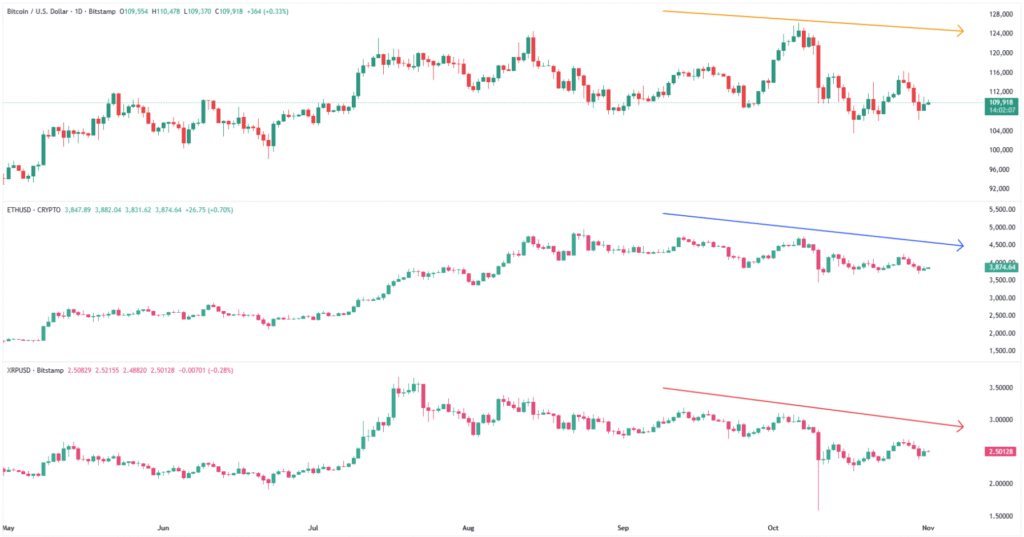
Bitcoin Drops: Bitcoin (BTC) reverses the previous weekly gains, despite Friday’s corrective bounce, down over 4.0% both weekly and monthly, to $110K by press time.
Ethereum Looks Weaker: Ethereum (ETH) supersedes BTC while posting close to 7.0% weekly loss, versus the previous weekly gains, to $3,880 at the latest. The ETH’s latest slump adds to the second monthly negative for the altcoin, worth around 7.0% by press time.
Ripple Slides: Ripple (XRP) traces other major cryptos, reversing last week’s gains with a 5.5% weekly loss to $2.50, as well as reporting a 12% monthly loss, by press time.
The Weekly Moves
Key Macro Catalysts
Among the key catalysts, the U.S. Federal Reserve (Fed) chatter gained major attention and fueled the Treasury bond yields, as well as the Dollar, which in turn weighed on the risk assets like the cryptocurrencies.
On Wednesday, the U.S Fed matched market forecasts of a 0.25% rate cut, but Chairman Jerome Powell said another rate cut in December is “far from assured” and will depend on upcoming data, which in turn weighed on the optimism. Following the latest Federal Open Market Committee’s (FOMC) monetary policy meeting, the market expectations for a December cut have fallen to 65%.
On the same line, Kasnas City Fed President Jeffrey Schmid appeared to be hawkish while saying, “(I) Dissented against rate cut because of continued momentum in economy.”
Furthermore, Atlanta Fed President Raphael Bostic and Elizabeth Morgan Hammack, the President and CEO of the Federal Reserve Bank of Cleveland, both conveyed their resistance before eventually giving in to the rate cut. Meanwhile, Dallas Fed President Lorie K. Logan, a voter in 2026, said that she would have preferred to hold rates steady.
As per the latest market expectations for the Fed interest rate decisions, a 68% probability of a rate cut at the upcoming meeting in December, lower than the previous week, weighs on the sentiment and fuels the U.S. Dollar and yields, as well as weighs on the cryptos.
Elsewhere, after the much-awaited Trump-Xi trade talks, their first face-to-face since 2019, U.S. President Donald Trump said that the meeting with Xi was ‘amazing’, and confirmed a visit to China in April 2026. The U.S. leader also announced a 10% reduction in China tariffs, a resolution of the rare earth supply issue, and a discussion on China buying chips from Nvidia.
On the other hand, Chinese President Xi Jinping said that the U.S.-China relations maintain overall stability, while adding, “Two sides should look at the long-term interest of cooperation, not fall into a vicious cycle of ‘revenge’.”
On the technology side, Nvidia CEO Jensen Huang conveyed his hopes that the widely discussed Blackwell chips could be sold in China. However, U.S. President Donald Trump and Trade Representative Jamieson Greer both looked possessive about talks of selling Blackwell to China. This could flare the U.S.-China tensions and weigh on the technology shares, as well as the cryptocurrencies, in turn, due to the crypto’s close ties with the tech sector. Recently, CNBC’s Kristina Partsinevelos reported that Trump told China’s Xi that chip sales are “between you and Nvidia.”
On a geopolitical front, the Miami Herald came out with concerning news of the U.S. preparations for striking alleged military installations in Venezuela. “U.S. officials believe the cartel exports around 500 tons of cocaine yearly, split between Europe and the United States,” added the news.
Furthermore, Trump announced that the Department of War will resume nuclear weapons testing for the first time since 1992, following Russia’s claim of testing a tsunami-generating nuclear weapon.
Additionally, Israeli Prime Minister Netanyahu ordered military action in Gaza, while Hamas postponed the handover of Israeli hostages’ bodies, a sign of escalating geopolitical tensions that was already expected.
Meanwhile, Ukraine’s President Volodymyr Zelenskyy threatened more long-range strikes on Russian refineries, even as he awaits the U.S. Tomahawk missiles to support its efforts.
Talking about the data, the Conference Board’s (CB) Consumer Confidence for October rose past 93.4 market forecasts to 94.6, versus 95.6 prior (revised), while the Richmond Fed Manufacturing Index for the same month hit a seven-month high of -4.0 compared to the -11.0 expected figure and -17.0 prior readings. Further, Housing Price Index and S&P/Case-Shiller Home Price Indices for August flashed mixed results as the former improved to 0.4%, but the latter eased to 1.6%. Moreover, Chicago PMI hit a three-month high of 43.8, versus 42.3 expected and 40.6 prior.
For more macro updates like this, please check our news section here!
Crypto Market News
In the crypto universe, Bitcoin (BTC), Ethereum (ETH), and Ripple (XRP) all reversed the previous weekly gain and ended October on a negative note, defying the ‘Uptober’ concerns. That said, this year marked the first time since 2018 that the ‘Uptober’ phenomenon did not continue for Bitcoin.
Meanwhile, the crypto market capitalization (market cap) dropped 1.6% to $3.70 trillion, whereas the Bitcoin Dominance remained mostly unchanged near 59.2%, versus 59.1%, during the last week.
That said, some of the top crypto news are as follows, while more updates like this could be traced to our Coin Bytes.
An international payment processor, Western Union, looks set to pilot a stablecoin-based settlement system with an aim to modernize global remittances for its 150 million clients across 200 countries. The payment giant handles around 70 million money transactions every quarter.
On October 27, Japan’s registered transfer company JPYC Company Ltd. launched the Asian nation’s first fully backed Yen stablecoin. The stated stablecoin is 1:1 backed by Japanese yen deposits and government bonds.
Read Details: Japan Launches First Regulated Yen-Pegged Stablecoin JPYC
ChinaAMC got Hong Kong’s (HK) approval to launch the world’s first SOL Exchange-Traded Fund (ETF), starting from October 27, with a minimum $100 investment limit. This will be HK’s third ETF approval after Bitcoin (BTC) and Ethereum (ETH) products.
Read More: Hong Kong Approves World’s First Solana ETF Through ChinaAMC
Citibank collaborates with Coinbase to create crypto asset payment capabilities for institutional clients. The news adds that, “The partnership will initially concentrate on simplifying the transition between fiat and cryptocurrency before expanding into payments orchestration for continuous settlement.”
Global credit rating agency S&P downgrades Michael Saylor’s Bitcoin-focused company, Strategy, to the speculative, non-investment-grade category of ‘B-’ while citing its heavy reliance on Bitcoin and limited liquidity.
The international technology giant IBM launches IBM Digital Asset Haven, an all-in-one platform for managing institutional digital assets across 40+ blockchains. Details suggest that the platform will be available in Q4 2025 as a Service as a Software (SaaS) offering, with on-premises deployment planned for 2026.
Read More: IBM Digital Asset Haven Launches to Bridge Traditional Finance & Crypto
Bitwise Asset Management launched the first U.S.-based Spot Solana exchange-traded product (ETP), called the Bitwise Solana Staking ETF ($BSOL). The financial instrument will start trading on the NYSE on October 28, allowing investors to gain 100% direct exposure to SOL through a traditional ETP wrapper.
Also Read: Bitwise Launches First Spot Solana ETP in U.S. BSOL with Innovative Staking Strategy
A global crypto prediction giant, Polymarket, braces for reentering the U.S. markets after a three-year absence in November 2025. The analytical firm intends to enter the sports betting market, with a particular interest in the sports-focused licensed product, which might increase hardships for more established online gambling sites.
The issuer of the USDC stablecoin, Circle Internet Group, launched the public testnet of Arc, an open Layer-1 blockchain network comprising over 100 financial and technology partners, including BlackRock, Goldman Sachs, HSBC, Visa, and Mastercard. The firm terms the network as a “new economic operating system” for the internet.
Read More: Circle Launches Arc Testnet with Backing from BlackRock, Goldman Sachs, Visa, and Mastercard
Bank Indonesia (BI) joined the stablecoin race as it prepares to launch a digital currency backed by government bonds (SBN), referring to it as the “national stablecoin version.”
Ethereum successfully launched the much-awaited Fusaka hard fork upgrade on the Hoodi testnet and completed Ethereum’s three-stage simulation, following earlier tests on the Holesky and Sepolia networks. According to the Ethereum Foundation, the mainnet release will happen at least 30 days after Hoodi’s activation, with developers aiming for December 3.
Global payment giant MasterCard eyes another attempt to have a crypto infrastructure company in its bag, following an unsuccessful bid for stablecoin startup BVNK, as it negotiates an acquisition deal with Zerohash worth around $1.5-$2.0 billion.
Read More: Mastercard Zerohash Acquisition Nears $2B to Boost Stablecoin Infrastructure
In the U.S., lawmakers introduced the bipartisan GUARD Act to restrict AI chatbots from interacting with minors. The report mentioned companies that violate the law could face penalties of up to $100,000 per offense, enforced by the U.S. Attorney General and state attorneys general.
More Details: U.S. Lawmakers Unveil GUARD Act Imposing $100K Fines to Shield Children from AI Chatbots
Position Liquidations
Crypto market position liquidation flashed bearish signals, with long liquidations justifying the latest weakness in the major coins. That said, position liquidation is the forced closing of a trader’s positions by a broker due to insufficient margin. This data reveals whether long (buy) or short (sell) positions were closed, helping explain recent price movements. Typically, heavy long liquidations happen during a downtrend and suggest short-term bearish sentiment, and vice versa.
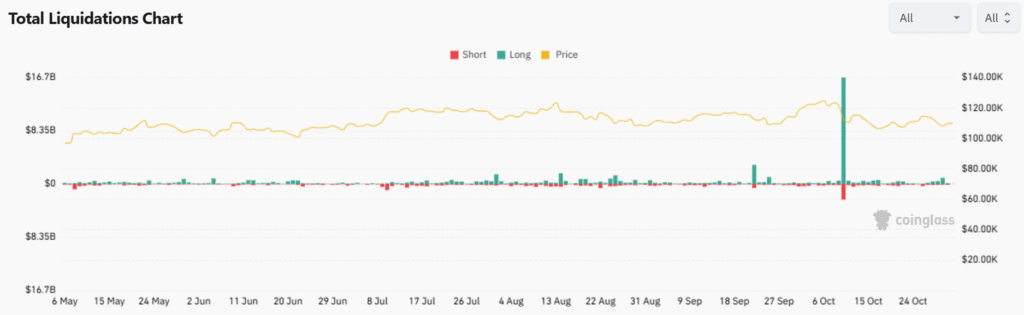
During the October 26 to November 01 period, a total of $3.237 billion of positions were liquidated, per the CoinGlass data. Out of which, “Long Positions” contributed $2.21 billion, whereas “Short Positions” accounted for $1.03 billion, suggesting a bigger flow of long liquidations.
Bitcoin and Gold Decline, But Equities Stay Firmer
Bitcoin (BTC) posted the fourth weekly loss in five, barring the previous weekly rebound, as Fed concerns fueled the U.S. Treasury bond yields and the Dollar, down nearly 4.0% near $110K as we write.
It’s worth noting that the market sentiment remained mostly upbeat due to the U.S.-China trade ‘framework’ and upbeat third-quarter (Q3) earnings from Wall Street majors, which in turn favored the equity benchmarks.
This allowed the S&P 500 (SPX) to post a third consecutive weekly gain, after facing a fresh record high earlier in the week and a mid-week pullback, up 0.71% on a week to 6,840 by the end of Friday.
However, the spot Gold (XAU) dropped for the second consecutive week, down 2.71% weekly to $4,004 by press time.
With this, BTC is down nearly 4.0% in October, whereas SPX and XAU are both up 2.3% and 3.7% respectively for the said month.
This raises doubts on Bitcoin’s historical linear relationship with equities and Gold. Santiment cites this as an early bullish sign, as Bitcoin buyers could portray the Fear of Missing Out (FOMO) once the market’s risk profile improves.
To clearly visualize links among these key risk assets, let’s see the correlation chart from TradingView.
BTC, S&P 500, and Gold
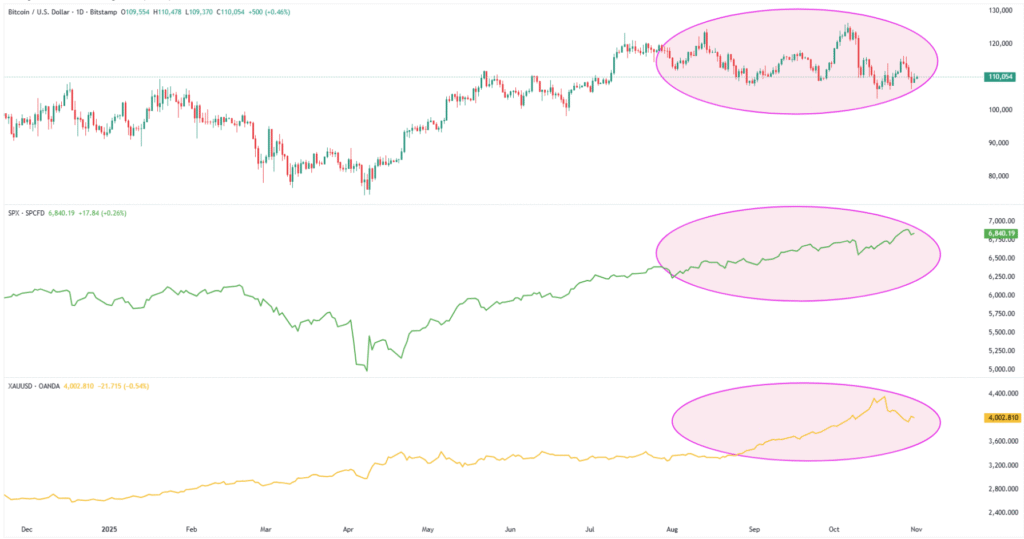
With the clearly linear relations between Bitcoin, Gold, and the U.S. equities on a broader timeframe, despite the latest friction, the BTC traders should be optimistic if the market remains positive, which is likely during the early November period.
BTC ETF, Whale Moves, and Options Market Flash Mixed Signals
Bitcoin’s (BTC) latest weakness justifies the ETF outflows and selling from whale wallets, addresses holding between 10 and 10,000 BTC, apart from the broadly firmer U.S. Treasury bond yields and the Dollar. However, the options market suggests slight recovery in prices, but was mostly ignored.
Starting with the latest U.S. spot Exchange Traded Fund (ETF) data from the SoSoValue, the Bitcoin (BTC) spot ETFs reported consecutive three-day outflows, with Friday’s daily outflow of $191.60 million.
Notably, BTC reported a two-week high daily ETF outflow on October 30, worth $488.43 million, which in turn allowed the crypto major to reverse the previous week’s inflow pattern. With this, the spot BTC ETFs marked the weekly outflow of $798.95 million for the last week ($607.35 shown in the chart till October 30+Friday’s $191.60 million).
It’s worth observing that August reported the first monthly outflow in five months, the biggest since March, but September’s inflows were stellar with the $3.53 billion figures, whereas the October inflows have been $3.61 billion by press time.
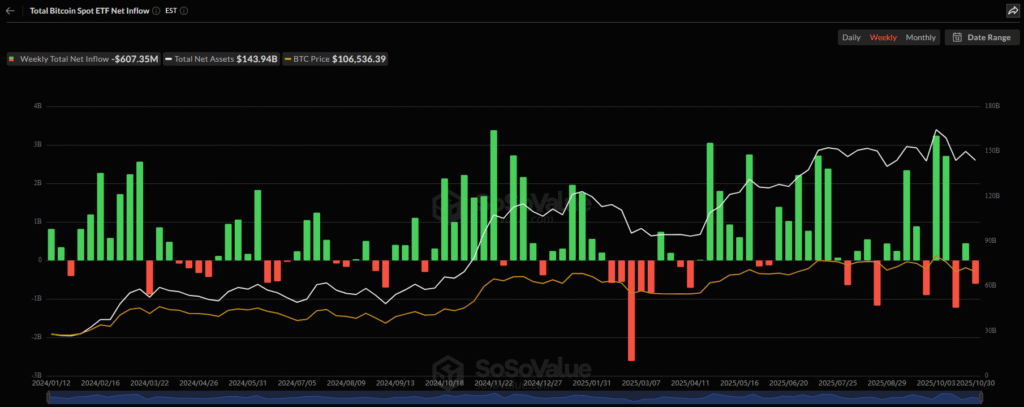
With this magnitude of surprise from the ETF flows every week, the BTC bulls should remain cautious going forward.
Alternatively, Whale Wallets, addresses holding between 10 and 10,000 BTC, also flashed a negative signal, according to Santiment. “Bitcoin whales have sold approximately 23,200 BTC between October 12 and 31,” per the crypto data platform.
On the flip side, a $13.8 billion options expiry also weighed on the Bitcoin price last week, apart from the mixed sentiment and the firmer USD. That said, the total number of monthly options expiring was $13.80 billion on Friday, the day of expiry. Notably, the maximum pain price, the strike price at which option holders (buyers) lose the most money and options writers (sellers) profit the most, was at $114,000, up from the latest slump to $110K. This could be considered a pullback sign for the BTC.
Also read: Crypto Options: Bitcoin Trades below $110K ahead of $13.8Billion in Monthly Expiry
Technical Analysis Backs BTC Rebound
Bitcoin’s early-week reversal from the 200-day Exponential Moving Average (SMA) joins the bullish crossover on the Moving Average Convergence Divergence (MACD) momentum indicator to lure BTC buyers.
However, the Directional Moving Indicator (DMI) indicator flashes bearish signals and challenges the recovery hopes.
Bitcoin Price: Daily Chart Lures Bulls
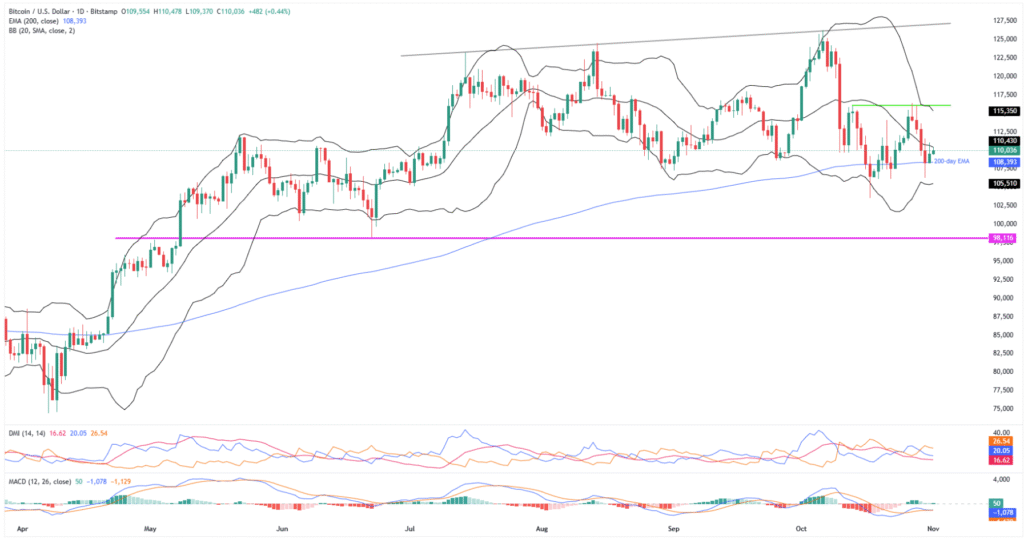
Bitcoin’s latest rebound from the 200-day EMA gains support from the bullish MACD signals (green histograms) as it approaches the middle Bollinger Band (BB) hurdle of $110,430. However, the DMI indicator cites the presence of a bearish momentum, requiring bulls to remain cautious.
That said, the DMI’s Downmove (D-, Orange) line is beyond the 25.00 neutral level, suggesting strong downside momentum, while the Upmove (D+, Blue) line is just beneath the orange line, and the Average Directional Index (ADX, red) line is at the bottom, citing very weak upside bias.
Hence, the BTC bulls may cross the immediate resistance near $110,430, comprising the middle BB, but can find it hard to break the upper BB of $115,350, and the ascending trend line from October 13 surrounding $116,200.
Beyond that, the $120K psychological magnet may act as an intermediate halt during the quote’s potential rally toward a rising resistance line from mid-July, close to $127,200 as we write.
Alternatively, a daily closing beneath the 200-day EMA support of $108,390 becomes necessary to recall the BTC sellers.
Even so, the lower BB of around $105,500 and the $100K threshold might test Bitcoin bears before directing them toward a horizontal support from early May, close to $98,000.
It’s worth noting that Bitcoin’s clear downside break of $98K could challenge the broad bullish trend by highlighting $91,000, $88,000, and April’s low near $74,400 support levels.
Ethereum Sinks!
Ethereum (ETH) dropped nearly 7.0% on the week, currently around $3,880, while being the biggest loser among the top-tier cryptocurrency coins. With this, the altcoin posted its second consecutive monthly loss, also of around 7.0%, while turning down the ‘Uptober’ hopes.
Notably, the ETH’s latest fall doesn’t justify the first weekly inflow of the U.S. spot ETH ETFs in three.
ETH ETFs Report First Weekly Inflow in Three
As per the latest SoSoValue data, the U.S. Ethereum (ETH) spot ETFs reported their first weekly inflow in three weeks, reversing the previous two-week outflow pattern, and after hitting a seven-week high in late September.
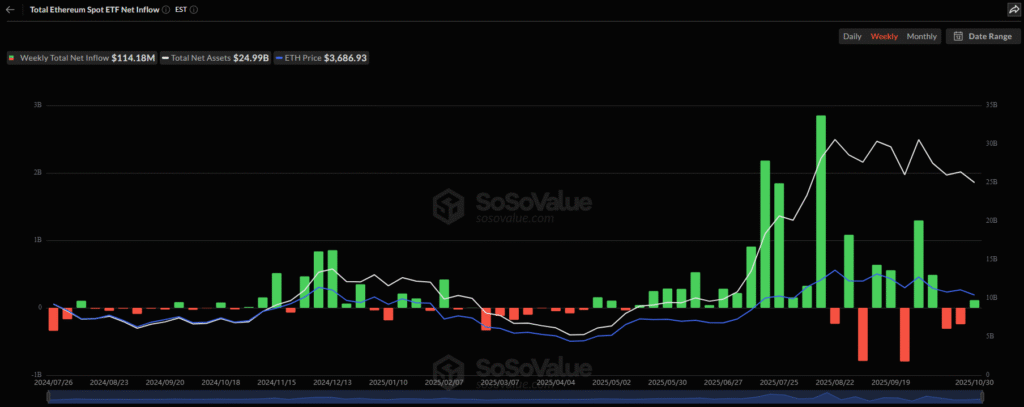
On October 31, the U.S. Spot ETH ETFs reported its third daily outflow, with a $98.20 million figure. Notably, the ETH ETFs posted outflows for three days in the last five.
Even so, the second-largest coin reported its first weekly ETH ETF inflows, with a total of $15.98 million ($114.18 shown in the chart till October 30-Friday’s outflow of $98.20 million).
Still, the monthly ETH ETF scenario is upbeat as it reports the seven-month inflow pattern, with October’s inflows being $569.93 million by press time.
Ethereum Technical Analysis Teases Buyers
Ethereum’s rebound from a seven-month-old ascending trend line support, joined the October-end consolidation of the crypto market, to trigger the latest recovery. Additionally, favoring the ETH bulls are upbeat signals from the Moving Average Convergence Divergence (MACD) and the 14-day Relative Strength Index (RSI) momentum indicators. However, the immediate support-turned-resistance and the 50-day Simple Moving Average (SMA) hold the key to the altcoin’s further rise.
Ethereum Price: Daily Chart Attracts Buyers
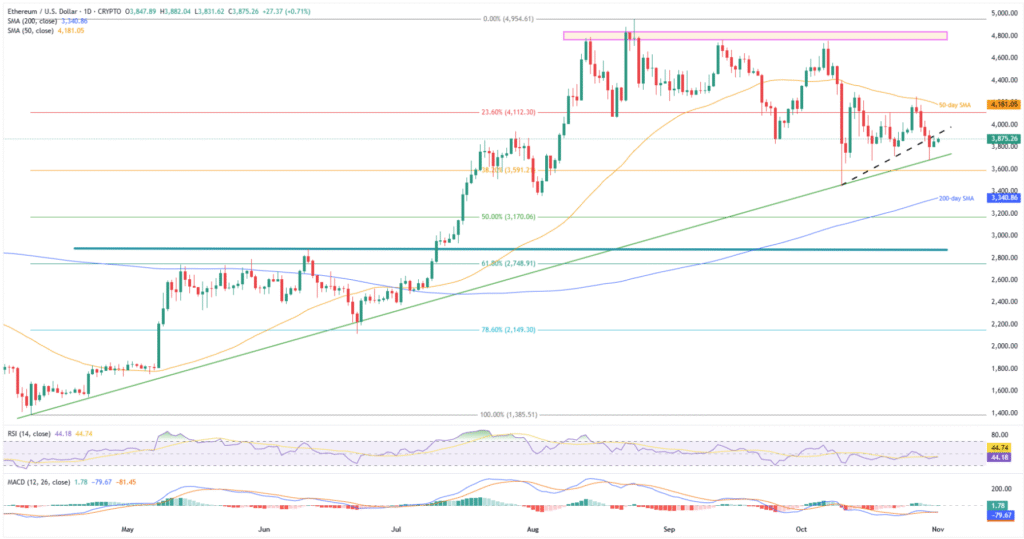
Ethereum’s U-turn from an ascending support line from early April joins bullish MACD signals (green histograms), and a steady RSI line near the 50.00 neutral threshold to suggest a continuation of the quote’s latest rise.
This highlights the previous support line from October 10, close to $3,920, as the immediate challenge for buyers ahead of the 23.6% Fibonacci retracement of its April-August rise, near $4,115.
However, the 50-day SMA hurdle of $4,181 will be crucial to watch for the ETH bulls afterward, as a clear break of which could allow prices to rally toward a horizontal area comprising multiple levels from mid-August, near $4,830-$4,768.
Additionally, ETH’s daily closing past $4,830 might extend the rally toward the record top of $4,955, and the $5,000 psychological magnet.
Alternatively, the ETH’s failure to stay beyond the immediate support line, close to $3,690, isn’t an open invitation to the bears as the 200-day SMA support of $3,340 stands tall to restrict the quote’s further downside.
Below that, a horizontal support from June, near $2,910-$2,880, will be crucial to watch for Ethereum bears.
It’s worth noting that the ETH’s weakness past $2,880 makes it vulnerable to aim for the 78.6% Fibonacci ratio and the yearly low, close to $2,150 and $1,385 in that order.
Ripple Ignores ETF Optimism…
Ripple (XRP) traces other major crypto coins while posting a weekly loss, reversing the previous week’s gains. In doing so, the altcoin ignores escalating chatter surrounding XRP ETFs and whale transfers. That said, the XRP dropped around 5.5% over a week and around 12% monthly, despite making rounds to $2.50 by press time.
TimesCrypto’s Chandan Gupta cites heavy XRP exit from exchanges and talks surrounding the ETF approvals to signal the altcoin’s potential recovery.
“Whale Alert shared a post on X, noting that 36.48 million XRP tokens worth $90.64 million were moved from Kraken to an unknown wallet. Meanwhile, spot inflow/outflow data revealed that, over the past 24 hours, more than $45 million worth of XRP has flowed out of exchanges, hinting at potential accumulation,” said the news.
The XRP news also added, “Following the approval of Solana (SOL) and Hedera (HBAR) ETFs, Canary filed an updated S-1 for its XRP spot ETF today.”
Read More: Ripple News Today: Millions of XRP Exit Exchanges as ETF Speculation Rises
Ripple Technical Analysis Looks Consolidating
Ripple (XRP) fades recovery from a seven-month ascending support, taking a U-turn from a horizontal resistance since March and failing beneath the 200-day Simple Moving Average (SMA). The weakness in the XRP’s price action, however, ignores bullish signals from the MACD and RSI momentum indicators, suggesting the presence of a consolidation pattern.
Ripple Price: Daily Chart Suggests Range Trading
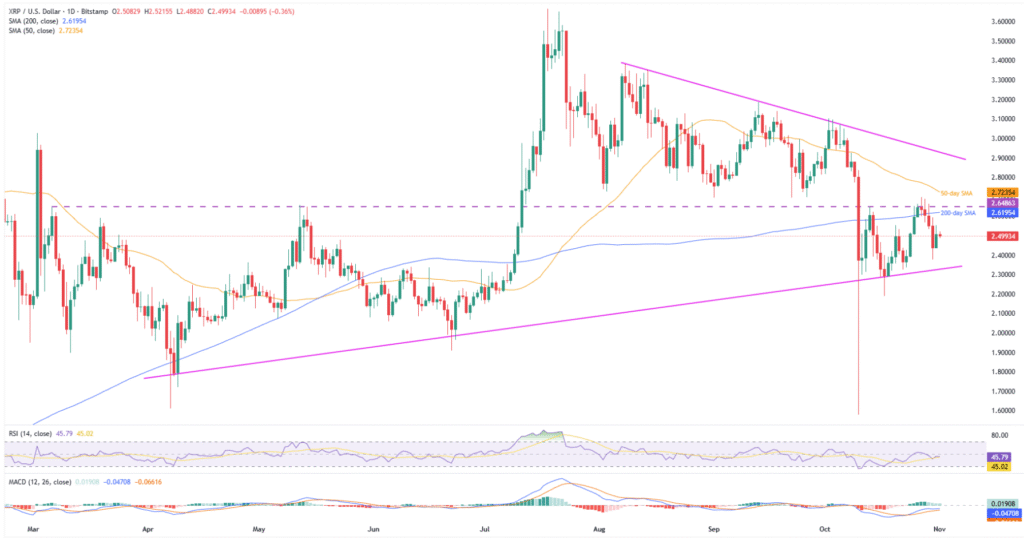
XRP’s failure to defend recovery from a multi-month support line, as well as a U-turn from the horizontal resistance and a downside break of the 200-day SMA, contrasts with upbeat RSI and MACD signals to suggest a short-term consolidation in the prices.
That said, the quote presently declines toward the aforementioned support line from April, close to $2.32, a break of which could drag the XRP to the October 17 low of $2.19 and June’s bottom of $1.91 before highlighting the yearly bottom of $1.58 for bears.
On the contrary, Ripple’s recovery could aim for the 200-day SMA resistance of $2.62 before the aforementioned horizontal hurdle from March, close to $2.65.
Should the quote manage to offer a daily closing beyond $2.65, it’s run-up toward the 50-day SMA of $2.72 and then to a descending trendline resistance from August, near $2.94, which acts as the final line of defense for the XRP bears.
Overall, Ripple’s technical analysis suggests a short-term consolidation between $2.65 and $2.32.
Conclusion
The latest weakness in the crypto market stems from the fading chances of a December Federal Reserve (Fed) rate cut, mixed trade and geopolitical news, and updates from Exchange-Traded Funds (ETFs), all undermining the ‘Uptober’ expectations. The U.S. government shutdown is restricting data flow, which could stir doubts about the Fed’s bias if next week’s reports from private institutions show weak employment and economic activity. Key data to watch include the Automatic Data Processing (ADP) October Employment Change on Wednesday, and the Institute for Supply Management’s (ISM) Manufacturing PMI and Services PMI, due Monday and Wednesday, respectively.
In addition to U.S. data, developments surrounding the U.S. government shutdown, China’s chip purchases from Nvidia, and Q3 earnings from major Wall Street companies will be key to short-term crypto momentum. U.S. Securities and Exchange Commission (SEC) ETF approvals, U.S. spot Ethereum (ETH) fund flows, and the performance of equities and gold will also be crucial for traders to monitor.
With ‘Uptober’ hopes dashed, crypto bulls may need a strong catalyst to regain momentum, which could benefit Bitcoin (BTC) more than Ethereum (ETH) and Ripple (XRP), based on technical factors.
Also read: What is Crypto Airdrop Farming? Learn How to Earn Free Cryptocurrency!


