




The Pi Network is entering an important phase after the mandatory Protocol 21 upgrade, whose deadline falls Monday.
But despite this milestone, market reaction has been subdued. The price of PI has shown only modest recovery, reflecting cautious sentiment among traders.
Over the past few weeks, Pi Network’s native token, PI, has been in a gradual decline, dropping from around $0.178 to a low of $0.1687 over the weekend, before slightly rebounding to approximately $0.171 at press time.
Protocol 21 Upgrade Deadline Arrives Today
Any node that fails to update following today’s deadline risks being disconnected from the network, effectively forcing full alignment. This ensures that only updated and fully compliant nodes remain active, a move that is essential for maintaining stability and network cohesion as Pi scales.
Protocol 21 upgrade aims to strengthen Pi Network’s core performance, preparing it to handle higher transaction volumes while laying the groundwork for real-world utility. With this foundation, the network is gearing up for future features such as the Pi DEX, on-chain swaps, and a suite of DeFi tools, signaling a clear shift from a mining-focused project toward a functional Web3 ecosystem.
The upgrade also comes at a time of rapid growth. Over 18 million users have now completed identity verification, adding credibility to the network and setting the stage for broader adoption. This growing verified user base will be essential once DeFi applications and smart contracts start running on the blockchain.
Importantly, the Protocol 21.2 upgrade is only the first step in a larger roadmap. Pi Network plans to roll out Protocol v22.1 on April 22, focusing on enhanced transaction processing and smoother node interactions. Another upgrade dubbed Protocol v23.o is also slated for May 18 to introduce full smart contracts support and comprehensive Web3 functionality.
Together, these upgrades are positioning Pi Network to move from a primarily mining-oriented platform to a fully functional blockchain ecosystem capable of supporting decentralized applications and financial services.
Technical Indicators Show Early Signs of Change
While the broader trend is still bearish, there are early signs that the selling pressure may be slowing down.
The Relative Strength Index (RSI) remains below 50, which typically signals that sellers are still in control. However, the RSI has started to move upward. This suggests that the intensity of the downtrend is fading, even if it has not fully reversed.
The MACD indicator tells a similar story. The histogram is still negative, meaning the market has not turned bullish yet. But the MACD line and the signal line are moving closer together, and the bearish histogram bars are shrinking. This kind of behavior often appears just before a shift in momentum.
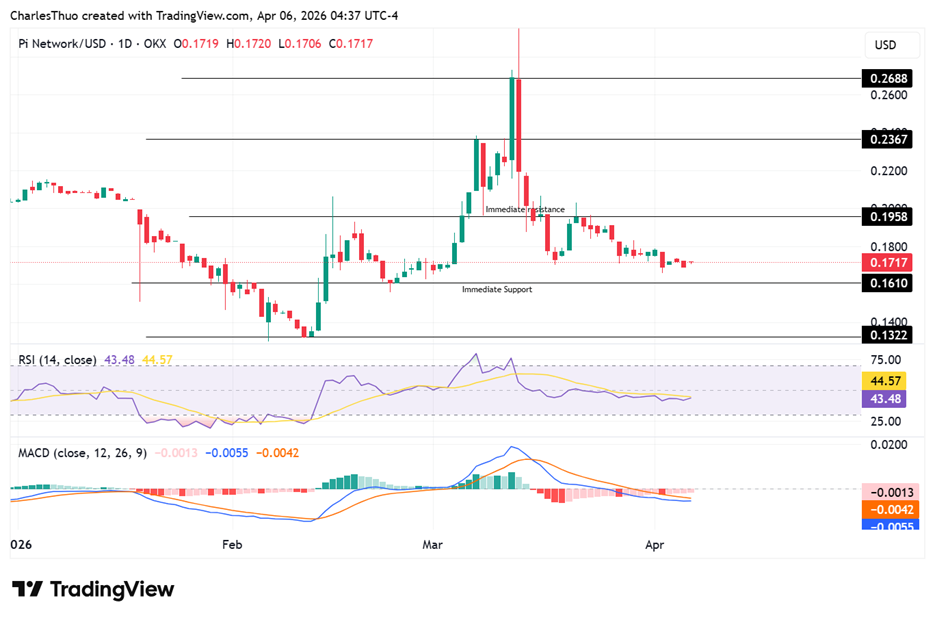
Taken together, these indicators point to a market that is no longer strongly bearish but is not yet bullish either. It is in a transition phase, with buyers slowly stepping in but not yet taking full control.
Pi Network Price Forecast
Looking ahead, the most important support level is around $0.1620. This level has recently acted as a floor, with buyers stepping in to prevent further declines. As long as the price stays above this zone, there is a chance for stabilization and gradual recovery. However, a break below it could open the door to a deeper drop toward previous lows.
On the upside, past price movements show the first major resistance sitting at $0.1958. For any meaningful bullish momentum to develop, PI’s price needs to break and hold above this level.
If that happens, the next target is the next resistance area around $0.2367. Beyond that, $0.2688 stands as a more significant barrier and would signal a stronger recovery if breached.
Looking at this, the most likely scenario is consolidation between $0.16 and $0.27 in the short term. This range reflects a market that is waiting for confirmation, either from stronger buying pressure or from further developments within the network.


