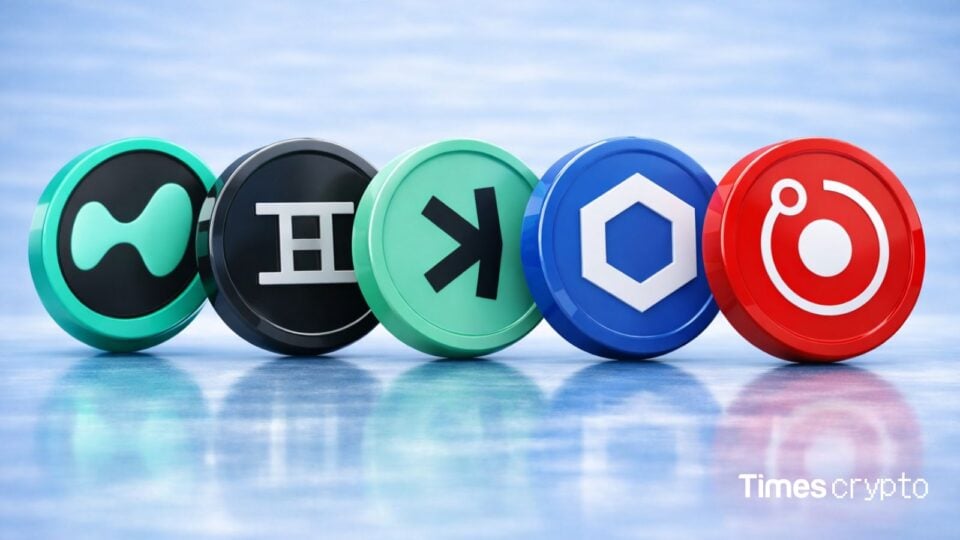
The crypto market is currently experiencing its corrective phase, which started in February 2026. The market downturn has decreased the value of mid-cap projects, but they still maintain their potential for future worth. The top 10 assets gain the highest media coverage based on their headline performance. The market investors can find great investment opportunities through cryptos that exist outside this range. The article focuses on the five selected projects that demonstrate their value through their operational capabilities and existing market momentum and blockchain usage and their significance within DeFi, enterprise technology, scalabiliaty solutions, oracles, and distributed AI computational frameworks. Investors face high risks because of the unpredictable nature of cryptocurrency markets.
1. Hyperliquid (HYPE)

Hyperliquid has established itself as a leading decentralized platform for perpetuals and DEX trading, with strong trading volume and a strong narrative in the DeFi sector even in times of market stress. The price for the native token of the HyperLiquid ecosystem is currently above the $28.65 level and the price requires another higher high to extend its uptrend towards the daily resistance level of $47.2. The market capitalization is now at $7.75 billion, thereby making it the 13th largest project in terms of market capitalization. Market analysis indicate that recent performance has been unstable but the asset’s robust fundamentals and on-chain activity boost it with a few short-term upward movements.
Hyperliquid’s infrastructure creates substantial liquidity pools, which enables the sophisticated trading systems to deliver the ecosystem’s competitive edge when compared to the other DEX platforms. The project continues to collaborate with various DeFi protocols, which could create network effects that drive ongoing customer usage of their platform. The current price and on-chain metric trend highlight the platform’s capability to maintain liquidity and user engagement even in times of market stress. The platform uses this implementation to maintain its competitive edge during times when users prefer to take fewer risks.
2. HBAR (Hedera)

Hedera makes use of Hashgraph, which is a consensus algorithm that makes transactions quick, safe, and cost-efficient, which supports business-level apps. It has been employed in areas like finance, supply chain management, and digital identity, which offer it real-world value in addition to just trading. At the time of writing, the asset is exchanging hands at $0.091, and the market cap is close to $3.9 billion. Compared to many other mid-cap assets,
The ecosystem focuses on making the asset different from most memecoins and DeFi tokens since the market participants utilize it for real-world problems instead of just for fun. The project establishes its credibility through a network governance model, which comprises major corporations together with institutional partners. The network is highly involved in development, which will aid in establishing structural advantages considering its enterprise-level scalability combined with its predictable transaction costs will drive market shifts toward a risk-on environment.
3. Kaspa (KAS)

Kaspa is a new proof-of-work blockchain that was made to handle huge chunks of transactions. The project focuses on speed, low latency, and quick transaction finality, making it a good choice for people who want to avoid traditional PoW networks with longer confirmation times. KAS trades at $0.031 with its market cap of $839.65M. Even during market corrections, the token has kept trading at a steady rate, which shows that the community is still using the network and is still interested in it.
Kaspa’s foundation utilizes a directed acyclic graph (DAG), which gives the network a scalability advantage over other networks that are based on the Proof of Work (PoW) consensus method. This system is useful for both high-frequency trading and microtransactions. The project’s network changes have seen significant technical progress by advancing the system throughput and boosting data transmission. Kaspa makes this mid-cap investment list as it makes use of cutting-edge blockchain technology and maintains a market capitalization that is still undervalued and makes it an opportunity for the traders and investors.
4. Chainlink (LINK)

Chainlink functions as a leading decentralized oracle network that links smart contracts with external data systems. This enables DeFi protocols, NFTs, and other Web3 applications to access trustworthy and precise data. The ecosystem assists in solving the Byzantine Fault Tolerance (BFT) problem. LINK currently trades near $8.59, while its market capitalization exceeds 6 billion. The asset price is going through price shifts with the continued rejection from the trendline (market in the above chart). The asset exhibits a robust correlation with DeFi market developments, resulting in its undervaluation during periods of market stress.
In the blockchain world, Oracle functions as a vital component, which makes Chainlink a signifipartonent for smart contract infrastructure development. The ecosystem functions to provide premium data sources to support the effective operations of decentralized applications. This model helps Web3 ecosystems grow as a whole and also accelerates progress over the long term as more and more on-chain activity takes place in DeFi and enterprise smart contracts.
5. Render (RNDR)

Render serves as a decentralized GPU computing platform, catering to AI training, 3D rendering, and metaverse apps. As more and more AI-powered blockchain projects and digital content are created, Render capitalizes from the growing need for decentralized computing resources. The token’s price is between $1.3 and $1.5, and its market cap is close to $680 million. Its momentum has been closely connected to the larger AI-blockchain story, facilitating investors access to a fast-growing area of the mid-cap universe.
The project gives GPU owners reasons to give resources to the network, which makes a decentralized compute marketplace. This structure supports both the supply and demand for high-performance computing. This lets Render generate revenue from new AI applications while also advancing the infrastructure of the metaverse.
The essential relationship between fundamental elements and ecosystem utility and sector-specific driving forces proves that mid-cap projects need this proof. Active volume and adoption trends with technological differentiation serve as crucial market indicators during the ongoing market correction. Investors need to allocate their funds to multiple investments while choosing secure platforms and monitoring economic conditions and regulatory developments and protocol-specific news.