As the crypto market moves into February 2026, investor attention is gradually shifting from major cryptocurrencies towards selected mid-cap altcoins that possess strong fundamental characteristics and clear market drivers. The current market situation shows a growing trend of investors moving their funds from Bitcoin and Ethereum to other projects with solid financial foundations.
The article presents five mid-cap altcoins that demonstrate real-world value and ecosystem growth and upcoming story developments. The assets reviewed are Avalanche (AVAX), Polkadot (DOT), Binance Coin (BNB), Bittensor (TAO), and Litecoin (LTC).
Avalanche (AVAX)
Avalanche maintains its status as a leading Layer 1 network that institutions prefer to work with. The subnet architecture of Avalanche enables businesses and DeFi protocols and gaming projects to create their own blockchains while using Avalanche’s security features and performance capabilities. The design of AVAX has established it as the primary asset that benefits from both real-world asset tokenization and institutional experimentation.
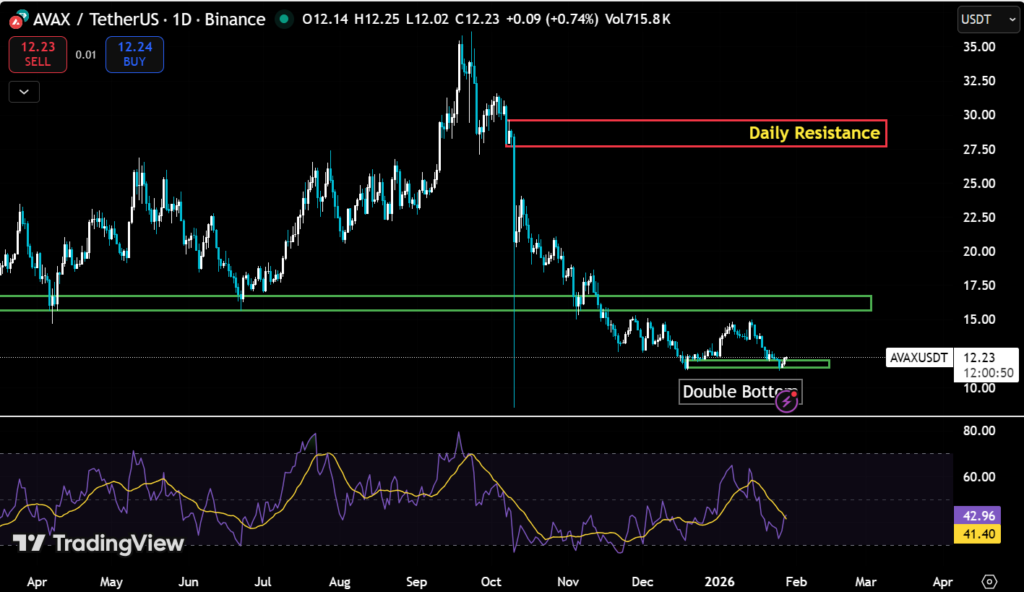
AVAX is currently trading in the $12 to $15.50 range after a prolonged drawdown. The market currently displays cautious sentiment because the RSI value shows movement between its neutral point and its slightly negative range, which stands at 42. The asset has reached a stage where it is not in oversold territory, which creates potential for a price increase since there are no signs of immediate market exhaustion.
Price action suggests consolidation, with support established near $12, making a double bottom. Resistance remains defined at $15.5 and $14.43. If ETF-related inflows or RWA adoption accelerate, AVAX could revisit the $15 to $16 zone by late February. Sustained volume above $13 would be a key confirmation signal.
Polkadot (DOT)

The main value of Polkadot exists through its support of blockchain interoperability, which enables users to access different blockchains through its parachain system and its shared security network. The asset maintains its strategic value for multichain Web3 environments even though the ecosystem has not performed well against competing systems during the previous market cycle.
The native currency of the Polkadot ecosystem maintains its price between two points, which range from $1.85 to $2.25, while its value remains near established support. The trend structure shows a bearish pattern and it currently indicates a cooldown in selling activity. The RSI indicator shows neutral to slightly negative results with a value of 42.3, which indicates that the situation has reached a state of stability instead of showing signs of complete market collapse.
Support between $1.86 and $2.01 has held consistently, while resistance is clustered between $2.25 and $2.48. A confirmed breakout above $2.29 would support the bullish scenario, opening potential upside toward $2.48 and possibly $3.30 if momentum rebounds. February performance will likely depend on ecosystem upgrades, renewed developer activity, or ETF-related speculation. Failure to hold the $1.85 level would reintroduce downside risk.
Binance Coin (BNB)
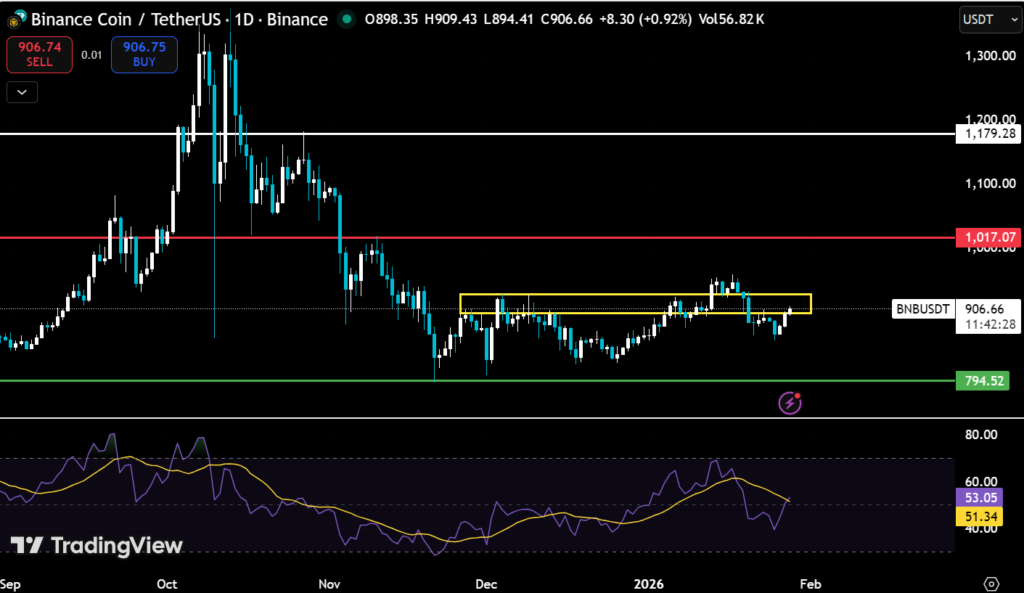
Binance Coin stays as one of the most powerful utility-based assets in the market because Binance controls the exchange market, the platform conducts regular token burns and BNB Chain supports various DeFi, NFT, and payment activities. The asset is changing hands at $906.66, showing relative strength compared to most altcoins. The current price movement shows a positive recovery trend because the market reached higher lows while staying above essential support levels. RSI signals active buying interest without extreme overbought conditions.
The support level exists between $900 and $925, while the main daily resistance level stands near $1020. The price will likely rise to the $960 to $1,000 range if $920 breaks through strong trading volume and stays above this level. The active on-chain transactions and high demand from exchanges make BNB one of the most durable altcoins.
Bittensor (TAO)
Bittensor sits at the intersection of blockchain and artificial intelligence, offering a decentralized marketplace where machine learning models are trained, evaluated, and rewarded. As AI narratives continue to dominate broader tech markets, TAO remains one of the purest blockchain exposures to this trend.
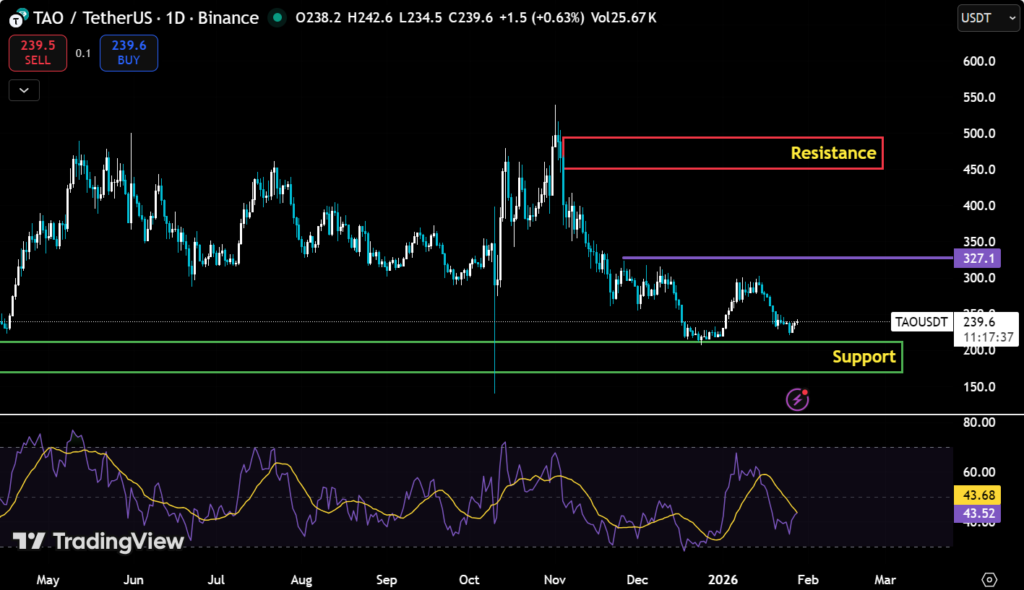
TAO is currently trading between $235 and $240 after a corrective phase. The short-term trends show a downward movement, although the RSI value of 43.5 indicates that the market has reached oversold conditions, which could lead to relief rallies to occur. The market has maintained support at $210 while the immediate resistance level exists between $330 and $350.
The supply mechanics of TAO, coupled with its post-halving behavior, create extra market fluctuations. The market calls for strong volume confirmation as a prerequisite before any major trading positions.
Litecoin (LTC)

LTC trades at $69.75 at the time of writing and is showing early signs of recovery from oversold conditions. The momentum indicators, like the RSI, remain near neutral and stand close to 40 after previously dipping into bearish territory, suggesting selling pressure has eased. Support lies between $69 and $63, while resistance levels are found at $89.7. If the price strongly flips this zone, the next potential resistance zone lies between $116 and $125. A sustained move above $80 to $84 would significantly improve the technical structure and could trigger a broader trend reversal.
Historically, Litecoin has responded well to liquidity-driven market phases. Any ETF-related developments or renewed payment narratives could act as catalysts in February.
The technical structures of the digital assets like Avalanche and Binance Coin show greater strength in comparison to Polkadot, Bittensor, and Litecoin, which currently exist at important market turning points. The rate at which investors move their funds into specific altcoins will depend on overall market conditions while major assets maintain their current prices. The process will require tracking volume and on-chain activity together with macroeconomic conditions and particular sector-based stories, which include AI and ETF developments.