




Key Takeaways
- The transaction speed of a blockchain network significantly affects fees and usability. The slower networks may cause congestion and may result in failed transactions.
- The chains with faster execution adopt advanced consensus, sharding, and Layer 2s to accomplish significant Transactions Per Second (TPS).
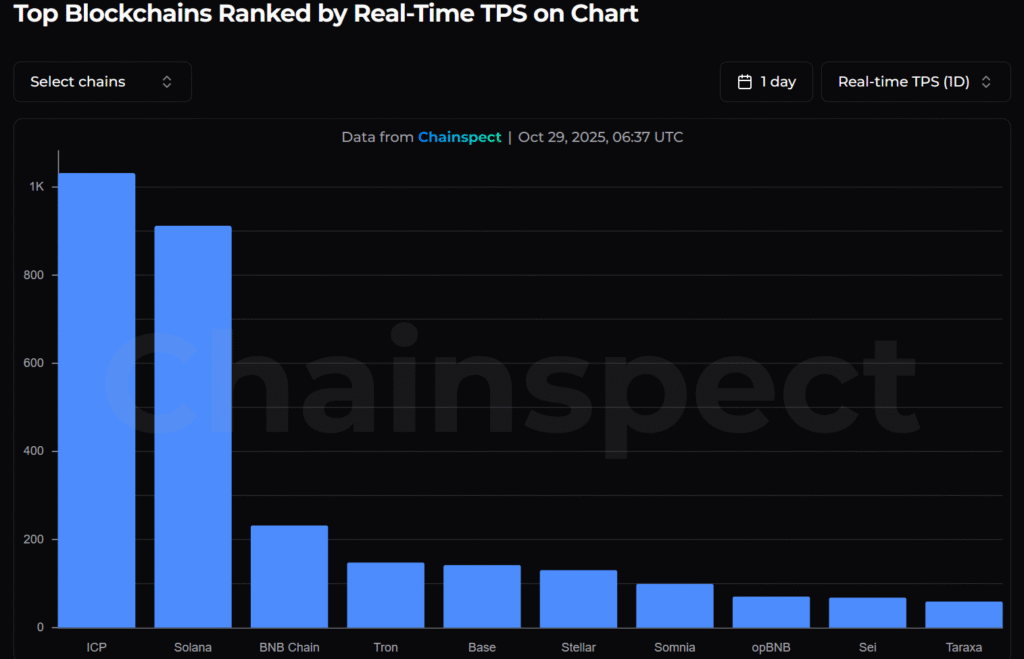
- ICP, Solana, and BNB Chain blockchains topped the leaderboard with TPS crossing over 900.
Table of Contents
Transactions per second (TPS) is one of the crucial parameters to measure the processing capabilities of the chain and validate transactions effectively. The metric defines the three main aspects of blockchain performance, which are speed, scalability, and security. A high TPS for a blockchain network indicates that the blockchain network can handle a heavy load of transactions with the combination of cost-effectiveness.
TPS metrics are considered one of the most important in areas such as decentralized finance (DeFi), gaming, and digital payments. The advancement of technology has led to the continuous innovation of developers in the area of throughput by the use of more complex solutions like proof-of-stake (PoS), sharding, and layer-2 rollups, which are among the most advanced ones now.
Top 5 Fastest Blockchains (Real-Time TPS)
Here is a list of the top 5 blockchains based on transaction processing time.
| Blockchain | Real-Time TPS (tx/s) |
|---|---|
| Internet Computer (ICP) | ~1,032 |
| Solana | ~912 |
| BNB Chain | ~231.8 |
| Tron | ~147.7 |
| Base | ~141.9 |
Internet Computer Protocol (ICP)
The Internet Computer Protocol offers internet services with a real-time transaction per second (TPS) rate of about 1,050. ICP was launched in May 2021 to achieve fast transaction finality and facilitate large-scale decentralized web services via Chain Key cryptography.
The blockchain supports both governance and execution of smart contracts. The structure of the Internet Computer is designed to handle enterprise-level applications, to accomplish a theoretical throughput of over 200,000 transactions per second (TPS).
Solana
Solana achieves real throughput close to 900 TPS, while its theoretical limit is about 65,000 TPS. The 2020 blockchain launch came with the high-speed transaction processing. Following this, the chain got the real adoption. The blockchain embedded an innovative Proof-of-History (PoH) mechanism that increased the efficiency and helps to achieve a block time of just 400 milliseconds
The projects include DApps, DeFi platforms, NFT marketplaces, and so on, along with other Web3 applications. Moreover, SOL, the native token, propels the network’s activity (both in DApps and as validator rewards), which is a win-win situation for both SOL investors and market observers. Fast speeds are an advantage for developers (although during peak traffic congestion can happen).
BNB Chain
In real time, the BNB Chain operates at about 250 TPS and supports a strong application ecosystem of smart contracts. Initially known as Binance Smart Chain, the rebranding indicates a wider use case than just the Binance exchange. The ecosystem was launched in July 2017 and supports DeFi applications, token swaps, and other decentralized applications.
The network is both fast and decentralized, as it employs a familiar toolset for developers and strong support for the fundamental infrastructure.
Tron
Tron operates with nearly 150 TPS on average and makes use of the Delegated Proof-of-Stake (DPoS) mechanism, which boosts block times and minimizes fees. Since its launch in 2018, the chain’s mission has been centered on content distribution and financial applications, especially stablecoin transfers.
The TRX token, a native cryptocurrency of the blockchain, serves as a smart contract on the blockchain and supports on-chain governance also. Despite TPS being modest, it serves as an open door for developers seeking stable performance without the involvement of high costs.
Base
Base is an Ethereum Layer 2 network that operates at roughly 100 TPS. It processes transactions off-chain and schedules subsequent settlement on Ethereum. The blockchain was developed and launched on August 9, 2023, by Coinbase, the U.S. crypto exchange.
One of the main advantages of the blockchain technology is that the network congestion and transaction fees are less because transactions are done off-chain prior to the finalization on the Ethereum mainnet. Such transactions are mostly utilized by developers who require a solution that is not only safer but also faster and cheaper. Base provides developers a high-scalability and low-cost environment that is nearly equal to the security of Ethereum.
Final Thoughts
Transaction speed has evolved into one of the primary factors that determine the broad performance of a blockchain, as it directly affects the cost and scalability of the network. Furthermore, the design and stability of the network are key factors that determine the transaction speed of the system. It is a common practice for a blockchain to strike a balance between speed and decentralization, without compromising the network’s security.


