





The $300M to $500M market cap zone is where memecoin risk and opportunity meet. It is broad in scope to attract institutional interest yet compact enough that a single coordinated move can contribute to significant price swings. This article covers the top five tokens currently occupying this range, and each one tells a different story about how speculative demand functions at this level.
1. Pudgy Penguins (PENGU)
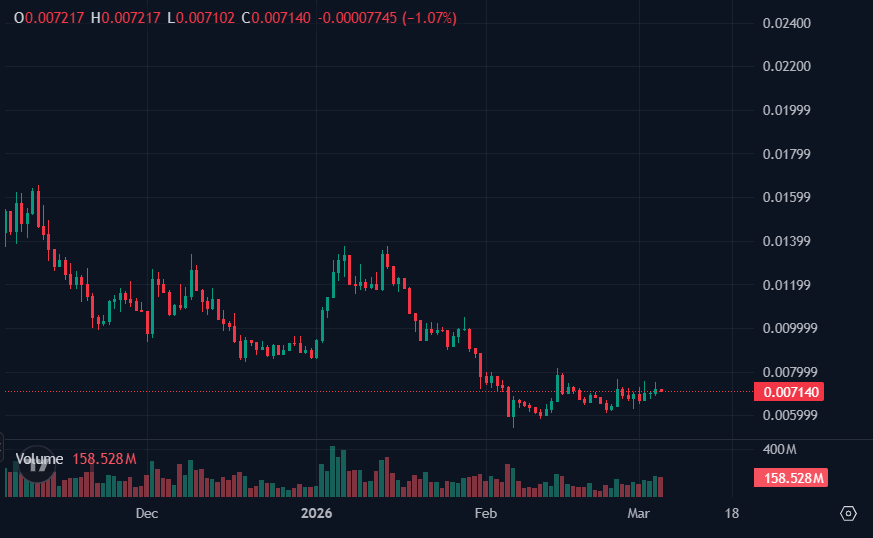
PENGU holds the top spot in this bracket at $0.00714 per token, backed by $449.22M in market cap and a fully diluted valuation of $635.22M. That FDV gap matters: 62.86 billion tokens circulate now, but 88.89 billion is the max supply ceiling, meaning meaningful dilution still sits ahead.
What stands out is volume persistence. PENGU moved $158.01M in the last 24 hours, $1.10B over seven days, and $5.08B across 30 days. For a sub-$500M cap asset, that 30-day volume-to-market-cap ratio of roughly 11:1 is exceptionally high. It signals active speculation rather than passive holding.
The price performance is more refined. PENGU is up 3.82% in 24 hours and flat on a seven-day basis (+0.02%), but it sits 24.47% below its YTD open and 87.55% below its all-time high of $0.05738. The NFT brand association drives periodic attention spikes, but the data suggests those spikes rarely sustain. At current levels, buyers are pricing in a brand narrative that has not yet translated into a durable price trend.
2. SPX6900 (SPX)
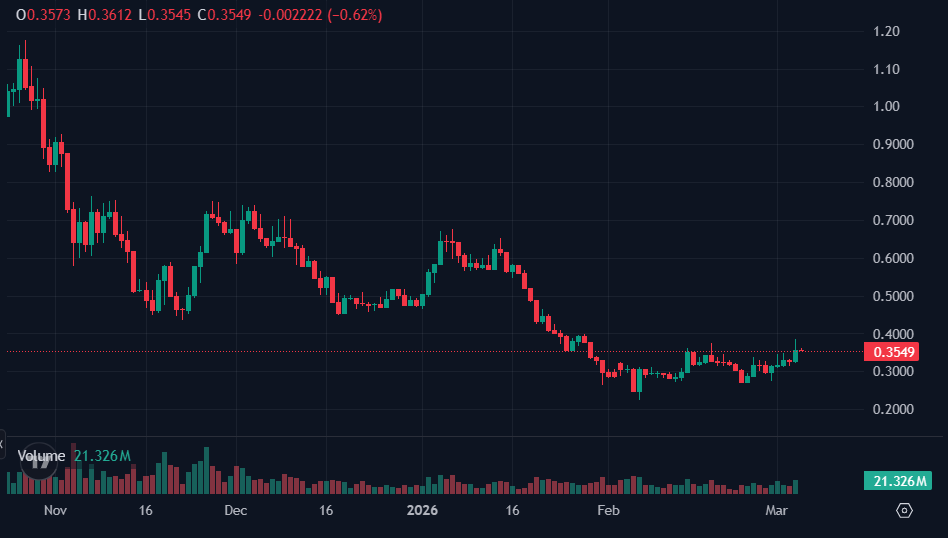
SPX trades at $0.3549 with a $332.36M market cap and a tightly aligned FDV of $356.99M. With 930.99M tokens in circulation out of a 1B max supply, the token is nearly fully diluted, which removes one common risk variable.
The performance picture is among the more intriguing in this group. SPX is up 9.72% in 24 hours and 10.99% over seven days, with a 16.45% gain over 30 days. That short-term momentum runs against a harder backdrop: SPX is down 40.61% over 60 days, 48.42% over 90 days, and 22.85% over the past year. YTD, it sits 29.15% in the red.
The all-time high of $2.28 against a current price of $0.35699 represents an 84.32% drawdown. Traders chasing the recent green candles should be aware that the token has not come close to recovering its prior peak despite periodic momentum rallies. The 24-hour volume of $21.75M and 30-day volume of $594.54M are respectable but thin relative to PENGU, which limits price impact per dollar deployed.
3. pippin (PIPPIN)
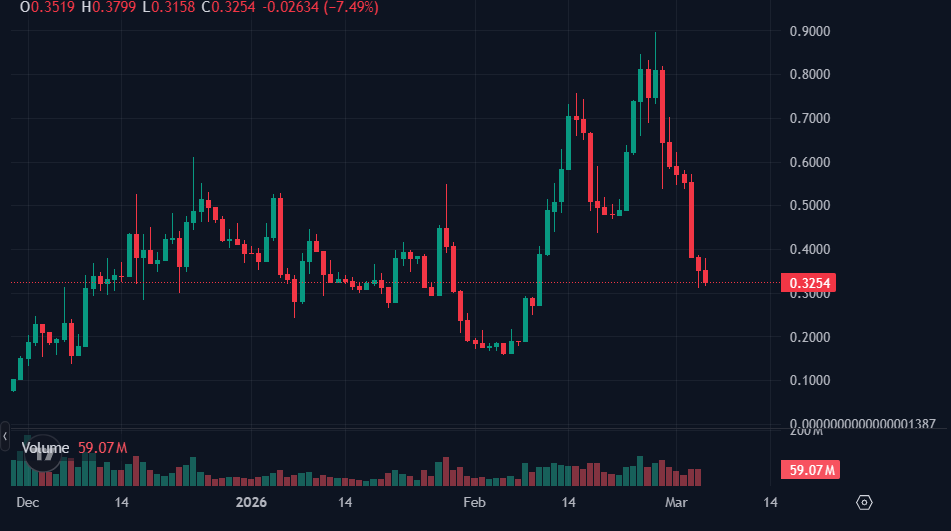
PIPPIN is the outlier in this group, and the data makes that clear immediately. The token trades at $0.3254 with a $316.81M market cap, a fully circulating supply of 1 billion tokens, and no max supply designation.
The one-year return of 1,265.59% is the headline. But context matters: PIPPIN is down 57.45% over the last seven days and down 6.73% in the last 24 hours. It reached an all-time high of $0.89644, which means current holders who bought near the peak are sitting on a 64.66% drawdown.
The 30-day gain of nearly 76.06% alongside a 57.45% seven-day loss reflects exactly what kind of asset it is: a high-amplitude token that moves in violent waves rather than trends. The 30-day volume of $1.68B on a $316M cap is notable and reflects active DEX participation. PIPPIN suits traders who time entries and exits around specific catalysts, not those seeking holding exposure.
4. Ducky (DUCKY)
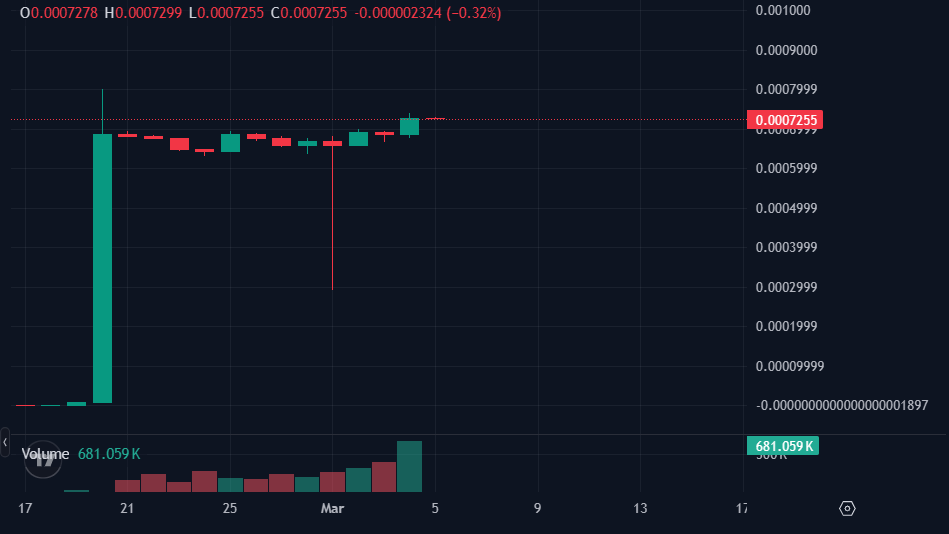
DUCKY presents one of the most statistically extreme cases in this dataset. The token trades at $0.0007255, carrying a $301.29M market cap across a 414.4B circulating supply.
The percentage performance numbers are not typographical errors. DUCKY is up 622,412.99% over 30 days, 442,279.9% over 60 days, and 330,951.59% over one year. The YTD gain stands at 434,835.54%. These figures reflect a token that started from a near-zero base, $0.000000086034 at its all-time low, and experienced explosive demand-driven appreciation.
The critical offset: 24-hour volume is only $681,127.95. The 30-day volume totals $21.83M. For a $301M market cap asset, that liquidity is shallow. DUCKY is 9.17% below its all-time high of $0.00080047, meaning it is among the closest to its peak in this group, but the thin volume means price is fragile in both directions. A relatively small sell order moves the market meaningfully.
5. Peanut (PEANUT)
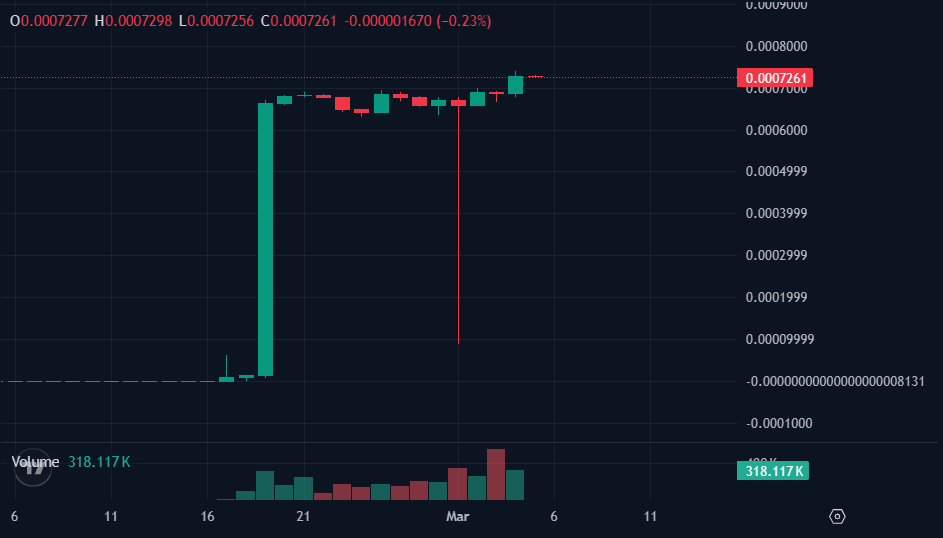
PEANUT sits at the bottom of this bracket at $0.0007261 per token and $297.72M in market cap. Its profile mirrors DUCKY closely enough to warrant a direct comparison. The asset is up 614,515.8% over 30 days, 445,205.26% over 60 days, and 251,141.74% over one year, with a YTD gain of 448,766.16%. Its all-time low was $0.000000094572 and its all-time high is $0.00073991, meaning it currently trades at a 1.73% discount to its peak.
That near-ATH positioning is both notable and cautionary. PEANUT has less room to run before hitting prior resistance, and the 24-hour volume of $313,360 is the lowest in this group. The 30-day volume of $10.19M across a $297M market cap signals that price discovery here is driven by narrative and thin liquidity rather than broad market participation.
What the Data Says, Collectively
These five tokens share a structural characteristic and all of them rely on demand cycles rather than supply scarcity to drive price. None carry infinite supply flags, but absolute supply figures are enormous across the board. Prices move up because buyers arrive, and they move down sharply when buyers step back.
Volume tells the clearest viewpoint about where real activity sits. PENGU and PIPPIN dominate on actual trading volume, while DUCKY and PEANUT’s extraordinary percentage gains occurred on comparatively thin throughput. The former group has more observable market depth; the latter group reflects how dramatically price can move when there are very few sellers and then very few buyers.
The ATH drawdowns ranging from 1.73% on PEANUT to 87.55% on PENGU show that prior peaks are not benchmarks for recovery. They are reference points for understanding how far speculative cycles have already run and how far they can retrace.


