





The memecoin conversation in 2026 rarely moves past Dogecoin and Shiba Inu, but fixating on the two largest tokens by market cap means missing the more analytically noteworthy tier sitting directly beneath them. Five tokens, ranging from $282 million to $1.43 billion in market cap, have accumulated enough trading history, liquidity depth, and on-chain presence to warrant a data-level examination rather than a passing mention. Each one carries a different risk profile, a different demand driver, and a different story embedded in its volume and price action, and understanding those distinctions is what separates a positioned view from a generic memecoin allocation.
PEPE
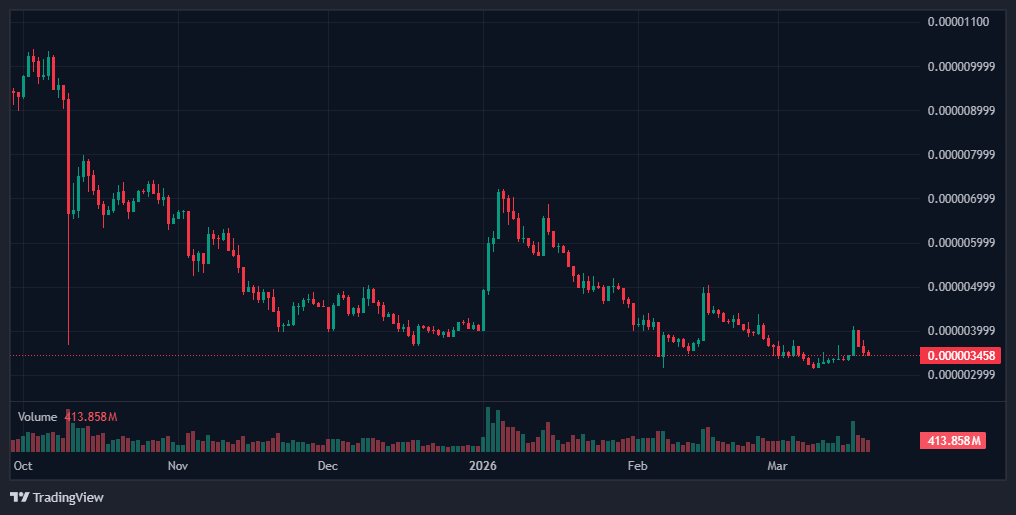
PEPE is the dominant memecoin in this group by a significant margin. Priced at $0.000053458 with a $1.43 billion market cap and $413.57 million in 24-hour volume, it sits closer to mid-cap altcoin territory than the typical speculative memecoin. That volume-to-market cap ratio of roughly 28.9% reflects sustained trader interest rather than a one-day spike.
The seven-day loss of 5.19% places it in line with the broader market softness visible across this snapshot. PEPE launched in April 2023 with no formal utility, no team allocation, and no presale, which gave it an unusual degree of community credibility in a space full of opaque token distributions. Its circulating supply stands at 413.77 trillion tokens, fully in the market with no unlock risk hanging over it.
At this market cap and volume level, PEPE is the most liquid memecoin on this list. It trades on every major centralized exchange and maintains deep order books. For traders looking for memecoin exposure without micro-cap volatility risk, PEPE is the clearest entry point in this group.
OFFICIAL TRUMP
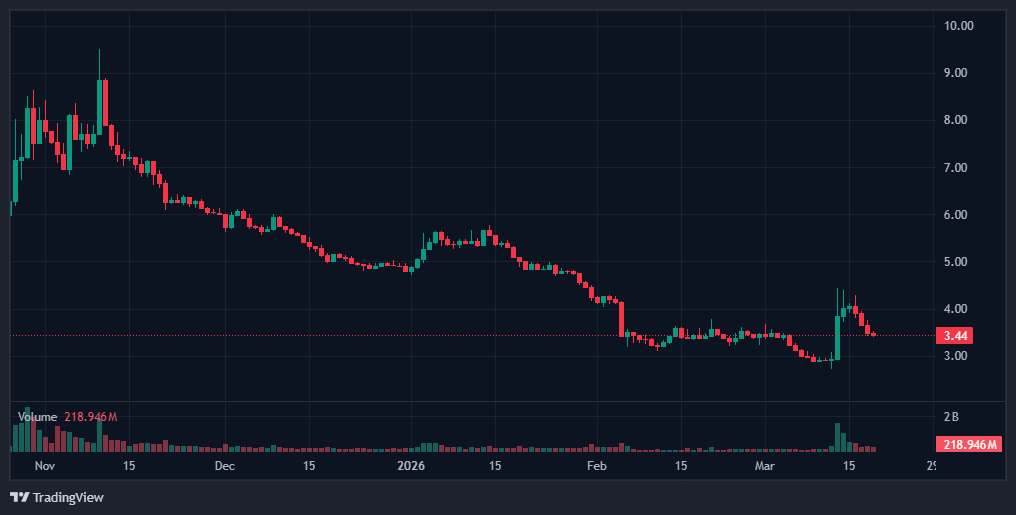
OFFICIAL TRUMP is priced at $3.44 with an $800.18 million market cap and $218.99 million in 24-hour volume, putting its volume-to-cap ratio at approximately 27.4%. The seven-day loss of 20.68% is the steepest decline in this group by a wide margin, setting it apart from every other token here in terms of recent downside exposure.
The structural risk is unique. TRUMP’s price is directly correlated with the political relevance and media coverage of its namesake. That is not a fundamental driver in any traditional sense. When TRUMP-adjacent news cycles are active, the token tends to see volume spikes. When they go quiet, it fades. The $218.99 million in 24-hour volume confirms that trading interest is still present, but the 20.68% weekly loss signals that recent news flow has not been favorable for the token’s price.
The circulating supply sits at 232.49 million TRUMP against a total supply of 999.99 million, meaning a significant portion of supply has not yet entered the market. Scheduled unlock periods create structural sell pressure at various points on the timeline, a dynamic that is not reflected in the market cap figure and deserves attention from anyone sizing a position here.
BONK
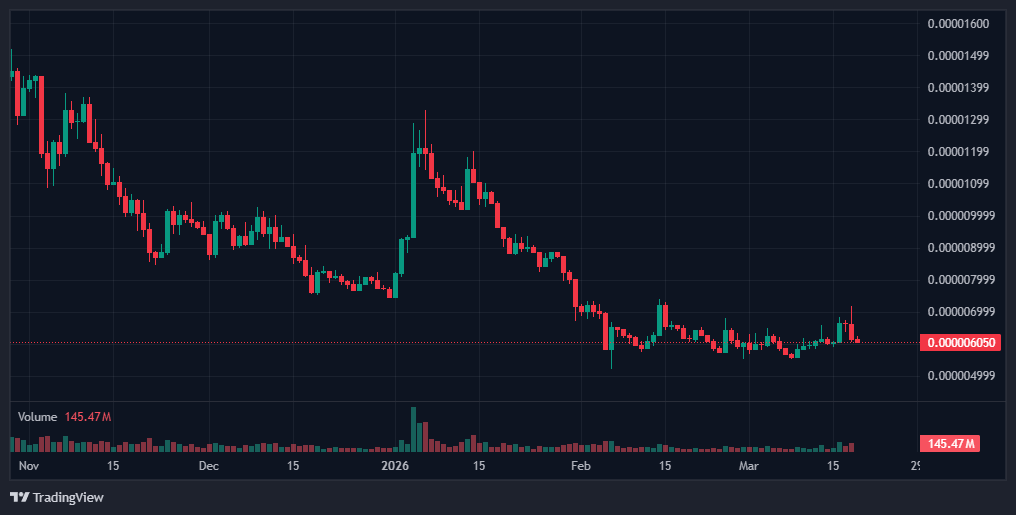
BONK is priced at $0.000056050 with a $532.39 million market cap and $88.98 million in 24-hour volume. The volume-to-cap ratio of 16.7% is moderate, and the seven-day loss of 3.00% is the smallest drawdown in this group, which stands out in a snapshot where every other token is down more significantly.
What separates BONK from most tokens in the memecoin category is that it has an actual use case embedded within an active ecosystem. It operates on Solana and is integrated across liquidity pools, DEX pairs, and various application-layer incentives within the network. That creates a baseline of transactional demand that does not rely purely on narrative or speculation to sustain volume.
The circulating supply stands at 87.99 trillion BONK. The practical risk is straightforward: BONK’s price ceiling is largely determined by Solana’s ecosystem activity. A contracting Solana user base compresses BONK’s demand directly. But in a cycle where Solana has been one of the stronger-performing Layer 1 networks, that correlation has worked in BONK’s favor more often than against it.
PENGU
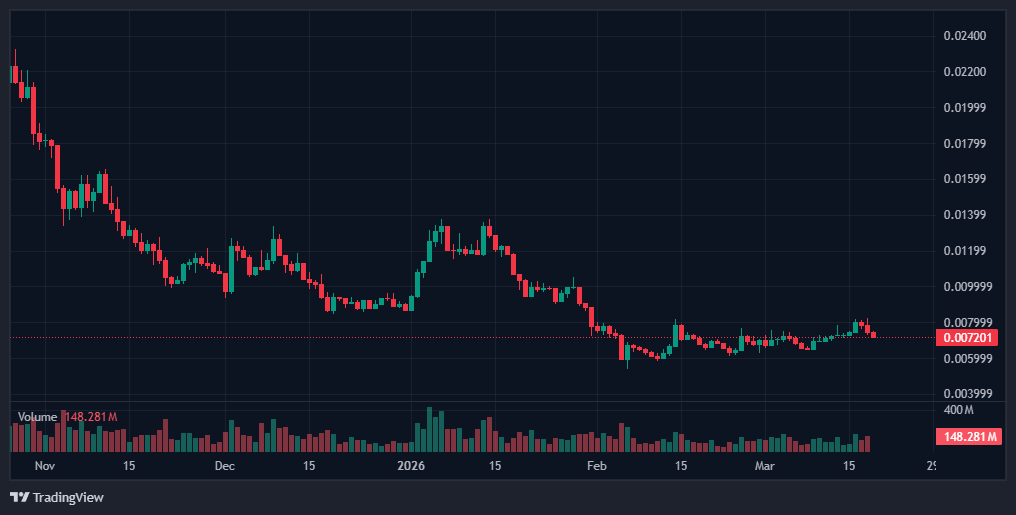
PENGU is the token attached to the Pudgy Penguins NFT brand, currently priced at $0.007201 with a $452.60 million market cap and $120.89 million in 24-hour volume. The volume-to-cap ratio of approximately 26.7% is one of the higher readings in this group. The seven-day loss of 2.39% is the second most contained decline across all five tokens.
Unlike every other token in this group, PENGU has a physical world anchor. The Pudgy Penguins brand moved beyond digital collectibles into a retail toy line distributed through major global chains, which gives it a demand narrative that does not depend entirely on on-chain activity or crypto market sentiment. That does not make it immune to drawdowns, but it means its price has more variables feeding into it than a token that exists purely as a speculative instrument.
The circulating supply stands at 62.86 billion PENGU against a total supply of 88.88 billion. Roughly 29% of the total supply has not yet entered the market, which is a relevant overhang for anyone holding with a medium-term view.
The token’s path to recovery depends on whether the Pudgy Penguins brand maintains its retail and cultural relevance and whether NFT market activity recovers in the current cycle. Neither is guaranteed, but the volume data suggests the market still supports this one.
FLOKI
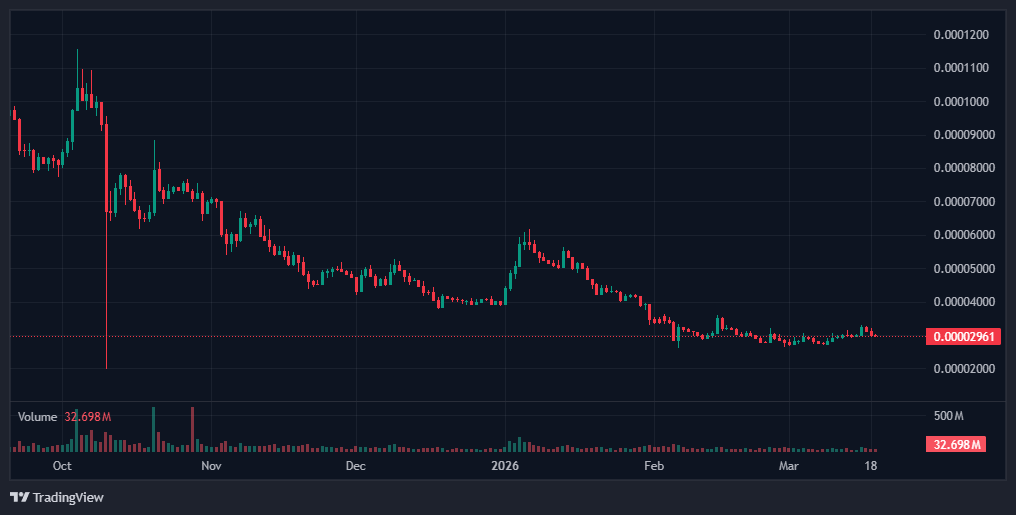
FLOKI rounds out this group as the fifth largest memecoin outside of DOGE and SHIB. Priced at $0.00002961 with a $282.53 million market cap and $32.73 million in 24-hour volume, its volume-to-cap ratio sits at approximately 11.6%, the lowest in this group.
The seven-day gain of 1.45% is the only positive weekly return among the five tokens here, which makes it notable in a snapshot where everything else is in the red. FLOKI has attempted to build beyond its memecoin origins through the Valhalla gaming metaverse project and a tokenomics structure that includes burn mechanisms and staking utility. Whether those development efforts translate into sustained demand remains the key question.
The circulating supply stands at 9.53 trillion FLOKI. A token posting a positive weekly return on below-average relative volume can either signal quiet accumulation or simply thin trading conditions. The next volume reading will clarify which it is.
What the Volume Distribution Uncovers
Across these five tokens, the combined market cap sits at approximately $3.5 billion against roughly $875 million in total 24-hour volume. PEPE dominates that volume distribution, generating $413.57 million of it while holding 40.8% of the combined market cap. No other token in this group comes close to that ratio, which confirms PEPE as the most actively traded asset relative to its size.
TRUMP is the more complicated read. It produced the second-highest volume at $218.99 million, but that figure sits alongside a 20.68% weekly loss. High volume on a sharp drawdown does not signal accumulation. It signals distribution. A significant portion of that TRUMP volume is likely exits rather than new positioning, which makes the headline number misleading without that context.
FLOKI is the only token here with a positive seven-day return. PENGU posted the second smallest weekly loss at 2.39%. The contrast between those two and TRUMP’s sharp drawdown illustrates how differently capital is behaving across tokens that sit within the same broad narrative category.


