




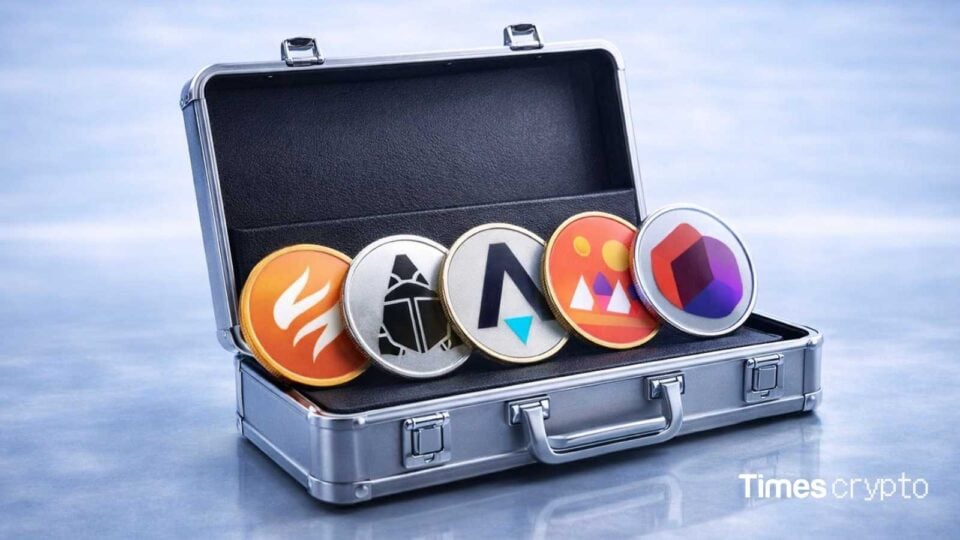
The metaverse narrative drove crypto conversations in 2021 and 2022, attracting billions of dollars into virtual land, play-to-earn ecosystems, and immersive commerce platforms ahead of the broader market correction wiped out most of those gains. In 2025, the tokens that defined that cycle continue to trade, build, and in some cases attract meaningful daily volume, but the landscape looks nothing like it did at peak euphoria.
The Current Market Snapshot
| Token | Price | Market Cap | 24h Volume | 7d Change | 30d Change |
|---|---|---|---|---|---|
| MANA | $0.09 | $175.22M | $20.19M | -8.84% | -4.92% |
| PYR | $0.28635 | $13.66M | $2.82M | -9.88% | -6.85% |
| TLM | $0.00171 | $11.18M | $3.67M | -5.43% | +5.27% |
| ATLAS | $0.00018191 | $4.45M | $55,846 | -6.42% | -6.97% |
| CUBE | $0.09537 | $1.19M | $2,230 | -16.36% | +8.84% |
1. Decentraland (MANA)
Decentraland is one of the earliest Ethereum-based virtual land platforms in the metaverse sector, where individuals, brands, and developers build experiences, host events, and conduct NFT commerce using MANA as the primary currency for land transactions and in-world economic activity.
At a $175.22M market cap with $20.19M in 24-hour trading volume, MANA turns over approximately 11.5% of its market capitalization daily, reflecting a deep and functional liquidity environment that the other four tokens in this group cannot match at their current sizes. The $20.19M in single-day volume that MANA generates is larger than the combined market caps of ATLAS and CUBE, which puts the liquidity comparison between MANA and the smaller entries in this group into concrete perspective.
The 24-hour performance of positive 0.64% is the strongest single-day reading in this group, though the 7-day decline of 8.84% and 30-day decline of 4.92% confirm that MANA is not insulated from the sector-wide pressure visible across all five assets.
2. Vulcan Forged (PYR)
Vulcan Forged is a gaming and metaverse ecosystem that combines VulcanVerse, an NFT marketplace, and a game incubator under one economic umbrella, with PYR as the native token powering transactions, staking, and marketplace activity across Ethereum and Polygon deployments.
At a $13.66M market cap with $2.82M in 24-hour trading volume, PYR turns over approximately 20% of its entire market capitalization in a single trading day, which is the strongest liquidity-to-market-cap ratio among the four smaller assets in this group and represents a meaningful practical advantage for anyone managing a position in the asset. The 47.69 million circulating supply keeps the per-token price at $0.28635, giving PYR the highest nominal per-token price in this group and a supply structure that is considerably more controlled than the billion-plus supplies seen in TLM, ATLAS, and MANA.
The 7-day decline of 9.88% and 30-day decline of 6.85% reflect broader sector pressure rather than project-specific deterioration, and there is no single-session volatility event in the data that would suggest a catalyst-driven move in either direction during the period covered. New game launches within the Vulcan ecosystem and sustained NFT marketplace volume growth are the primary catalysts to monitor for PYR, because the game incubator model only generates durable token demand when the games being built are attracting and retaining players who participate in the in-game economy rather than simply holding the token for speculative exposure to the metaverse narrative.
3. Alien Worlds (TLM)
Alien Worlds is a play-to-earn NFT metaverse running across WAX, Binance Smart Chain, and Ethereum, where TLM serves as both the governance and reward token and Planet DAOs give holders a direct role in shaping each planet’s economic parameters.
With $3.67M in daily volume against an $11.18M market cap, TLM is turning over roughly 33% of its market capitalization every 24 hours, which represents the highest daily turnover ratio in this entire analysis when measured against market cap and confirms that TLM has retained a genuinely active trading base despite the broader sector’s sustained decline from peak valuations.
The 30-day performance of positive 5.27% is the strongest in this group over that timeframe and the only asset besides CUBE to post a positive 30-day reading, suggesting some relative momentum that is not yet reflected in the weekly data, where TLM posted a 5.43% decline. The 6.52 billion circulating supply keeps the nominal token price deep in sub-cent territory at $0.00171, which historically creates psychological resistance to new retail inflows.
4. Star Atlas (ATLAS)
Star Atlas is a sci-fi metaverse game built on Unreal Engine with two tokens, ATLAS for in-game spending and POLIS for governance, but years of delayed delivery have kept the market skeptical and the $4.45M market cap reflects exactly that.
The current data places ATLAS at a $4.45M market cap with $55,846 in 24-hour volume, producing a daily turnover ratio of approximately 1.25% that is functional for small position sizes but leaves limited room for larger allocations without generating meaningful price impact on entry or exit. The 24.44 billion circulating supply is the single most consequential structural variable in the ATLAS, because at $0.00018191 per token, the asset requires appreciation across multiple orders of magnitude before it reaches price levels that historically attract the broader retail participation needed to sustain momentum.
Both the 7-day decline of 6.42% and the 30-day decline of 6.97% reflect steady and consistent downward pressure without any acute single-session event that would indicate a specific negative catalyst, pointing instead to a slow and continuous repricing of development timeline uncertainty by the market.
5. Somnium Space Cubes (CUBE)
Somnium Space takes a fundamentally different approach to the metaverse concept than the gaming-focused peers ranked above it, building a persistent VR world on Ethereum where CUBE tokens power land ownership, in-world commerce, and access to immersive virtual events. The focus on genuine VR immersion rather than tokenized gaming mechanics or play-to-earn reward structures provides Somnium a differentiated positioning within the sector that is not replicated by any other entry in this group.
At a $1.19M market cap with $2,230 in 24-hour volume, CUBE carries a 0.19% daily turnover ratio that is the lowest in this group and creates genuine practical constraints on position management at any size that would be meaningful relative to the other assets analyzed here.
The 30-day positive performance of 8.84% is the strongest reading in this group over that timeframe and stands in direct contrast to the 7-day decline of 16.36%, indicating that CUBE experienced a period of concentrated positive momentum earlier in the month that has since partially reversed without a clear catalyst. The 12.5 million circulating supply is the most controlled in this entire group by a substantial margin, which is structurally supportive of price appreciation if demand increases.


