




Outside the top cryptos by market cap, a handful of altcoins are doing something more interesting than chasing price action. They are building around specific structural themes: modular blockchain infrastructure, real-world asset tokenization, blockchain gaming, decentralized oracles, and finance-focused Layer 1s. The five coins below sit at the intersection of meaningful narratives and brutal drawdowns, which is exactly where research-grade opportunities tend to concentrate before a cycle turns. All of them are high-volatility, narrative-driven assets. But the data behind each one tells a story worth exploring.
Celestia (TIA)
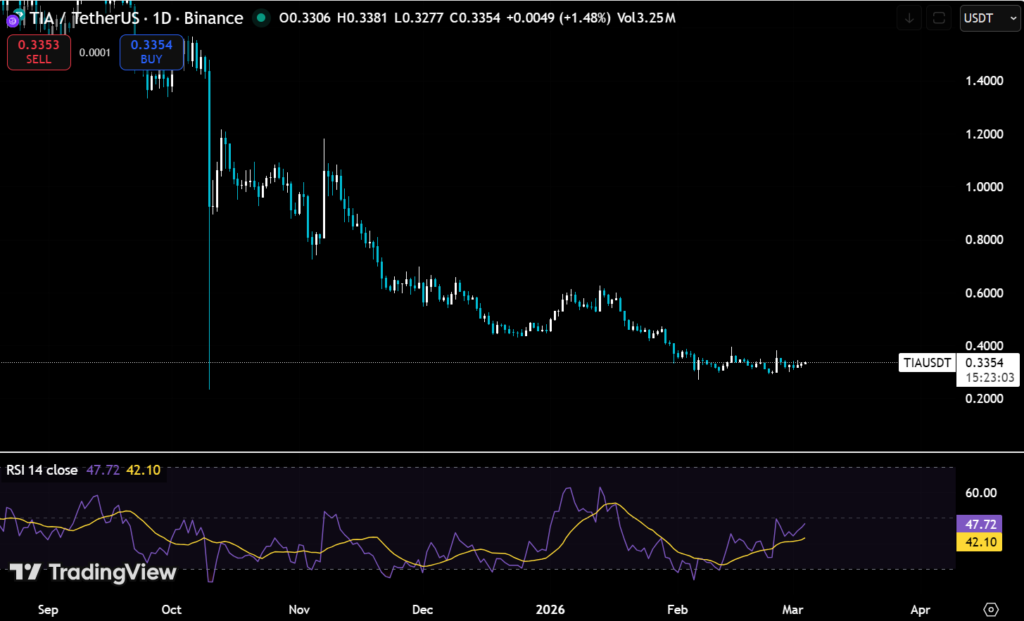
Celestia carries a market cap of $296.43 million, posted a seven-day gain of 7.84%, and sits 98.40% below its all-time high of $20.91. That last figure is the one that sets the context for everything else. It is a high-beta infrastructure play at a fraction of what the market once valued it.
The core thesis remains technically coherent. Celestia pioneered the modular blockchain design by separating data availability and consensus from execution entirely. Rollups and app-specific chains can plug into Celestia’s data layer without needing to run a full execution environment of their own. That sounds like an abstraction, but it has real consequences for how developers build and how costs scale. If Ethereum Layer 2 activity continues to grow and teams keep looking for cheaper, more flexible data availability options, Celestia stays relevant in that stack.
The 24-hour volume of $35.56 million against a $296 million market cap reflects a high turnover ratio for an asset this size, pointing to active short-term speculation rather than long-term accumulation. The seven-day performance of 7.84% is the strongest in this group, which is worth noting but not overstating.
The real test for TIA is competitive. EigenDA, Avail, and Ethereum’s native blob transactions introduced via EIP-4844 are all competing for the same data availability demand. Whether Celestia retains a meaningful share of that market or gets squeezed out as more integrated alternatives mature is not a price question but an adoption question. The metric that matters most is the number of live rollups routing data through Celestia, not the weekly candle.
Ondo (ONDO)
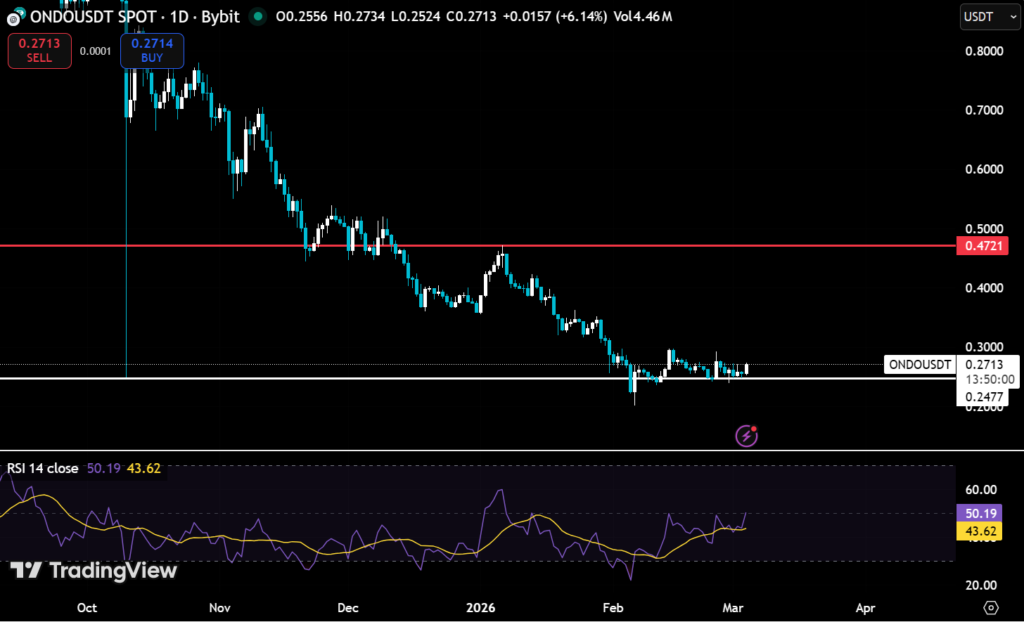
Ondo is the largest market cap name here at $1.26 billion, up 2.19% on the week and 87.93% below its all-time high of $2.14. It is also the most institutionally adjacent asset in this group, and that distinction changes how you analyze it.
The product focus is yield-bearing tokenized assets, primarily US Treasuries, managed and governed through the Ondo DAO. USDY and its integration with Flux Finance are the two main vectors through which the token’s value connects to actual protocol activity. This is not a governance token over an empty treasury. There are real assets and real yield flows underpinning the structure, which separates ONDO from most of its narrative peers.
The 24-hour volume of $46.28 million is the second highest in this group. The subdued seven-day return of 2.19% reflects that ONDO behaves more like a mid-cap with measurable fundamentals than a speculative micro-cap, which is a different risk and reward profile than the others on this list.
Regulation is the central variable. Tokenized securities operate in a legal gray zone in most jurisdictions, and ONDO’s exposure is more direct than most crypto assets. An adverse regulatory ruling hits ONDO harder than it hits a Layer 1. The flip side is that regulatory clarity, when it unfolds, will likely reprice ONDO faster than it reprices anything else here.
Immutable (IMX)
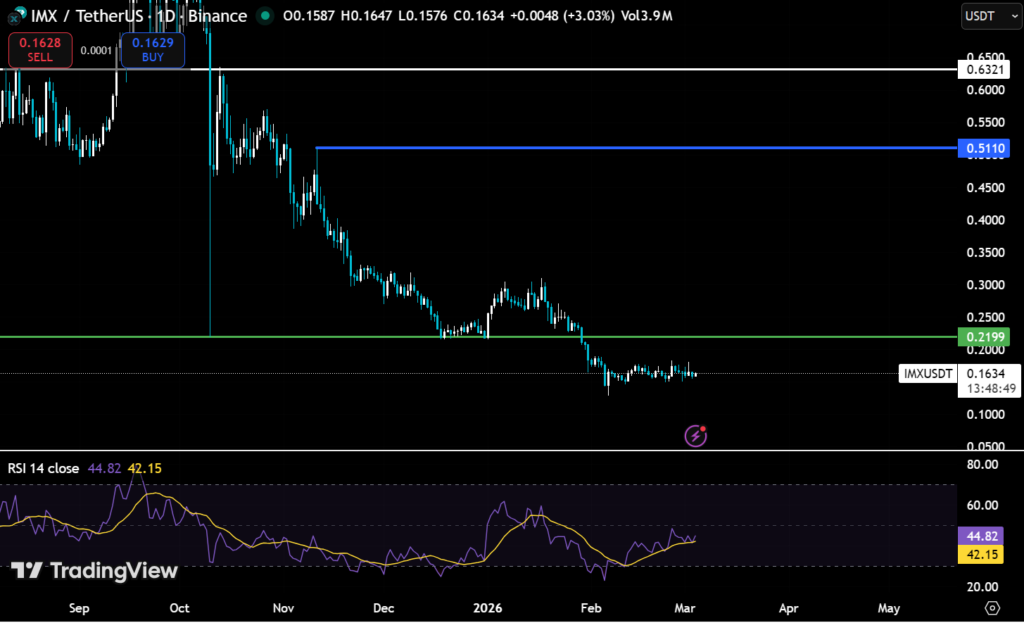
Immutable has a market cap of $317.66 million, is down 2.73% on the week, and trades 98.32% below its all-time high of $9.50. It is the only name in this group posting a negative seven-day return while peers gained ground, which is a mild underperformance signal worth tracking.
The investment logic is a sector infrastructure bet, not a bet on any single game succeeding. Immutable provides the underlying rails for blockchain-based gaming and NFTs: zk-rollup scaling, a shared order book, developer tooling, and marketplace infrastructure. The value proposition is that Web2 gaming studios wanting to explore on-chain economies come to Immutable rather than building their own chain or deploying on a general-purpose L2.
The 24-hour volume of $29.39 million is the second lowest in this group. That low volume is consistent with the broader cooling in NFT activity and gaming-related speculation. The honest read on IMX right now is that it is a call option on a gaming cycle that has not materialized at scale yet. The infrastructure exists. The developer pipeline is real. But until player counts and NFT transaction volumes show measurable recovery, the IMX price will continue to track sentiment rather than fundamentals.
Pyth Network (PYTH)
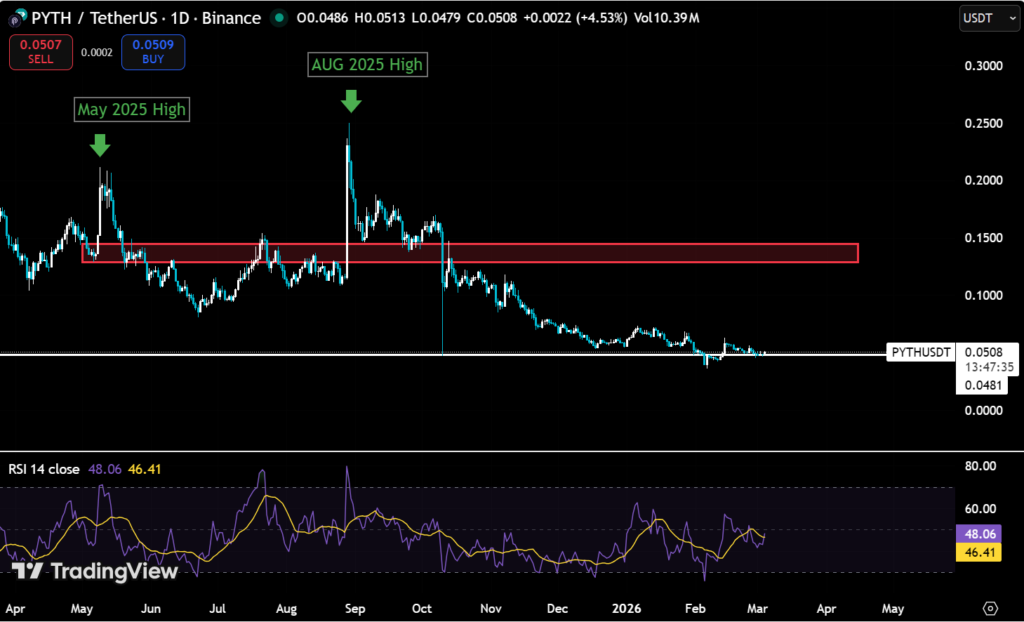
Pyth Network has a market cap of $281.35 million, is down 5.99% over seven days, and sits 95.75% below its all-time high of $1.15. It is the weakest performer in the group this week and records the lowest 24-hour volume at $14.67 million, which puts it in a different liquidity tier from the rest.
The technical differentiation lies in the first-party data model. Pyth does not aggregate from secondary sources. It pulls real-time price feeds directly from exchanges and market makers across crypto, equities, ETFs, FX, and commodities. For protocols that need sub-second price accuracy, the latency advantage over traditional oracle designs is meaningful.
The Chainlink comparison is unavoidable. Chainlink holds the dominant market share in oracle infrastructure with deep integrations across the largest DeFi protocols. Pyth competes on data freshness and multi-chain breadth rather than on decentralization guarantees. For PYTH to justify a meaningful re-rating, the numbers that matter are total value secured, protocol fee flows, and net new dApp integrations over time. At $14.67 million in daily volume, the market is not pricing in conviction on any of those metrics yet.
Injective (INJ)
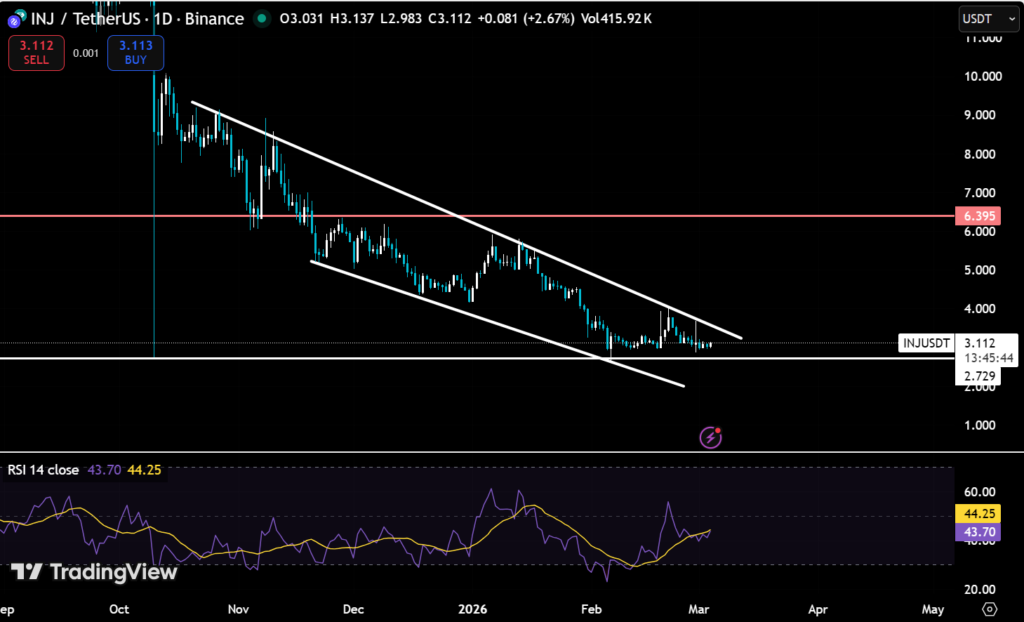
Injective has a market cap of $304.32 million, is down 3.83% on the week, and trades 94.23% below its all-time high of $52.75. Among the five, it is the most architecturally specific. Injective is not a general-purpose chain. It is built explicitly for financial applications: on-chain perpetuals, prediction markets, RWA trading infrastructure, and increasingly AI-driven trading strategies running natively on-chain.
The 24-hour volume of $58.36 million is the highest in this group by a significant margin. High volume against a down week is an ambiguous signal. It can indicate liquidation pressure and distribution by larger holders, or it can reflect genuine two-sided activity from a live derivatives market with real volume. The interpretation depends on open interest data and order book depth, neither of which is available in this snapshot. But the volume figure alone confirms that Injective’s ecosystem is generating real trading activity, not just paper metrics.
The tokenomics are structured around a buyback and burn mechanism funded by dApp fees, which creates a direct mechanical link between protocol revenue and INJ supply. The chain’s interoperability across Ethereum, Cosmos IBC, and Solana gives it access to capital pools that a purely isolated chain could not tap.
The Common Thread
All five assets sit between 87% and 98% below their all-time highs. These are not assets recovering from a rough quarter. They are assets working through cycle-scale corrections that represent the current state of how far peak-cycle pricing overshot underlying utility. What separates them from the broader altcoin graveyard is product continuity. Celestia is live and processing data. Ondo’s yield products are functional. Immutable is actively onboarding studios. Pyth is integrated across live DeFi protocols. Injective is running a derivatives ecosystem with real volume.


