



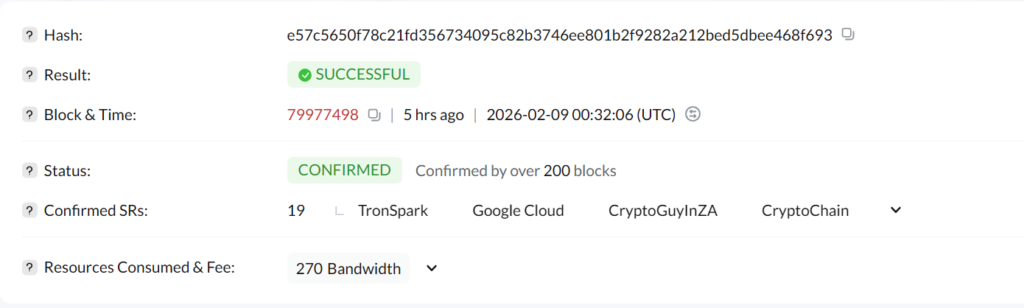
Tron Inc.’s most recent purchase of 179,408 TRX at an average price of $0.28 increased its total holdings to more than 680.7 million TRX and is more than just a normal treasury addition. The move shows a planned balance sheet strategy in which corporate capital is more and more linked to assets in the ecosystem. Instead of treating TRX as a tradable asset, the company is focusing on long-term network participation and value capture.
The method builds up a connection between shareholder results and the operational efficiency of the Tron network. The treasury operates as a financial instrument that multiplies ecosystem development when usage and transaction activity and liquidity increase. The strategy is identical to what a lot of crypto-aligned businesses are also working on, like they’re moving toward protocol-native treasury models instead of passive fiat reserves. The shifting trend is followed because they are meant to take advantage of structural upside.
The size of the most recent purchase isn’t as important as the pattern of accumulation. Adding more to a position over time shows conviction and risk-managed exposure, not speculative positioning. Over time, continued treasury expansion could lower the amount of money in circulation and boost long-term investor confidence, especially if the assets stay off the market.
Why Treasury Growth is Important for the Market Structure
Corporate accumulation fulfills two purposes in crypto markets. It has a signaling effect that boosts the confidence of institutional participants, developers, and liquidity providers on one side. On the other hand, it induces structural demand that can assist in achieving prices stability in the times of market stress.
Tron Inc. is solidifying the idea that TRX is a significant reserve asset in its ecosystem by expanding its TRX reserves. This framing is important considering that it changes the overall narrative from just short-term trading cycles to the value of infrastructure. Networks that have steady capital backing tend to be more adaptive in times of market stress.
Technical Analysis: TRX Is Getting Close to a Decision Point
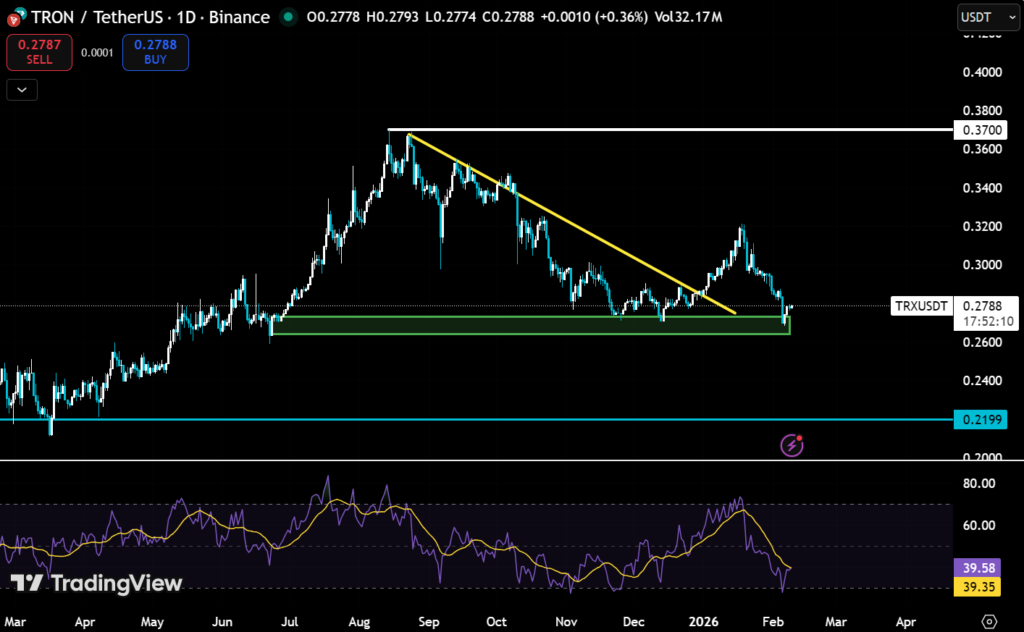
TRX is changing hands between $0.27 and $0.28, holding above the daily support zone ($0.273-$0.264). The daily structure of the asset shows that there was a long period of correction after a strong rally that peaked around the $0.36–$0.37 level. Since then, price action has followed a downward trendline, which means that there is a larger consolidation going on in a macro uptrend.
The most important area right now is between about $0.265 and $0.275, where prices keep reacting in ways that show demand absorption. This area has served as a base several times, showing that buyers are still willing to defend the level even though there is a lot of selling pressure. If this area stays above this level for a long time, it is more likely that the structure will continue rather than break down. Indicators of momentum show a neutral-to-recovering position. Relative strength readings have cooled off from being too high and are now close to the middle of the range. This means that the market is not too hot or too cold. When combined with structural support, this level often comes before expansion phases.
The first real resistance zone for the asset lies between the zone of $0.31 and $0.33. In the case of price breaking above this area, the lower-high pattern will no longer be valid, and the market structure will make a shift toward bullish continuation. The next macro resistance level is around $0.36–$0.37, where the last rally saw a pause.
If traders decisively lose the green support zone on the chart, this gap could lead to the $0.24 area, followed by a deeper structural level around $0.22. If tested, these levels could attract long-term buyers because they are in line with previous accumulation areas.
Market Structure and Liquidity
The current market structure is like a normal post-rally compression phase, where liquidity moves around and the price starts building a base. The downward trendline reflects that the market participants on the sell side have been slowly stepping in at lower highs, while the horizontal support shows that the bulls have been consistently absorbing. A volatility expansion move usually fixes this tension.
The accumulation of corporate treasury can further strengthen this setup, considering it enables investors to develop greater market confidence. The market has established a pattern where the market participants continue to accumulate assets, which results in sustained demand despite minimal price volatility. In the maturing crypto markets, perception can have as much of an effect on liquidity flows as the base fundamentals.
Strategic Effects on Shareholders and the Environment
For shareholders, the treasury accumulation represents a direct connection between how well a company does and how the current user base is utilizing the network. If Tron continues to lead in the segment of low-cost transfers and high-volume stablecoin settlements, TRX maintained by the treasury could experience a boost in value as more users start tapping into the ecosystem. This trend transforms the asset characteristic from just a speculative holding to a strategic reserve, which serves as a crucial role for operations.
Corporate participation also promotes the long-term growth of the ecosystem. Developers, liquidity providers, and big investors usually find such treasury-backed ecosystems a strong indication of growth since the money invested signifies the market’s confidence in future improvements.
The strategy also makes people expect more. People in the market will want to see measurable growth in network activity, partnerships, and transaction volumes to justify their continued accumulation. Without continued growth in usage, treasury concentration could turn into a weakness instead of a strength.


