





Bitcoin still controls the majority of crypto value. But over the past seven days, it has been the slowest asset in the room, and the total crypto market cap sits at $2.53 trillion. With Bitcoin dominance at 59.12%, the math leaves roughly $1.05 trillion, about 41.47% of the total market, sitting in non-BTC assets. That figure is not new. What is notable is the speed at which it is growing relative to Bitcoin itself and the alignment across multiple large-cap altcoins that is driving it.
The Dominance Math and What It Actually Means
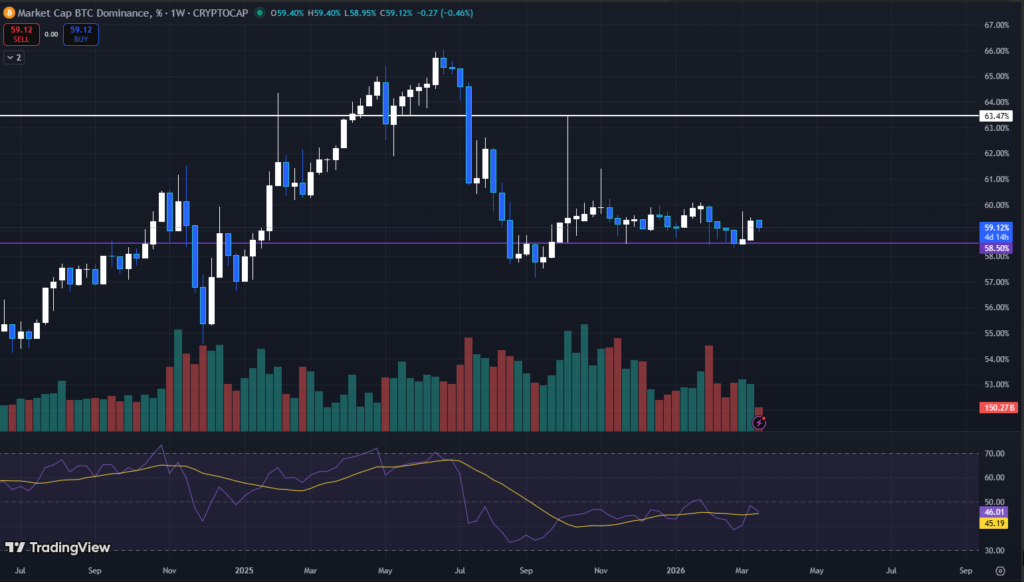
With a market cap of $1.48 trillion and a dominance reading of 59.12%, Bitcoin distributes approximately $1.05 trillion among its competitors. That split has been shifting, not because new capital is flooding in at scale, but because existing liquidity is rotating out of Bitcoin and into higher-beta alternatives.
This distinction matters more than it might appear. A dominance decline driven by fresh inflows looks different from one driven by internal rotation. The current 24-hour volume reading of $88.45 billion, down 35.8% from the prior measurement, points toward the higher end. The total pie is not dramatically larger. Money is simply moving around within it, and right now it is moving away from Bitcoin.
Historically, periods where Bitcoin dominance begins to compress while total market cap holds or grows have preceded broader altcoin rallies. The current reading does not confirm that the pattern is repeating, but the structural setup is consistent with early-stage rotation rather than a temporary blip. The key variable is whether spot demand follows.
ETH, SOL, and ADA: The Performance Gap Is Significant
The seven-day return comparison is where the rotation becomes quantifiable.
Bitcoin posted a 7-day gain of 6.84%, trading at $74,190.98 with $35.66 billion in 24-hour volume. That is a solid weekly move for the largest asset in the market. But it is being outpaced by the next tier down across the board.
Ethereum gained 15.35% over the same seven-day window, trading at $2,330.73 with an $18.87 billion 24-hour volume and a $281.3 billion market cap. That is more than double Bitcoin’s weekly return from an asset that still carries enough liquidity to absorb meaningful size. ETH’s outperformance at this scale is significant because it reflects institutional-grade capital moving, not just retail speculation on a mid-cap token.
Solana added 10.89% over seven days, trading at $94.25 with $3.30 billion in 24-hour volume and a $53.86 billion market cap. Cardano, further down the cap scale at $10.51 billion, posted 12.93% over seven days at $0.29, with $500.6 million in 24-hour volume.
The pattern across all three is difficult to dismiss. ETH, SOL, and ADA operate on different tech stacks, serve different user bases, and carry different narratives. The fact that all three are outpacing Bitcoin on the same weekly timeframe removes the single-asset explanation. Capital is moving across the altcoin tier simultaneously, which is the clearest definition of a rotation.
Volume Decline and What It Complicates
The 35.8% drop in total 24-hour volume to $88.45 billion is the clearest risk flag in this snapshot and the one most likely to be overlooked when weekly return charts look this clean.
Strong price performance on declining volume is a pattern that historically precedes either a consolidation phase or a sharp reversal, particularly in assets with thinner order books. The gains are real, but the participation level behind them has dropped materially in a single measurement window. That gap between price and volume needs to close, either through volume recovering to confirm the move or through price pulling back to find a more sustainable level.
Derivatives open interest remains elevated at approximately $420 billion in perpetuals. That level of open interest alongside declining spot volume creates a specific condition: price moves become easier to trigger but harder to sustain. A relatively small spot order can shift prices significantly when spot liquidity is thin, which cuts both ways. Longs can get squeezed just as fast as shorts in this setup.
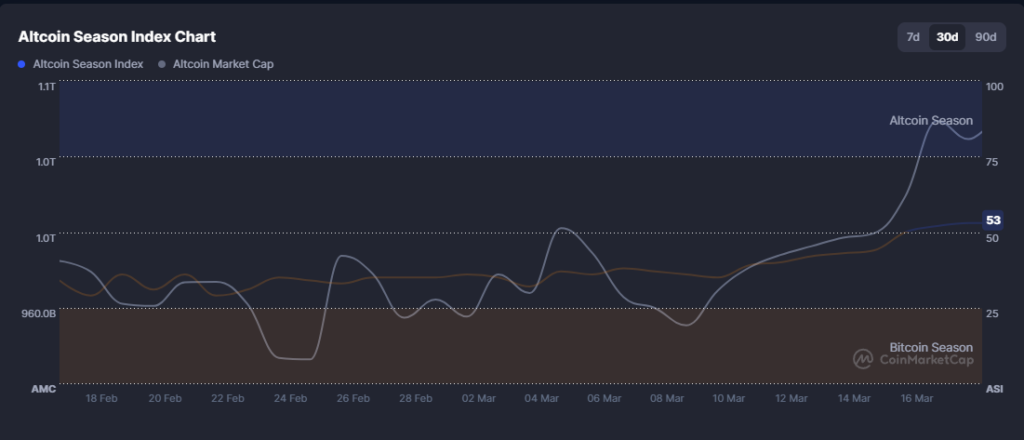
The Altcoin Season Index reading of 53 confirms that rotation is underway but has not yet reached the kind of extreme readings that historically signal a cycle top for altcoin outperformance. A reading above 75 has typically marked periods of peak alt enthusiasm. At 53, the index suggests the rotation is real but not overextended on a sentiment basis, which means there is room for it to continue if volume recovers.
Where the Risk Is Concentrated
Large-cap altcoins with genuine liquidity, ETH and SOL specifically, are best positioned to sustain outperformance in this environment. Their 24-hour volumes of $18.87 billion and $3.30 billion, respectively, mean rotation capital can enter and exit without significant slippage. These are the assets where the risk-reward of participating in the current rotation is most clearly defined.
Mid- and small-cap tokens face a different setup entirely. Spot liquidity pockets are uneven across the market, and the overall volume decline means that concentration risk is higher than the weekly return charts suggest. A token posting strong weekly gains on thin volume is more exposed to a rapid unwind than one where volume is confirming the move. The gap between price action and underlying participation is wider in the lower cap tiers, and that gap tends to close sharply.
This trend is applicable to sector-specific tokens as well. NFT coins, gaming tokens, and other narrative-driven assets that are catching bids in a rotation environment are borrowing momentum from the broader market rather than generating their own. When sentiment shifts, those positions tend to unwind faster than the assets that led the rotation in the first place. The current environment rewards selectivity over breadth. Chasing weekly gainers down the cap scale, in a market where total volume just dropped by more than a third, carries a materially different risk profile than allocating to the large caps that are leading the rotation.


