





The total reserves of Binance, comprised of BTC, ETH, XRP, and stablecoins spanning over the ERC20 and TRC20 networks, have fallen drastically from a mid-2025 peak of roughly $140 billion to about $102 billion. This is the lowest level recorded since April 2025. The $38 billion decline, approximately 27% in just a few months, is significant not only for its speed but also because it captures both passive market price effects and active user behavior in a single USD-denominated metric
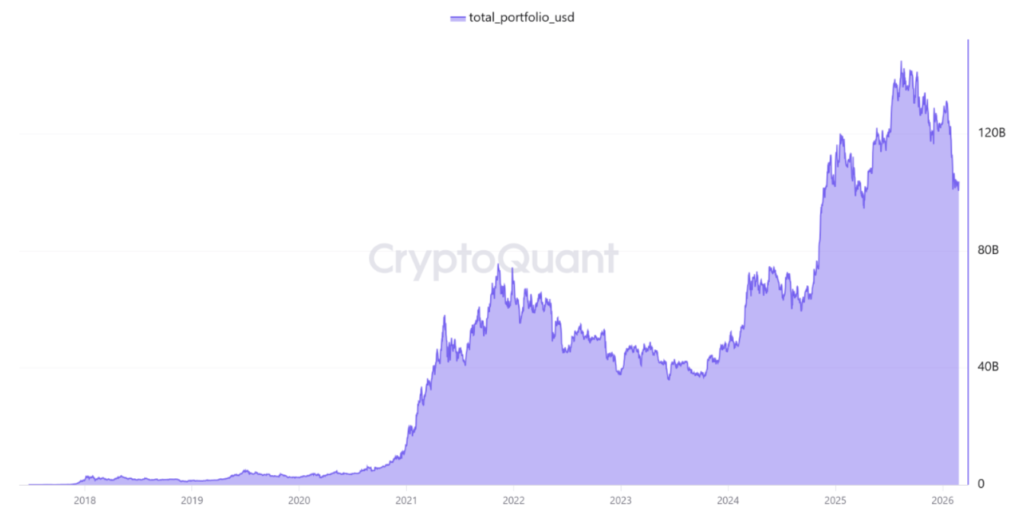
The long-running CryptoQuant chart shows reserves starting out at almost nothing in 2018 and steadily rising through bull cycles to reach plateaus of around $40–80 billion in 2022–2023. Then, in 2024–2025, they rose even faster, hitting new highs before the recent drop. The line shows a clear pattern: it builds up slowly during accumulation phases, is volatile during corrections, and now has a clear downward slope that wiped out most of the gains made in late 2025.
This metric adds up volatile holdings (BTC, ETH, XRP) whose USD values change with market prices and stablecoins that are almost always worth the same amount. The total shows two things at once: changes in asset prices and net flows into and out of the exchange.
The Current Phase’s Background
The drop happened at the same time that Bitcoin fell from its late-2025 highs of about $126,000 (reported in October) to levels close to $64,000–$68,000 in the past few weeks. This is a drop of about 50% in the leading asset. ETH and XRP have experienced the same trend to the downside, which triggers the stablecoin impact on the reserves. Stablecoin balances have also been declining on their own, falling from highs of around $50.9 billion in late 2025 to about $41.4 billion more recently, an 18.6% drop. Reports indicate that these balances could continue to decrease toward the $36–43 billion range by mid-February 2026.
Despite the drop, Binance is still the biggest player, holding about 64–65% of all centralized exchange stablecoin reserves. This suggests that users are de-risking rather than leaving the platform completely.
Main Reasons for the $38 Billion Drop
There are two main reasons for the contraction, and market depreciation is doing more work than you might think at first.
The main passive driver is the drop in market prices. Holdings of BTC, ETH, and XRP stay the same or even grow in number (Binance BTC reserves recently hit multi-year highs near 676,000 BTC), but their value in USD drops a lot during corrections. A significant drop in the price of BTC can wipe out tens of billions from the total portfolio without a single coin leaving the exchange. This valuation effect has a bigger impact on the combined metric during broad sell-offs, making what looks like “reserve shrinkage” mostly a sign of lower asset prices.
Active outflows, which represent assets moving out of exchanges, have added to the decline. Since the November peaks, stablecoin reserves have seen steady net withdrawals of about $9–10 billion, indicating that users are shifting funds to self-custody due to market volatility and uncertainty. XRP balances have also decreased over time, from more than 3.2 billion coins in late 2024, reducing liquidity for that asset on exchanges
The interaction creates a feedback loop that results in two effects: individuals who experience price drops become more cautious in their behavior, and in many cases, such actions leads to outflows that cause more severe liquidity problems.
What This Means for Traders and Investors
Binance’s reserves, which are worth $102 billion, show that on-exchange liquidity is much lower than it was at its peak in 2025. Less stablecoin dry powder leads to challenges for dip buying and this can make consolidation periods longer or make volatility escalate when there is sell pressure. Lower valuations for volatile assets also mean that there is less collateral value available for leveraged positions. These developments could slow down upward momentum until the market recovers.
For a wider view of risk, the data shows that Binance is still the leader in spot and derivatives volumes, and BTC coin reserves are growing again. Some important watches are
- A change in stablecoin net flows (inflows would mean that people are feeling more confident and have more buying power).
- Continued inflows and outflows of money, specifically withdrawals, exert pressure on prices, while reversals provide support to the potential base.
In long-term corrections, falling CEX reserves often show when retail investors give up and off-exchange investors build up their positions.
Looking Ahead
The metric has experienced a plunge from $140 billion to $102 billion, highlighting the strong relationship between user sentiment and market price movements. This helps in determining the liquidity of centralized exchanges. Users have withdrawn their funds while the asset values of BTC, ETH, and XRP have decreased, which caused most of the decline. People demonstrate their cautious nature through their behavior because they will not come back until they see definite evidence that shows the market stability.


