





Bitcoin ended the first quarter of 2026 at $66,694.59, down 19.00% from its Q1 2025 close of $82,336.06. The decline is real, the drawdown is measurable, and predictably, the declarations of Bitcoin’s demise have followed. What the data also shows, across six consecutive Q1 snapshots dating back to March 2020, is that this instance is not the first time the asset has handed its critics what appeared to be a conclusive argument.
The Q1 Record Six Years of Extreme Variance
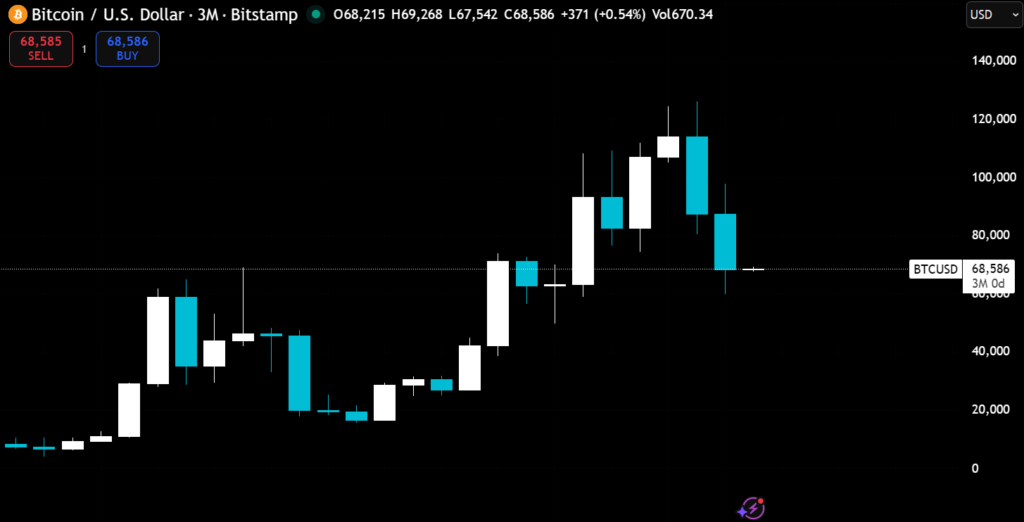
Tracking Bitcoin’s price at the close of each first quarter from 2020 through 2026 produces a dataset that defies any single narrative. On March 31, 2020, Bitcoin closed at $6,430.61. One year later, it closed Q1 2021 at $58,930.28, a year-over-year gain of 816.40%. That single data point represents one of the most compressed appreciation cycles in the asset’s publicly traded history.
What followed was a sequence of violent corrections and recoveries that challenge any linear interpretation of Bitcoin’s trajectory. Q1 2022 closed at $47,062.15, down 20.14% from the prior year. Q1 2023 fell further to $28,032.26, a 40.44% year-over-year decline and the lowest Q1 close in record since 2020. Then Q1 2024 reversed sharply to $69,647.78, a 148.46% recovery from the prior Q1. Q1 2025 extended those gains modestly to $82,336.06, up 18.22%. And now Q1 2026 registers a 19.00% pullback to $66,694.59.
The six-year arc from $6,430 to $66,694 represents a net appreciation of approximately 937%, even after the current drawdown is factored in. The path to that figure included two distinct Q1-over-Q1 drawdown periods and one that nearly cut the Q1 price by half.
The 471 Notes: A Parallel Dataset
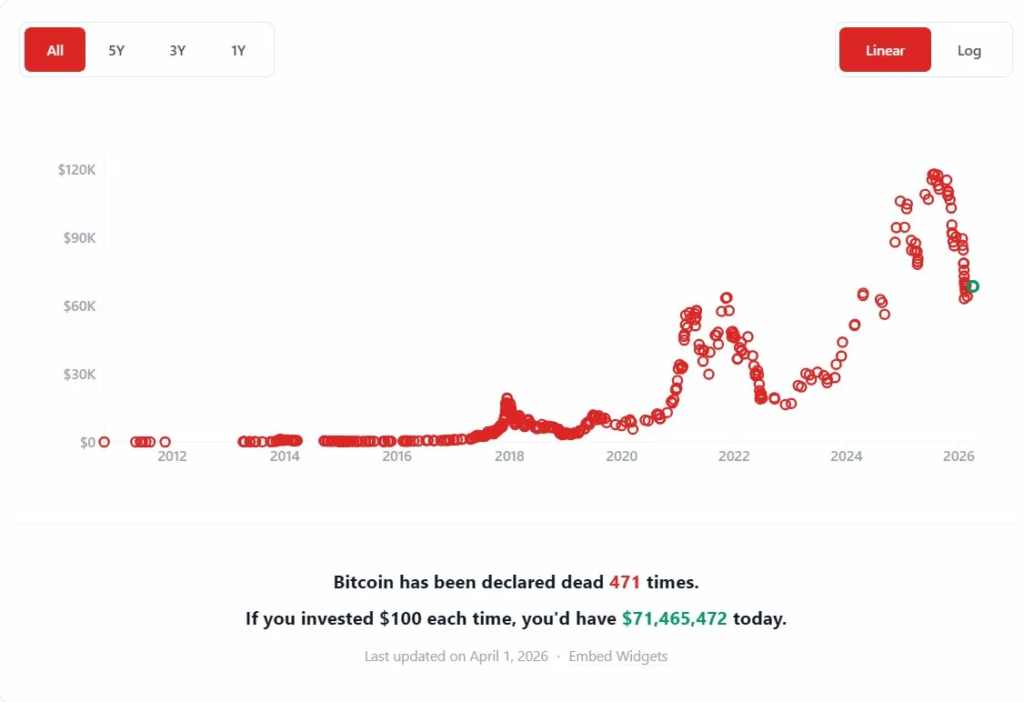
Running alongside the price history is a separate but analytically relevant dataset maintained by Bitcoin Is Dead, a database that has tracked every documented declaration of Bitcoin’s death since 2010. As of April 1, 2026, the count stands at 471 obituaries sourced from 321 critics across 210 publications over 16 years.
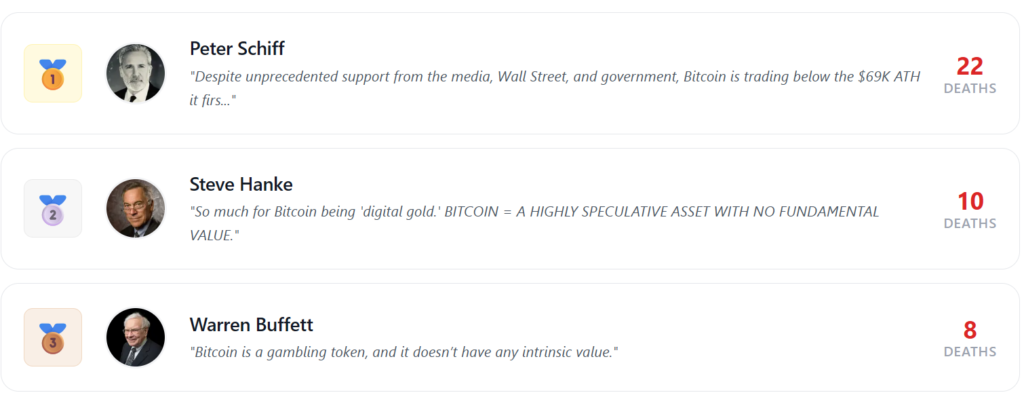
The database’s critics leaderboard, tracked across 312 named individuals, reveals that the most prolific Bitcoin obituary authors are not anonymous commentators. Peter Schiff leads with 22 documented death declarations. Economist Steve Hanke follows with 10. Warren Buffett, whose most recent tracked quote describes Bitcoin as “a gambling token” with no intrinsic value, accounts for 8.
What the database captures is not simply a list of wrong predictions. It maps the timing of those predictions against Bitcoin’s price at the moment each declaration was made. The pattern that emerges is structurally consistent: a significant portion of obituaries cluster around periods of sharp price decline, precisely the market conditions that tend to generate the most confident bearish commentary.
The current environment fits that pattern. Bitcoin is down from a Q1 2025 close of $82,336 and well off its cycle high near $109,000. The conditions for a new round of obituaries are present. The historical base rate for those obituaries proving accurate across 471 prior attempts is zero.
What the Data Actually Supports
The Q1 2026 closing price of $66,694.59 does not exist in isolation. Placed within the six-year Q1 sequence, it sits above every Q1 close from 2020 through 2023 and only 4.24% below the Q1 2024 close of $69,647.78. The drawdown from Q1 2025 is meaningful and historically precedented, structurally similar to the 20.14% Q1-over-Q1 decline recorded in 2022, which was followed by the deepest trough in the series before a 148.46% recovery.
Framed against the full range of Q1 closes, the current price occupies the third-highest position, sitting below only the $82,336.06 registered in Q1 2025 and the $69,647.78 from Q1 2024, which itself was the inflection point that broke a two-year streak of consecutive Q1 declines.
The more instructive comparison may be the 2022 to 2024 sequence. Q1 2022 closed at $47,062.15, down 20.14% year-over-year. Q1 2023 fell a further 40.44% to $28,032.26, extending the drawdown into a second consecutive year before Q1 2024 produced the dataset’s largest single-year recovery at 148.46%. The current setup shares the entry condition of that sequence, a Q1-over-Q1 decline in the range of 19% to 20%, but it does so from a base price of $66,694.59 rather than $47,062.15, meaning the absolute floor of the prior drawdown cycle sits close to $38,662 below where Bitcoin closed this quarter. That gap does not guarantee a different outcome, but it does establish that the current decline is beginning from a structurally higher base than the last comparable Q1 drawdown, a distinction that context-free percentage readings alone tend to obscure.
None of these figures means the current drawdown is over or that Q1 2027 will necessarily reverse the decline. The data does not support that conclusion, and making it would require speculation beyond what the numbers authorize. What the historical data of the largest cryptocurrency does support is that it has produced negative Q1-over-Q1 readings twice before, in 2022 and 2023, and in both cases the subsequent Q1 close was significantly higher.
For investors and traders using Q1 close prices as a medium-term reference frame, $66,694.59 represents a level that needs to hold on a year-over-year basis in Q1 2027 to avoid extending the current drawdown streak. The nearest comparable support that the asset’s history shows is the $69,647 Q1 2024 close, which the current price sits marginally below.
Forward Context
Six years of Q1 data establish that Bitcoin’s price trajectory is defined by intervals of compression and expansion that make any single-quarter reading an incomplete basis for a structural conclusion. The 471 entities that declared the asset dead across 16 years made their calls at prices that, in most documented instances, now represent significant discounts to current levels, including the first obituary recorded when Bitcoin was valued at $0.23.
The Q1 2026 close is a data point. It reflects a 19% decline. It also reflects a price 937% above where the comparable Q1 snapshot stood six years ago.


