





This week was more of a week of sorting rather than global crypto recovery. Two assets moved higher, three did not, and the split between them carries more analytical weight than any single price point.
At the time of writing, Bitcoin trades at $68,399.24, up 2.71% on the week. Ethereum sits at $2,092.37, up 2.75%. BNB closed at $597.01, down 1.27%. Solana at $79.26, down 1.62%. XRP at $1.31, down 0.57%. The 24-hour picture is uniformly negative across all five, with declines ranging from 1.41% for BNB to 3.93% for Solana. What the weekly numbers reveal is a market where capital is concentrating into the two highest-liquidity assets while rotating away from everything else.
Bitcoin
Bitcoin’s 2.71% weekly gain is the least interesting number in its data set. The more revealing figure is the sequence that preceded it. A Monday push toward $70,000, triggered by ceasefire reports, briefly looked like a breakout. By Tuesday, the price was back below $68,500.
Konstantins Vasilenko, Co-Founder and CBDO of Paybis, identifies what the pattern actually signals: “Three failed attempts at $70,000 in recent weeks have made institutional players cautious, and an unconfirmed ceasefire proposal does not clear that bar. The weekly return barely reaches 2%, which says more about the state of conviction than any single-day rally does.”
The $33.28 billion in 24-hour volume confirms market activity is not the problem. What is missing is the kind of macro clarity that sustains a move through resistance rather than retreating from it. Vasilenko puts it directly: real follow-through needs a macro catalyst with substance, and current diplomatic signals have not delivered that yet.
The more durable signal comes from ETF positioning. Wenny Cai, Founder and CEO of Anchored Finance, notes that Bitcoin ETFs pulled in approximately $471 million in a single day, the strongest inflow since February. Her interpretation cuts against the simple geopolitical read: “Institutional positioning right now looks more like measured accumulation than a binary bet on geopolitics.” This isn’t “accumulate and wait for peace’ it’s accumulate while hedging.”
She also flags a narrative shift that the 90-day data quietly supports. Bitcoin’s 90-day return of -25.73% is the shallowest drawdown in the top five, and it has held in the upper $60,000 range even with oil above $110. “That’s beginning to reshape its narrative from purely high-beta risk to a more complex role that includes elements of a macro hedge against monetary instability and capital fragmentation.” The structural bid is real, but as Cai notes, ETF inflows reinforce momentum rather than initiate it. The initiation still requires macro conditions with more clarity than currently exists.
Ethereum
The second largest digital asset by market cap experienced a 2.75% weekly gain that is almost identical to Bitcoin’s. Against the peer group, it is the most analytically meaningful return in the top five.
Vasilenko draws the comparison precisely: “Bitcoin gave back its rally, Solana dropped nearly 5%, and most of the group went sideways. When the rest of the group is treading water or worse, even a small gain suggests that someone with a longer time horizon is accumulating.”
WIth the L2 expanding adoption, the derivatives market recorded its first net inflow since 2023, a directional shift in how traders are positioning around the asset rather than simply managing downside. The $252.53 billion market cap and $16.63 billion in 24-hour volume give Ethereum the liquidity profile that allows large allocators to build meaningful positions without distorting price in either direction.
The 90-day drawdown of 35.09% is steeper than Bitcoin’s and reflects how hard ETH was hit during the broader market compression. The 30-day return of +6.78% tells a more recent story, one where accumulation has been quietly outpacing the selling. Cai identifies the structural reason this matters: that depth of liquidity is precisely why Ethereum tends to recover earlier than most of the market once risk appetite returns.
BNB
The Binance ecosystem native token, BNB, is down 1.27% during the week, 1.41% in 24 hours, 3.89% over 30 days, and 34.46% over 90 days. BNB is the only asset in the top five showing negative returns across every measured period. The $1.52 billion in 24-hour volume is also the thinnest in the group by a significant margin relative to its $81.41 billion market cap, a ratio that signals relatively low turnover for an asset of its size.
Low volume against a declining price is not a bullish setup. It suggests the absence of buyers rather than the presence of aggressive sellers, which makes recoveries slower to develop. BNB’s 90-day drawdown of 34.46% sits between Ethereum’s 35.09% and Solana’s 42.53%, placing it in a mid-range compression position with no clear near-term catalyst visible in the data provided. Until volume picks up meaningfully and the 30-day trend reverses, BNB remains the weakest structural setup in the group.
Solana
Solana’s week is where the data produces the most notable divergence. A 1.62% weekly decline and a 3.93% 24-hour drop bring the asset to $79.26. The 90-day return of -42.53% is the steepest in the top five. The 24-hour volume of $3.23 billion, however, is not the profile of a network losing user engagement.
Vasilenko frames the disconnect clearly: “Volume around $3.2 billion, active developer engagement, and growing protocol usage all point in the right direction. The selling pressure appears to be coming from the macro side rather than anything specific to the network.”
The mechanism he identifies is institutional risk management: “Institutional allocators tend to pull back from assets with perceived operational risk first, and Solana’s history of outages keeps it higher on that list than its technical progress probably warrants.” That distinction has direct implications for how the discount resolves. If the gap between fundamentals and price is being driven by macro-level risk aversion rather than network deterioration, then it is temporary. The timing, as Vasilenko notes, depends on the broader conflict environment, and no reliable timeline exists for that.
XRP
XRP’s week is defined more by what did not happen than what did. A 0.57% weekly decline at a price of $1.31 makes it the most stable of the three underperforming assets, but stability in a downtrend is not the same as a base forming.
The 24-hour volume of $1.58 billion is thin for an asset with an $80.21 billion market cap, tracking closely to BNB’s volume-to-cap ratio and carrying the same structural implication: the market is not actively building positions. The 30-day decline of 4.07% and the 90-day decline of 41.99% place XRP in the same compression range as BNB and Solana, suggesting the asset is moving with the broader altcoin beta rather than finding independent support.
The Forward Setup Across the Five Cryptos
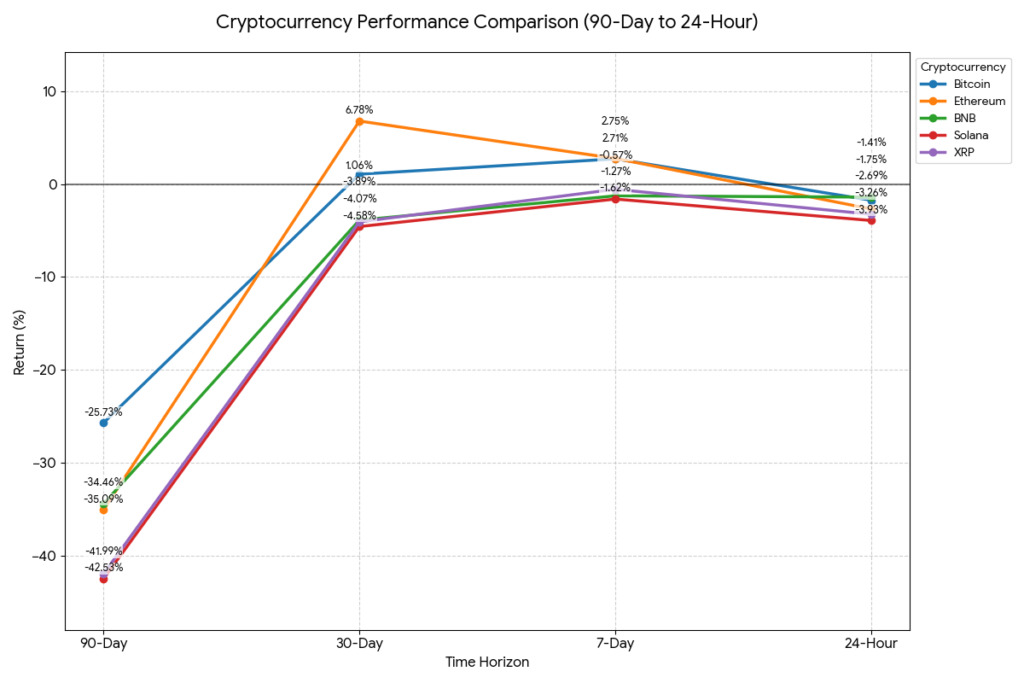
The 90-day drawdowns tell a consistent story across the group: these crypto assets are all materially below prior highs, with declines ranging from 25.73% for Bitcoin to 42.53% for Solana. That compression keeps both downside risk and rebound potential elevated simultaneously.
The near-term structure favors BTC and ETH. A sustained break above near-term resistance for either, on rising volume, would likely pull the broader group higher. BNB, SOL, and XRP carry thinner relative liquidity, which means they would see proportionally larger moves in both directions once directional conviction returns to the market. Cai’s observation on Bitcoin applies to the group: $70,000 is acting more as a test zone than a floor, and a sustained bull run will depend more on global liquidity conditions than on any single geopolitical development.


