





The stablecoin market spent the better part of its early years being treated as a back-office utility for crypto traders, useful for moving between positions but not serious enough to sit alongside conventional financial infrastructure. That characterization has not aged well. A new industry report from Morph, a high-performance Ethereum Layer-2 settlement network, compiles the data that formally closes the debate. The numbers no longer describe a market finding its footing; they describe one that has already arrived. As Morph CEO Colin Goltra puts it: “Stablecoins are now a structural necessity for modern treasury and procurement.”
The Scale of the Shift
The stablecoin market closed 2025 at a total capitalization of $312 billion, representing a 60-fold increase from its approximate $5 billion base in 2020. That trajectory, compressed into five years, is not the growth curve of a niche financial instrument finding its footing. It is the growth curve of infrastructure. The more revealing figure, however, is not market cap. It is transaction volume.
Stablecoins processed $33 trillion in annual transaction volume in 2025, a figure that exceeds the combined throughput of Visa ($15.7 trillion) and Mastercard ($9.8 trillion) in raw settlement terms. To be precise, Visa and Mastercard together handled approximately $25.5 trillion last year. Stablecoins handled $7.5 trillion more. Monthly volume crossed $1.25 trillion in August 2025 alone, while active wallets grew 53% to surpass 30 million.
The gap between stablecoin volume and the two dominant card networks is significant. It is 29.4% larger than both networks combined. That comparison requires context: card networks carry consumer protections, dispute resolution, and fraud infrastructure that stablecoins do not yet fully replicate, but as a raw measure of capital in motion, the number reframes the conversation entirely.
It is also worth noting what these wallet and volume numbers represent in terms of network density. Thirty million active wallets across a $33 trillion volume base implies an average throughput per active wallet of over $1.1 million annually; that is not retail consumer behavior. That is institutional and commercial-scale activity concentrated in a relatively small but rapidly expanding user base, which itself signals the market is still in an early adoption phase with significant headroom before saturation.
Where the Volume Is Actually Coming From
The data challenges the persistent assumption that stablecoin transaction volume is inflated by crypto-to-crypto trading activity. According to the Morph report, which draws on analytics from Artemis, the fastest-growing use category is B2B payments in the real economy.
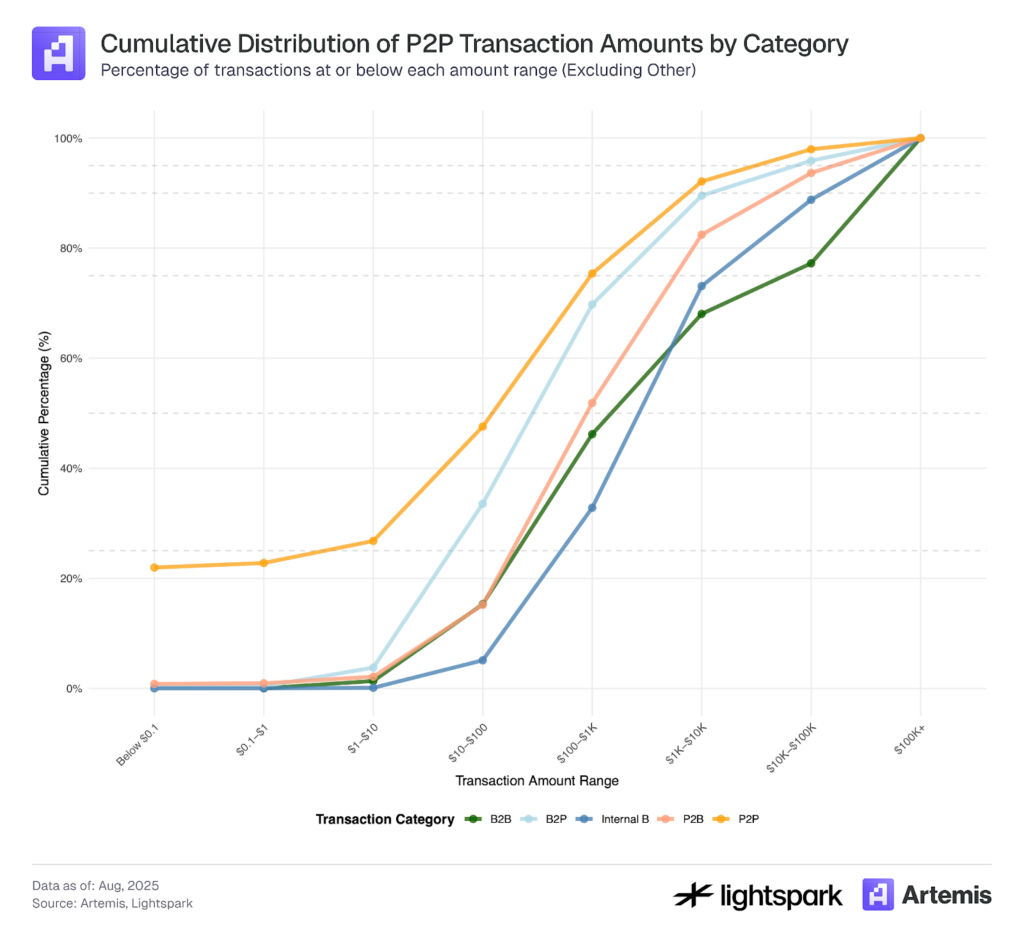
Among firms tracked by Artemis, B2B stablecoin payment flows grew from under $100 million per month in early 2023 to over $6 billion per month by mid-2025. That is a greater than 60-fold increase in roughly 30 months. B2B flows now account for approximately $226 billion of identifiable real-economy stablecoin volume, representing 60% of the estimated $390 billion in total annual real-economy stablecoin activity.
Corporate adoption data reinforces this trajectory. The report notes that 77% of corporate stablecoin adopters cite supplier payments as their primary use case, and 41% of corporate users report cost savings of at least 10% compared to legacy payment methods. The cost efficiency story is particularly relevant for cross-border supplier payments, where traditional wire transfers carry fees typically ranging from 1% to 3% of transaction value plus multi-day settlement delays. Stablecoin transfers operate at a fraction of that cost with near-instant finality.
For businesses running high-frequency procurement or operating across multiple currency jurisdictions, that delta is not a convenience. It is a structural cost advantage.
The geographic dimension of this shift deserves attention. Emerging markets, where correspondent banking infrastructure is expensive, slow, or unreliable, represent some of the highest-growth corridors for stablecoin adoption. Businesses in regions with limited access to competitive foreign exchange markets or dollar-denominated banking are not adopting stablecoins as an experiment. For them, the cost and speed differential relative to legacy rails is acute enough to make stablecoins the rational default, not an alternative.
What the Predictions Signal

The Morph report outlines eight predictions spanning 2026 through 2030, and the near-term forecasts carry more weight than the longer-dated ones simply because they are grounded in observable momentum rather than speculative extrapolation.
The projection that annual stablecoin settlement volume is expected to exceed $50 trillion by the end of 2026 is not a dramatic leap from the current $33 trillion baseline given the growth rate in play. The expectation that the majority of Fortune 500 companies will pilot stablecoin payments in 2026 tracks with the 54% of organizations the report identifies as planning stablecoin deployment within the next 12 months.
The 2027 prediction that AI agents will become the largest category of stablecoin transaction initiators is harder to quantify today but directionally coherent. Autonomous software systems that manage procurement, treasury operations, or vendor payments will need programmable, API-native payment rails. Traditional banking infrastructure was not built for machine-to-machine financial interactions. Stablecoin networks are.
The 2028 forecast that a first emerging market economy will adopt a private stablecoin as legal tender alongside its national currency is the most speculative of the near-term predictions. Several dollarized or heavily dollarized economies in Latin America and Sub-Saharan Africa already use USD-denominated instruments as a de facto monetary standard. A private stablecoin serving that function formally would be an incremental regulatory step in some jurisdictions, not a radical one.
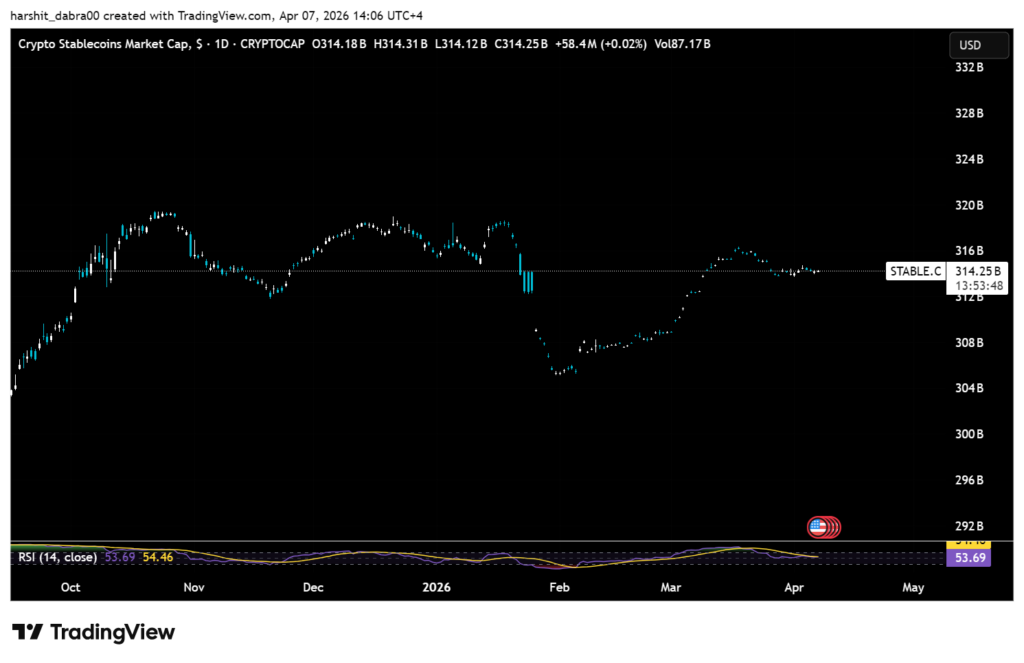
At the time of writing, the current crypto stablecoin market capitalization stands at 314.25 billion. By 2030, the report projects total stablecoin market capitalization will exceed $1.9 trillion, with stablecoins intermediating between 5% and 10% of all global cross-border payments.
The Forward-Looking Picture
The data as per the official report does not suggest stablecoins are on the verge of displacing the global banking system. What it does suggest is that more and more commercial payment transactions are moving to programmable settlement systems, and this shift is now significant enough that corporate treasury teams, financial institutions, and payment infrastructure providers need to pay close attention.
The regulatory environment will play a defining role in how quickly the next phase of growth materializes. Several major jurisdictions, including the United States and the European Union, are in active stages of stablecoin-specific legislative frameworks. Clarity on reserve requirements, issuer licensing, and cross-border transaction rules will either accelerate institutional adoption or introduce compliance friction that slows it. The direction of that regulatory outcome over the next 24 months is arguably the single largest variable in whether the $50 trillion 2026 projection holds or is revised.
Organizations that treat stablecoin adoption as an exploratory experiment in 2026 may find themselves responding to a competitive gap rather than building one by 2028.


