





The Layer 2 ecosystem in 2025 completed its shift from experimental scaling tools to a mature and highly concentrated market. Activity and capital consolidated around a small group of dominant networks, while distribution advantages replaced technical novelty as the main growth driver. Despite incremental progress at the top, centralization remained the prevailing operational model across most chains.
Market Concentration Defines the Category
The year 2025 saw Layer 2 networks adhering to a distinct power law distribution. Base by Coinbase was the leading platform in terms of total value locked, daily active addresses, and transaction count and volume of decentralized exchanges. On the other hand, many newly launched rollups suffered from poorly planned marketing strategies that first caused temporary high activity spikes due to points farming and incentives but then quickly declined as soon as the rewards were over. This trend revealed how badly on-chain participation was treated and how challenging it was to create sustainable ecosystems without having strong distribution already in place.
Base and Arbitrum Capture the Majority of DeFi TVL

The Base ecosystem showed continuous growth throughout the year. It was able to achieve such success since it was able to attract more users to its DeFi platform, where the total value locked (TVL) rose from around $3.1 billion in January 2025 to more than $5.6 billion in October, thus accounting for nearly 46.6 percent of the total Layer 2 TVL in DeFi.
On the other hand, Arbitrum only experienced a slight decline, with the TVL going down from $2.9 billion to $2.8 billion, which still means that the platform has over 30 percent market share. The two platforms, Base and Arbitrum, combined, were able to dominate more than 75 percent of the total Layer 2 DeFi TVL, which further supported the winner-take-most dynamics.
Total Value Secured Contracts as Composition Shifts
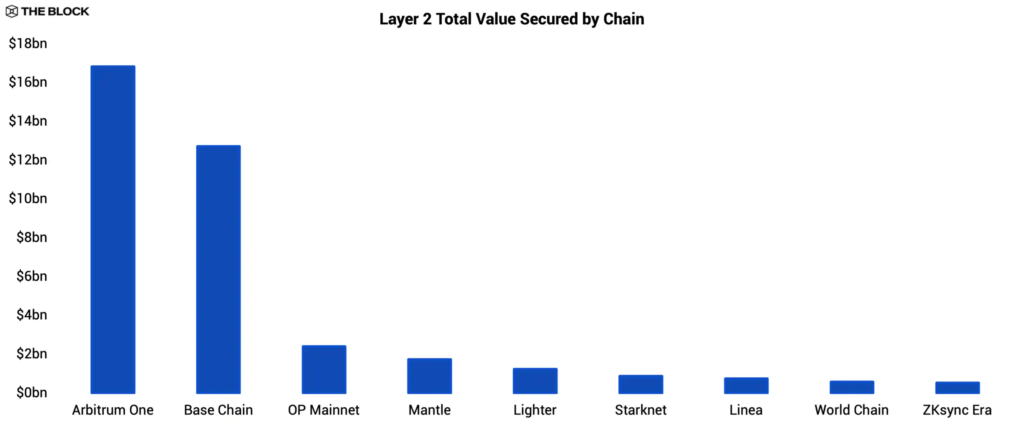
The Total Value Secured, which comprises all assets originated through bridging as well as the assets held natively, experienced a drop of 10.3% from January 19, 2025, to January 19, 2026. The combined TVS value decreased from $43.89 billion to $39.36 billion during the times of large market fluctuations and through the shifting of capital distribution practices.
Ethereum-Native Bridging Loses Share
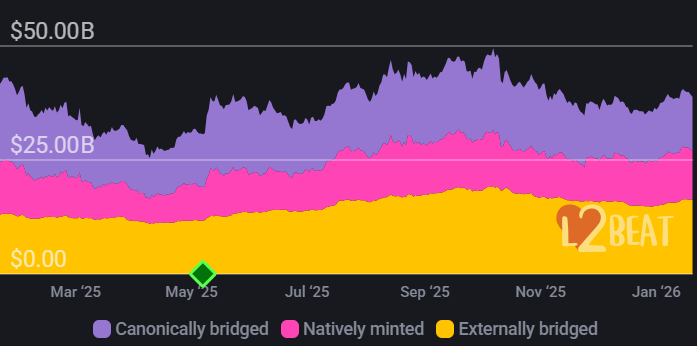
Canonically bridged assets declined sharply from $17.94 billion to $12.05 billion, reducing their share from 40.8 percent to 30.6 percent. The 32.8% decline indicates that there is less of a dependence on direct inflows of Ethereum, mainly because of higher Layer 1 data costs at certain times, throughput limitations, and a move to other liquidity sources.
Externally Bridged Assets Take the Lead
Externally bridged assets experienced the highest growth among all categories, increasing by 23.2%, from $13.26 billion to $16.33 billion. They accounted for 41.5% of total volumes secured by early 2026, surpassing both the traditional and the natively minted assets. The mentioned development was indicative of the increasing reliance on third-party bridging and integration services for cross-chains, particularly in the case of the institutions and corporations.
L1 vs L2 Transaction Growth
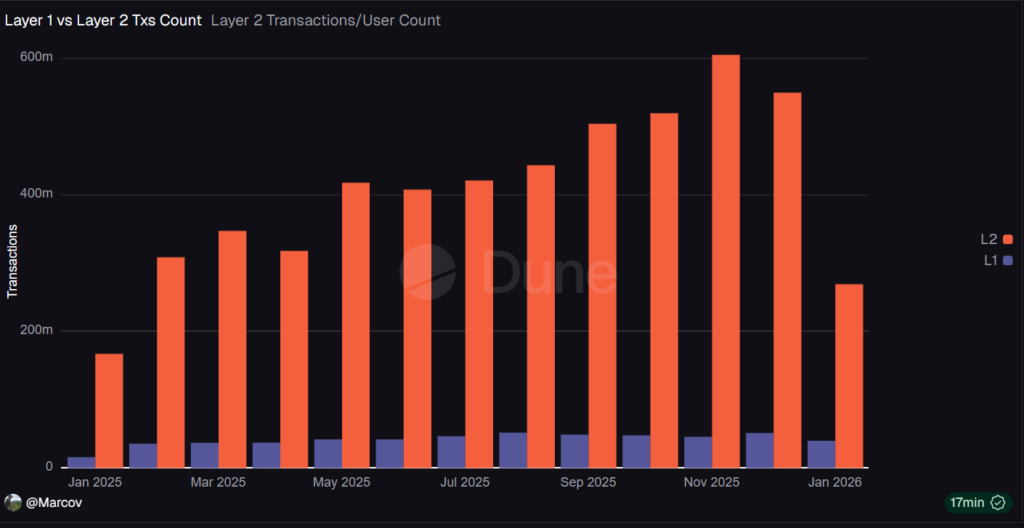
The above Dune Analytics chart highlights the dramatic growth of Ethereum Layer 2 transactions throughout 2025. Monthly L2 counts rose from around 167 million in January to peaks above 600 million by late 2025, settling at roughly 269 million in early January 2026. On the other hand, Layer 1 transactions did not experience any significant changes and were always low, with a monthly range between 15 and 40 million. This remarkable trend indicates that the Layer 2 solutions have taken over the processing of Ethereum, generally more than 85% of the total transactions, while the main network only serves as a secure settlement for the rest of the transactions. The increase in volume has been caused by the fees being cut drastically, the throughput reaching higher levels, and the cascading effect of adoption in DeFi, trading, and daily usage, with the positive impact estimated to last even into 2026.
Distribution Becomes the Primary Advantage
Base strengthened its leadership position by securing approximately 50% of the total Layer 2 decentralized exchange volume. Moreover, the native apps like Morpho saw a tremendous increase in the number of lending deposits, which rose from $354 million to over $2 billion. Additionally, the OP Stack Superchain, encompassing projects like World Chain, Soneium, INK, and Unichain, gave this benefit a further boost by employing a common infrastructure and strong collaborations for expanding the reach.
Persistent Centralization and 2026 Outlook
While the growth of ecosystems did take place, the majority of the Layer 2 solutions still had a very high level of centralization, as they were dependent on permissioned sequencers, multisig upgrade keys, and minimal exit guarantees. As the crypto enters 2026, the industry is characterized by concentration, partnerships, and institutional integration. Another round of consolidation seems to be on the cards and the factors determining the long-term success will be distribution secured and defended at a large scale rather than technical differentiation.


