





The TVL Illusion
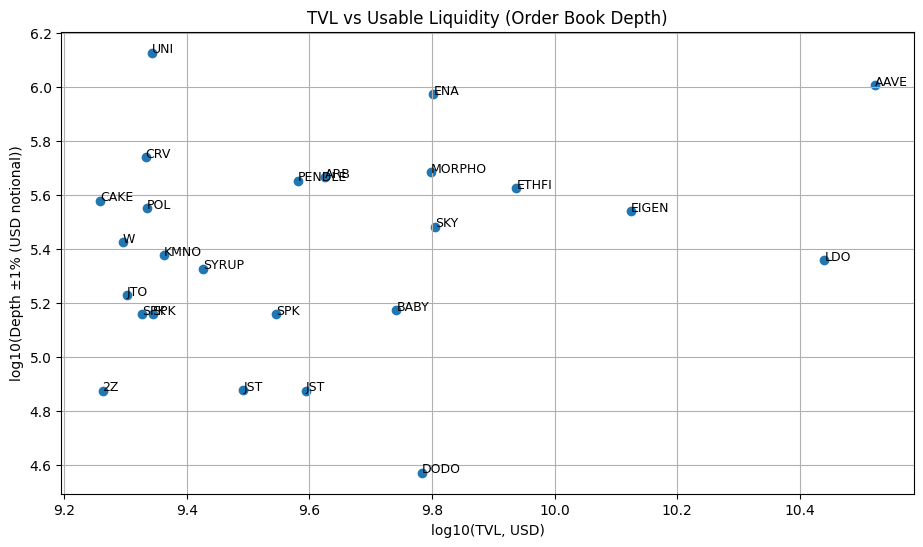
TVL has become the scoring board for the cryptocurrency industry because of its simplicity, comparability, and easy marketing. A protocol that has a huge TVL seems to be “big”, “secure” and “significant”. However, TVL is a stock variable, not a market variable. It reveals how much value is locked in a system, not the level of risk that the market could absorb when the flows come in. This difference is really important because the market does not make trades based on what exists in theory. It trades on what can be settled in practice. Institutions do not invest in the noisiest ecosystems or the most impressive numbers on the dashboard.
They invest in the assets which are able to accommodate size. Such predictable execution, tight spreads, and the reliability of the market during stress are necessary. In simpler terms, they are concerned about the quality of liquidity and not its appearance. TVL can exist alongside order books that are not deep, curves that are fragile, and price gaps that are abrupt. That is the TVL illusion: a façade of strength without the microstructure that can support real flow.
TVL Measures Storage, Not Execution
TVL reflects the value that is kept. The execution of the trade takes liquidity that is usable. The variation between the two is not about words; it is about the capability of a protocol to bear institutional demand and the one that gets broken as soon as it meets that demand. A protocol can show a significant TVL because of rewarding programs, limited positions, or non-active deposits which are not providing any tradable depth at the current prices. When there is an actual buy or sell pressure, the liquidity available at the midpoint determines the market impact and not the total value that the system has somewhere.Most of the time this is why two protocols that have the same TVL can act in totally different ways regarding price.
One can take a large trade repeatedly without any significant price change. Another can go through the roof on the volume that is quite small because the depth is shallow, and the size is limited or goes away when there is a rise in volatility. TVL fails to see that weakness. Depth does see it.
The Metric Institutions Underwrite: Usable Liquidity
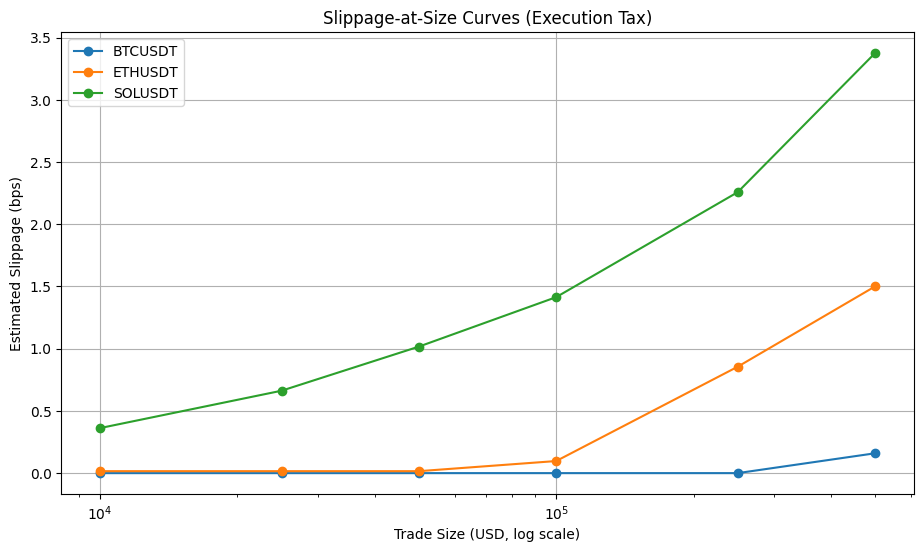
Usable liquidity is the amount that you can execute near the midpoint without incurring a big tax in slippage. Various market structures have different measurements of this, but the underlying principle is the same. In the case of centralized exchanges, it is displayed through order book depth, spread width, and replenishment speed. In the case of AMMs, it is reflected in the curve itself: slippage rises nonlinearly as the trade size increases, particularly when liquidity is concentrated in narrow ranges. Institutions mostly want to know one thing: if we have to either put money into the market or take it out, how much will it cost? The answer to that question is in numbers. It’s slippage-at-size. It’s market impact. It’s depth within a defined band. It’s resilience after a sweep.
And it varies with the market situation. In quiet markets, the liquidity seems to be plentiful. In troubled markets, it often disappears right where it is most needed. Total Value Locked (TVL) may stay the same through the different regimes, but usable liquidity cannot. This is why TVL is the least informative precisely when the risk is at its highest.
Slippage Is the Hidden Fee That Decides Winners
Retail usually views slippage as an annoyance, while institutions perceive it as a structural cost of capital. Slippage is not just an inconvenience to trading; it’s a silent performance killer that grows with the trading volume. A strategy that looks good on paper can turn out to be a loser in reality if a large execution cost is involved. This also clarifies why, at times, the markets seem to be very active and yet are still very fragile. It is possible to have a situation where the on-chain volume is high, numerous transactions are taking place, and TVL is even going up, and still, the price is weak because the incremental demand is not able to clear without moving the market too much.
When slippage is large, buyers become uncertain, sellers are selling hard, and the market through mechanics becomes a mean-reverting one. This is what “heavy” price movements usually are: not the bearish market mood but rather the difficult trading conditions.
Depth Is Not a Number, It’s a Shape
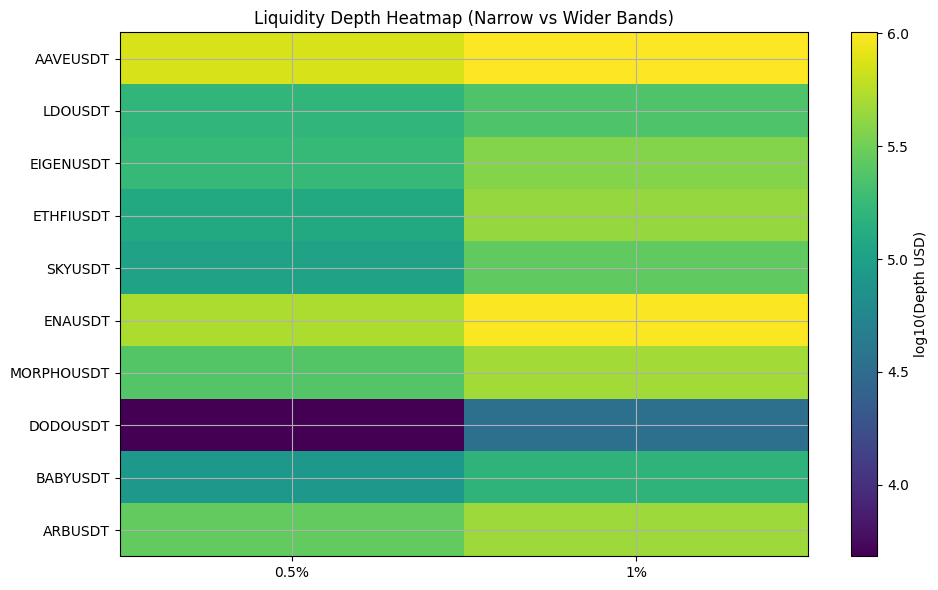
The quality of liquidity is not merely an issue of the amount of depth, but mainly an issue of its distribution. A market may have a high total depth but at the same time be structurally unstable due to liquidity being concentrated at just a few levels causing discontinuities. When the very top levels are consumed, then price gaps appear. For a market to be stable it needs to have liquidity distributed smoothly and replenished quickly, while fragile markets depend on cliffs.
It is in this situation that depth heatmaps come into play. They indicate whether liquidity is distributed evenly across price bands or it is just concentrated in a narrow zone that will be gone when pressure is applied. They show whether a token can take up flows over and over again, or whether it only lasts through small flows. Institutions do not just want to know if there is liquidity. They want to know if it is available when they need it, and does it return after impact.
TVL can rise while liquidity gets worse
This is the section that the majority of the people overlook. The total value locked (TVL) can increase, but at the same time, the quality of liquidity can decrease. Incentives can lead to TVL growth but can also discourage the actual trading depth. Concentrated liquidity can make TVL look bigger, but it can also make the asset more fragile if it is outside the restricted area.
Even during “growth” periods, the markets can become more unstable if the TVL growth is not supported by deeper and more resilient markets. This results in a dangerous misconception. People perceive the increase in TVL and think the asset is becoming more and more attractive to invest in. However, investability is not a metric of deposits; it is a metric of marketability. If the depth, spread, and resilience are not improving, then the market’s capacity to absorb the flow is not improving either. The next stress event will reveal it.
What This Changes for Market Interpretation
When you no longer regard TVL as a marker of safety, the market opens up and is much easier to analyze. You get the reasoning behind some assets trending effortlessly while others going through severe price fluctuations. You get the reason for “good protocols” being accompanied by weak tokens. You get the reason for broad rallies being harder: capital concentrates where execution is reliable, and ignores ecosystems where size cannot clear efficiently. Depth is now the real map of where institutions are willing to deploy. Slippage is turning into the unnoticed factor determining whether a trend can last. Resilience is becoming the distinguishing feature of the all-assets-that-survive-volatility-and-get-restructured ones. This is not a change of narrative. It is a shift of microstructure.


