





PUMP carries a market cap of $584 million, lacks any audit reports, and has no notable derivatives market. Pump.fun’s token runs entirely on Solana’s decentralized rails, which means the only honest read on its health comes from onchain data. What that data shows is three things: a liquidity structure thinner than the headline number suggests, a buy-sell balance that is barely holding constructive, and a supply event in July large enough to reframe everything above it.
This is what the numbers look like today and what they may look like by mid-summer.
The Price Picture: Controlled Drift, Not Collapse
At the time of writing, PUMP is trading at $0.0017579. That number needs context and over a 24-hour period from March 26 to March 27, the token oscillated in a tight band between $0.0017534 and $0.0017954. The range spread is roughly 2.4%, consistent with the reported 24-hour price change of -2.43%.
The weekly performance experienced a fall of 6.85%, which is not a violent selloff. It is a slow, orderly decline with no outlier candles and no volume surge on the downside. The sampled price points show the token peaked briefly at $0.0017954 around 10:45 PM UTC on March 26 before resuming its drift lower to $0.0017536 by 9:25 AM UTC the following morning.
Liquidity Structure: One Pool Dominates, and That’s the Problem
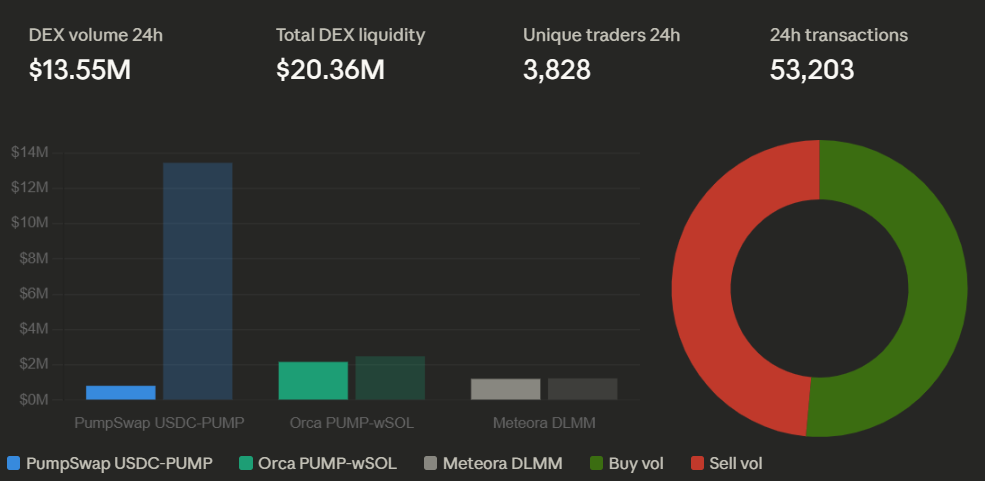
According to the data, as per CoinMarketCap, total on-chain liquidity across all PUMP pools stands at $20.36 million. Against a $584 million market cap, that is a liquidity-to-market-cap ratio of approximately 3.5%. For context, a ratio that low means meaningful position sizes can move the price noticeably.
The PumpSwap USDC-PUMP pool holds $13.44 million of that total, representing 66% of all available liquidity. This pool generated only $821,657 in 24-hour volume, a volume-to-liquidity ratio of roughly 6.1%. Orca’s PUMP-wSOL pool tells a different story: $2.17 million in 24-hour volume against $2.49 million in pool liquidity, a ratio above 87%. Meteora’s DLMM pool runs even tighter with $1.21 million in volume against $1.24 million in liquidity.
The practical reading here is that PumpSwap is where the liquidity sits, but Orca and Meteora are where the trading activity concentrates. Traders routing through Orca are cycling through nearly the entire pool’s depth every single day. That creates a fragile microstructure: any sustained directional volume on those pools will move price faster than the headline liquidity number suggests.
Buy-Sell Balance: A Small Edge That Hasn’t Moved Price
The 24-hour DEX data shows $6.97 million in buy volume against $6.57 million in sell volume. The net differential is approximately $400,000 in favor of buyers across 53,203 transactions and 3,828 unique traders.
This is a mildly constructive signal, but a small one. The buy-side edge accounts for roughly 2.9% of total DEX volume. That margin has not been enough to arrest the weekly decline. What it does suggest is that selling pressure is not aggressive, and there is no evidence of large coordinated exits at current prices.
The social sentiment reading of 4.83 out of 10 aligns with this week’s performance. The sentiment is mildly bearish-to-neutral, with no strong conviction on either side.
The Supply Event That Demands Attention
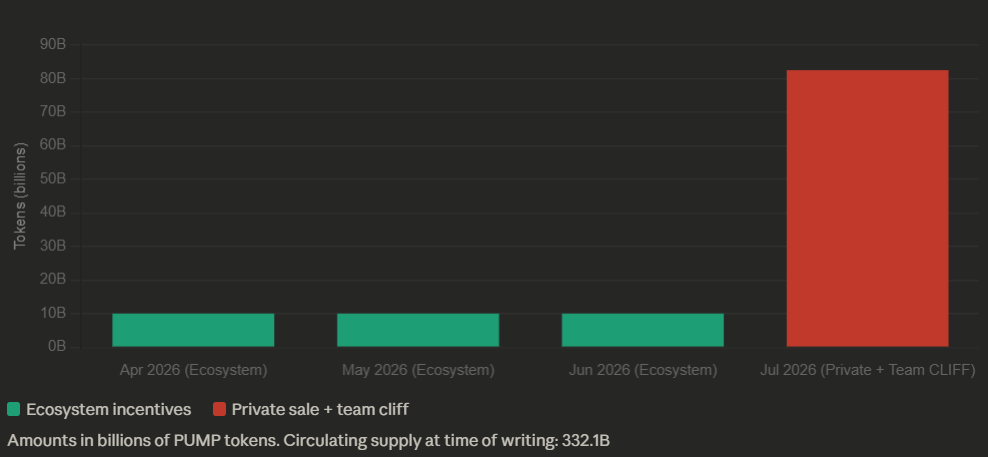
The unlock schedule shows three tranches of 10 billion PUMP each in April, May, and June 2026, labeled as ecosystem incentives. Those are manageable relative to the current circulating supply of 332.1 billion tokens, representing roughly 3% additions each. The fourth event is different in kind and in July 2026, 82.5 billion tokens are set to be unlocked in a single cliff event. This includes 32.5 billion from the private sale and 50 billion allocated to the team, advisors, and contractors. Together, this cliff represents a 24.8% increase over the current circulating supply, arriving in one scheduled moment.
At the current price of $0.0017579, that 82.5 billion token unlock has a notional value of approximately $145 million. That is roughly 25% of the entire current market cap becoming liquid in a single month. Vesting cliffs do not equate to instant market dumps, but the structural pressure is real. Private sale participants typically acquired tokens at a discount. Team allocations, depending on grant terms, may be subject to further vesting post-cliff. The actual sell-side impact depends on those specifics, which are not available in the current metadata.
What is available is the fact that zero audit reports have been filed against this project. That is not necessarily disqualifying for a Solana-native launchpad token, but it is a data point worth noting for anyone evaluating risk.
What This Data Supports
PUMP is a token with a real market presence, active onchain trading, and a buy-sell balance that leans modestly constructive in the short term. Its DEX microstructure is thin relative to its market cap and that asymmetry matters more than the weekly -6.85% decline on its own. The current 3,828 unique traders across 53,203 transactions in a single day points to genuine activity, not a dead market. But genuine activity and deep liquidity are different things. At $20.36 million in aggregate DEX liquidity against a $584 million market cap, PUMP is trading on infrastructure that represents roughly 3.5 cents of depth for every dollar of implied value. That gap does not cause problems until something tests it.
The July cliff event is the defining variable for the medium-term outlook. Anyone positioning in PUMP before that date is implicitly taking a look at how private sale holders and team members allocate their tokens when they unlock them. Private sale participants acquired tokens at a discount to current market price and have a clear economic incentive to realize gains. Team and advisor allocations depend on internal grant structures that are not publicly available in the current metadata. The behavior of those two cohorts will likely diverge, and the market will not know which way until the selling, or the absence of it, shows up in volume.
The data confirms the event will consist of a significant amount of 82.5 billion tokens and roughly $145 million in notional value at current prices, and the liquidity standing between that unlock and meaningful price impact is $20.36 million. That is the number worth keeping in view between now and July.


