





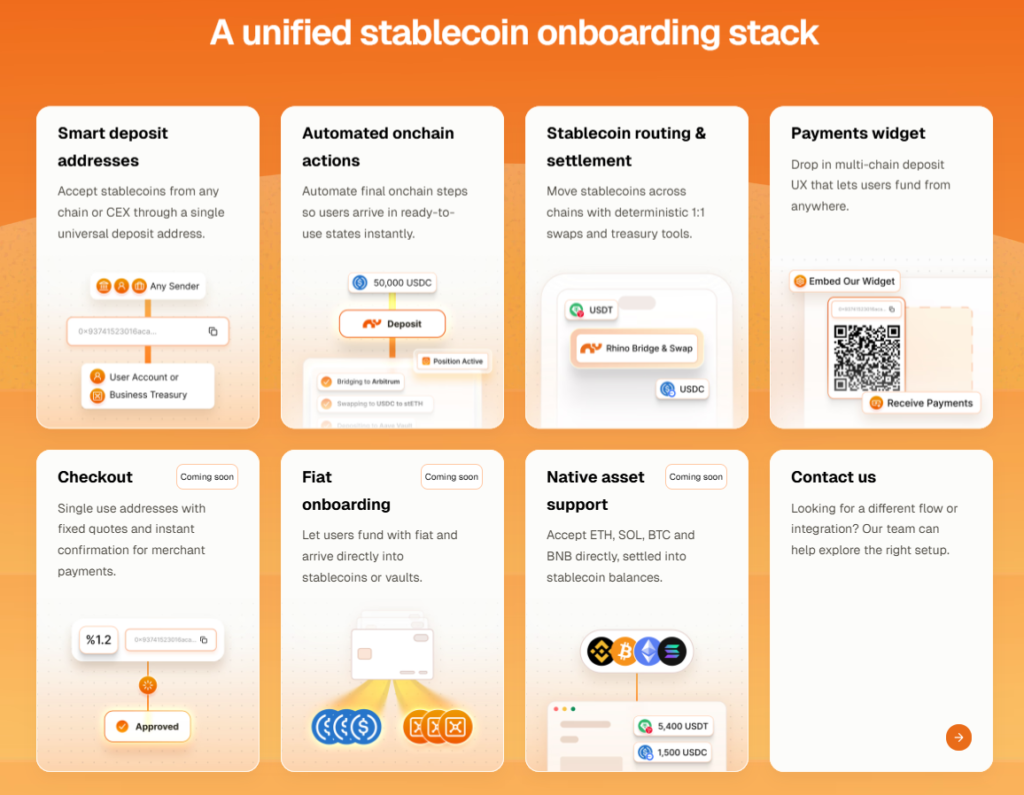
Rhino.fi announced that it will be launching its new Business-to-Business (B2B) solution, Stablecoin 1:1, which was specifically created to provide neobanks and fintechs with predictable stablecoin settlements. The Stablecoin 1:1 platform continuously monitors global stablecoin foreign exchange (FX) rates and always returns a firm, unequivocal 1:1 USD quote for USDT and USDC, along with an explicit fee with no hidden spread.
How Rhino.fi’s Stablecoin 1:1 Works:
Stablecoin 1:1 addresses a primary friction point in stablecoin settlements: the unpredictable value businesses actually receive after conversion spreads and multi-network routing. According to Rhino.fi’s estimations, a business processing USD 10 million in stablecoins in a single month may lose approximately USD 5,000 to a 5 basis point (0.05%) spread.
With Stablecoin 1:1, clients have the option to absorb or pass the transparent fee onto their consumers. The solution operates on more than 25 chains, including Ethereum, Tron, TON, Base, Polygon, Arbitrum, and Solana, with built-in guardrails or protections against arbitrage exploitation. WirexPay has already joined as the initial design partner for the Stablecoin 1:1 project.
Stablecoins are meant to be dollars on the internet, but businesses still experience them like fragmented liquidity and unpredictable outcomes. Stablecoin 1:1 is our step toward making digital dollars truly usable at scale. – Rhino.fi’s CEO, Will Harborne
Why It Matters For the Stablecoin Ecosystem
Rhino.fi has entered the arena with a lightning-fast stablecoin interoperability layer. USD 1 billion in volume has already been routed to be processed through the Extended app to Rhino Activation Stack, simplifying cross-chain deposits, offering faster onboarding, and above all, a solid infrastructure.
Lexi Short, Chief Growth Officer, noted that “predictability is what turns stablecoins from a crypto feature into real payment infrastructure.” This launch coincides with the growing number of regulatory frameworks, such as Markets in Crypto-Assets Regulation (MiCA), and institutional demand for transparent stablecoin settlements.


