




Stablecoin transfer volume has reached $30 trillion annually, according to a McKinsey report, a number that implies a functioning, reliable payments layer. But behind that headline figure is a system where two users can both send what appears to be one dollar and arrive at two different outcomes depending on which chain they used, which stablecoin they held, and how the transaction was routed. That gap between what stablecoins promise and what they actually deliver at settlement is what Rhino.fi is targeting with its newly announced Stablecoin 1:1 product.
Will Harborne, spokesperson for Rhino.fi, framed the problem directly: the industry has normalised a situation where two people can both send what looks like one dollar and arrive at two different outcomes. “If stablecoins are going to underpin payments,” Harborne said, “the industry has to move past this idea that ‘close enough to a dollar’ is good enough.”
The Fragmentation Problem Is Deeper Than It Looks
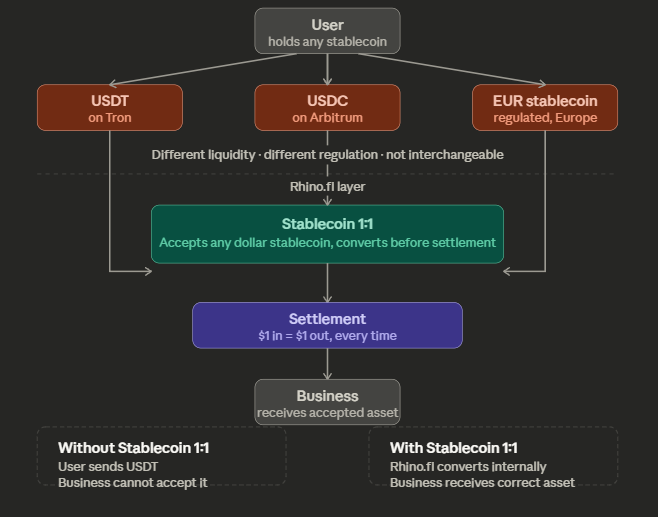
The standard framing around multi-chain fragmentation treats it as a technical inconvenience, a routing challenge that better infrastructure will eventually resolve. Will Harborne, spokesperson for Rhino.fi, argues the problem has moved well past that characterization. Fragmentation is no longer just a matter of assets sitting on different chains. It now extends across regulatory jurisdictions and asset classifications in ways that make the surface-level dollar equivalence between stablecoins increasingly fictional.
USDT on Tron, USDC on Arbitrum, and a regulated dollar stablecoin operating under European frameworks may all be denominated in dollars, but they are not interchangeable in any practical sense. Each carries different liquidity profiles, different regulatory constraints, and different counterparty acceptance rules. The consequence of that divergence is already showing up at the business level, where some companies can no longer accept USDT directly due to regulatory shifts, meaning a user who sends what they believe to be a standard dollar transfer may be sending something the recipient is structurally unable to receive. The fragmentation that was previously a back-end routing issue has been pushed forward onto the user and the settlement layer simultaneously.
What Stablecoin 1:1 Actually Does
Rhino.fi’s existing infrastructure already addresses part of this problem by absorbing conversion complexity before settlement. Users deposit whichever dollar stablecoin they hold, and Rhino.fi handles the conversion internally before the transaction reaches its destination. Stablecoin 1:1 extends that logic by making dollar-denominated stablecoins interchangeable at the point of use rather than requiring users or businesses to manage the conversion themselves.
The practical implication is that the dollar a user sends should behave like a dollar at settlement, not like a specific asset tied to a specific chain with a specific regulatory classification. In traditional finance, the inconsistency that currently exists across stablecoin settlements would be treated as a system defect. In crypto, it has been normalized as an accepted characteristic of how the infrastructure works. Stablecoin 1:1 is positioned as a correction to that normalization rather than an accommodation of it.
The Settlement Reliability Gap
The volume figures tell one story, and the settlement reality tells another. Stablecoin transfer volume scaling to $30 trillion annually is a meaningful data point, but it does not measure how often the outcome of a stablecoin transaction matched the sender’s expectation. That metric, which would more accurately reflect the reliability of dollar-denominated settlements, is not one the industry currently tracks with any consistency.
What the data does show is that the routing layer, the chain selection, and the asset choice all introduce variables into what should be a fixed outcome. A payment system that produces different results for identical inputs is not functioning as a payments layer in any meaningful sense. It is functioning as a probabilistic routing system with dollar-denominated inputs, which is a fundamentally different product than what stablecoins are marketed as to end users and businesses building on top of them.
The Rhino.fi framing is that the industry is at the beginning of a correction toward predictability and that Stablecoin 1:1 represents their architectural view of where that correction needs to land. Making dollar-denominated stablecoins behave like actual dollars at settlement, consistently and regardless of the underlying asset or chain, is the stated objective. The simple thinking that goes into it is if stablecoin infrastructure is going to serve as the foundation for global payments, the current tolerance for settlement variability is not a minor inconvenience to be worked around. It is a fundamental design flaw that compounds in severity as volume scales.
The $30 trillion in annual stablecoin transfer volume that McKinsey documents does not represent a solved problem. It represents a system that has grown large enough to make its inconsistencies consequential. At smaller volumes, routing errors and settlement mismatches are edge cases. At this scale, they are a daily operational reality for businesses and users who assumed the dollar they sent was the same dollar that arrived. Rhino.fi’s argument is that the correction was always inevitable and that the regulatory divergence now accelerating across jurisdictions is forcing it to happen faster than the industry planned for.
Why This Matters Now
The timing of this announcement is not incidental. Regulatory pressure on stablecoin issuers is increasing across multiple jurisdictions simultaneously, and the divergence between compliant and non-compliant stablecoin assets is widening rather than narrowing. As more businesses face restrictions on accepting certain stablecoin assets, the fragmentation problem transforms from a technical issue to a commercial one. Companies building payment infrastructure on top of stablecoins need settlement predictability. The current environment does not reliably provide the necessary support.
Rhino.fi’s approach is to internalize that complexity rather than pass it downstream. Whether that model scales to the volume levels where it would become infrastructure-grade rather than a product-level solution is the open question. But the problem it is addressing is real, measurable, and becoming more acute as regulatory divergence between stablecoin asset classes continues to develop.


