





Two of the largest Layer 1 blockchains are no longer fighting for the same ground. Over the past 30 days, Solana processed 3.59 billion transactions and on the other hand, Ethereum processed 65.6 million. That gap does not come from a single market event or a spike in activity. It reflects how differently these two networks are built and what each one is actually optimized for. Transaction volume is just the entry point. The real comparison starts when decentralization, developer depth, and fee economics enter the picture.
Throughput: Solana Is Running a Different Race
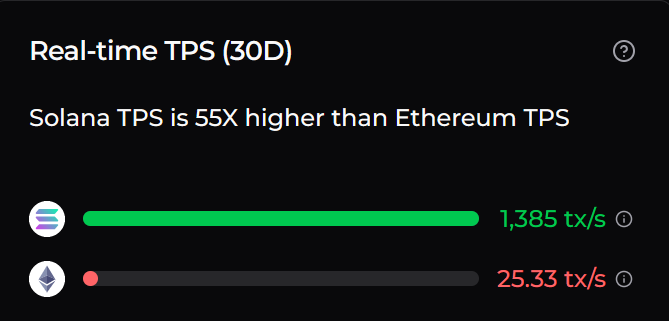
Solana’s real-time TPS over the last 30 days averaged 1,385 transactions per second. Ethereum averaged 25.33. That 55x gap is not a temporary anomaly tied to a market event; it reflects the fundamental architectural difference between the two chains.
At peak load (measured over 100 blocks), Solana reached 6,284 tx/s against Ethereum’s 62.87 tx/s, a 100x spread. The theoretical maximum extends that further: Solana is rated at 65,000 tx/s, while Ethereum’s ceiling sits at 238.1 tx/s, which makes the difference of a 273x.
Block time reinforces the gap. Solana produces a block every 0.4 seconds, in comparison to Ethereum, which takes 12.06 seconds. Transaction finality, the point where a transaction is considered irreversible, lands at 12.8 seconds on Solana. On Ethereum, that same threshold takes 12 minutes and 48 seconds.
For applications where speed is a core product requirement, such as high-frequency DEX trading, gaming infrastructure, and micropayment rails, this is not a footnote. It is a hard product constraint and what can be built on Solana today simply cannot be replicated on Ethereum at the base layer, and that boundary is defined entirely by these numbers.
Fees: Solana’s Cost Advantage Is Significant, but Not Translating to Revenue Dominance
The average transaction fee on Solana over the measured period was $0.003906. On Ethereum, it was $0.1314, which is roughly 34x higher per transaction. This creates an unusual dynamic in the revenue data. Solana processed 55x more transactions but generated only marginally more chain revenue: $384,200 versus Ethereum’s $259,600. In other words, Ethereum is extracting substantially more revenue per transaction despite moving far fewer of them.
This is relevant for two reasons. First, it signals that Ethereum’s fee base is more concentrated and, arguably, more monetizable per unit of activity. Second, it raises a question about Solana’s long-term validator economics: at $0.004 per transaction, volume must remain enormous and sustained to maintain network security incentives.
Decentralization: The Number That Rarely Gets Discussed
On the Nakamoto Coefficient, which measures how many validators would need to collude to compromise the network, Solana scores 20 against Ethereum’s 2, but that single metric sits uncomfortably alongside a validator count of 774 on Solana versus 931,900 on Ethereum, a participation gap that complicates any straightforward reading of which network is actually more resilient.
Both figures are factually accurate. What they represent, however, is a fundamental philosophical split. Ethereum has built a validator base that is broadly distributed across geographies and entities, which is difficult to coordinate or coerce at scale. Solana has a smaller but more economically concentrated set of validators, which produces a higher Nakamoto coefficient at the top but a much narrower participation base overall.
Ethereum’s staked value also reflects this: $79.2 billion is secured across those validators, versus $35.73 billion on Solana. Both chains use Proof of Stake with off-chain governance, but the security profiles are not equivalent.
Developer Ecosystem: Headcount vs. Depth
Solana has 10,867 contributors across its ecosystem versus Ethereum’s 9,050, a roughly 20% lead that looks meaningful until the underlying codebase activity is examined. Ethereum has accumulated 505,276 commits against Solana’s 90,772, maintains 434 repositories to Solana’s 133, and has received 190,761 GitHub stars compared to Solana’s 42,134, a depth of activity that a headcount figure alone does not capture.
The more useful interpretation is that Solana’s contributor numbers likely reflect growth at the application layer, wallets, protocols, and tooling built on top of the chain, rather than contributions to its core infrastructure. Ethereum’s commit and repository depth point to a more mature and extensively audited codebase, which carries real weight for institutional builders and protocol developers who treat long-term technical risk as a first-order consideration.
What the Market Cap Gap Actually Reflects
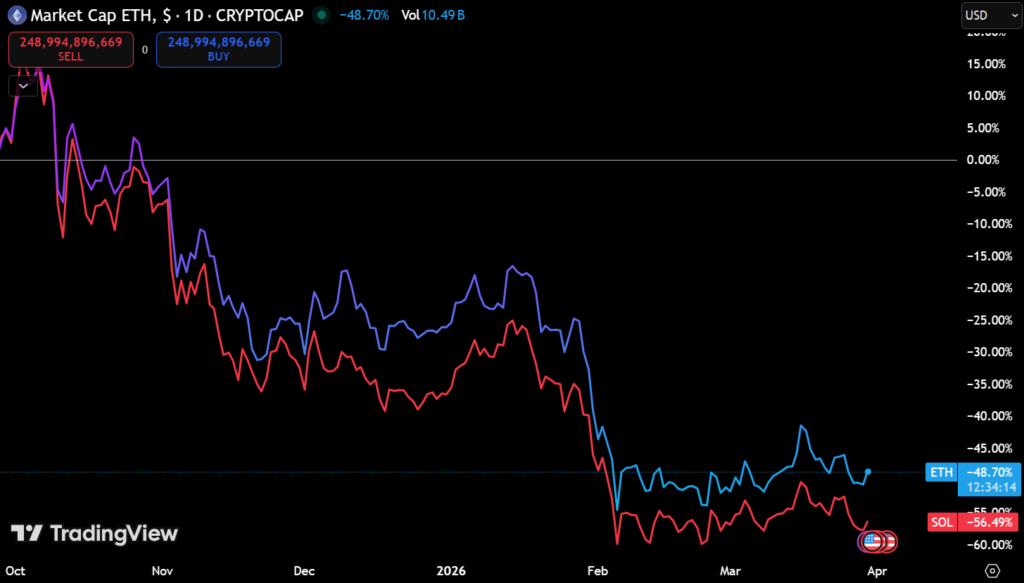
Ethereum’s $246.4 billion market cap against Solana’s $47.76 billion is an 80.6% gap that does not close just because one chain is faster than the other. Ethereum also has its entire supply already in circulation, sitting at a market cap to FDV ratio of 100%, while Solana’s 91.84% ratio means some supply is still waiting to hit the market, which is a small but genuine dilution consideration that Ethereum holders simply do not have to think about.
Solana launched in March 2020, five years after Ethereum’s July 2015 genesis, but the valuation difference is better understood as a reflection of what Ethereum has compounded over that period: DeFi composability, stablecoin infrastructure, institutional familiarity, and developer trust that does not get repriced upward simply because a newer network posts better throughput numbers.
What the Data Actually Shows
Solana is the throughput leader by a wide and measurable margin, processing faster, charging less per transaction, and accumulating 105 billion all-time transactions against Ethereum’s 3.34 billion, making it the more capable infrastructure today for use cases that require high-speed, low-cost execution.
Ethereum’s edge comes from things that are harder to replicate than raw speed: 931,900 validators securing the network, $79.2 billion in staked value, and a market position that a decade of real usage has quietly made very difficult to displace. Its lower TPS is not a secret or a failure; it is a deliberate trade-off that Ethereum has largely handed off to Layer 2 rollups rather than trying to solve at the base layer.
The comparison is not a verdict on which chain is better but a question of which properties are relevant for a given application. Solana is built for performance and Ethereum is built for distribution and trust, and both represent rational engineering trade-offs that the data reflects clearly without requiring further editorializing.


