




TicoBlockchain 2026 will take place on May 14 at the Barceló San José Hotel in San José, Costa Rica, opening the Costa Rica Tech Week, a series of technology and innovation events running from May 14 to May 24. Now in its sixth edition, the conference arrives at a moment when the regional context it operates in has shifted considerably from its early iterations.
The numbers behind that shift are significant. Between July 2022 and June 2025, Latin America recorded nearly $1.5 trillion in cryptocurrency transaction volume. Monthly activity climbed from $20.8 billion in July 2022 to a regional record of $87.7 billion in December 2024. Chainalysis: In 2025 alone, the region processed over $730 billion in on-chain crypto volume, a 60% year-on-year increase that placed Latin America at roughly 10% of global crypto activity. Monthly active crypto users across the region grew 18% in the same period, three times faster than in the United States.
This is the market backdrop against which TicoBlockchain 2026 is being convened.
From Retail Survival to Regional Infrastructure
Latin America’s crypto adoption did not originate from speculative interest. It emerged from structural financial failure. The region’s combination of persistent inflation, currency volatility, and restrictive capital controls across several countries continues to drive demand for stablecoins as a store of value and as a hedge against local macroeconomic risk. Chainalysis Argentina exceeded 220% inflation in 2024. Venezuela recorded 65,000% in a single year at its peak. For millions of people, stablecoins denominated in US dollars became a practical financial tool before they became a talking point.
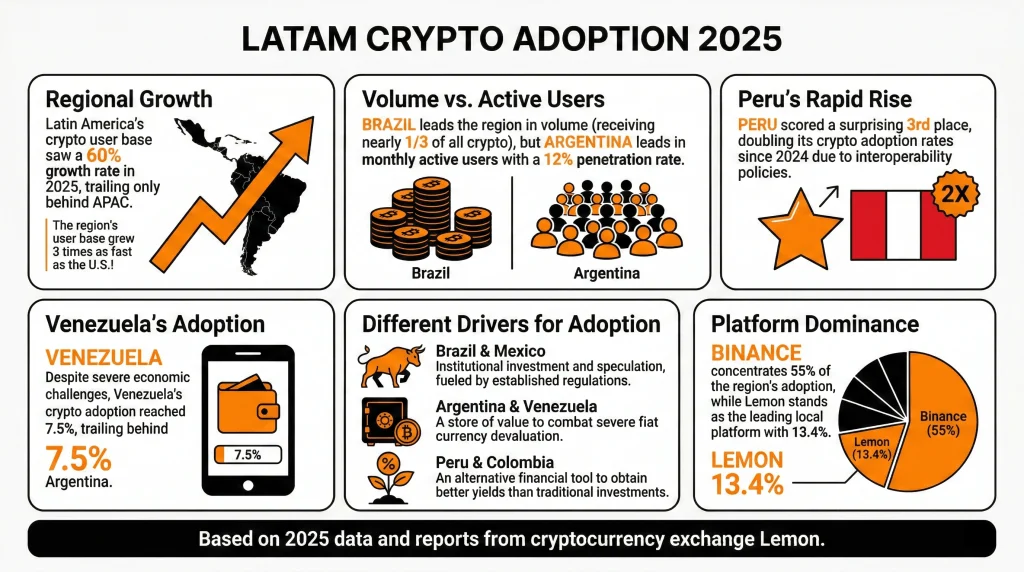
Institutional activity has now added another layer to that context. Brazil dominates the LATAM region with $318.8 billion in crypto value received, accounting for nearly one-third of all LATAM crypto activity, with a period-over-period growth rate of 109.9%. Chainalysis: Over 90% of Brazilian crypto flows are now stablecoin-related. Brazil’s B3 exchange approved the world’s first spot XRP and SOL ETFs ahead of the United States in 2025. In February 2026, Crypto Finance Group, part of Deutsche Börse Group, announced its expansion into Latin America, targeting institutional-grade custody and trading infrastructure.
The stablecoin story runs deeper than Brazil. Of the $730 billion received across LATAM in 2025, stablecoins made up a dominant share, with officials reporting that for the Colombian Peso, the Argentine Peso, and the Brazilian Real, stablecoin purchases account for over half of all exchange purchases between July 2024 and June 2025. Chainalysis: The remittance use case reinforces this. Latin America receives hundreds of billions in annual cross-border transfers. Traditional services charge an average of 6.2% per transaction. Blockchain-based infrastructure can reduce that figure dramatically, from roughly $3.12 per $100 on Bitcoin to under $0.01 on faster settlement rails.
What TicoBlockchain 2026 Is Built For
The 2026 program focuses directly on practical deployment: financial services, asset tokenization, and regulatory developments. These are not abstract conference themes. They map to the specific pressures and opportunities visible in the regional data. More than 400 attendees are expected, with 28 speakers from multiple countries, including representatives from Visa, Wink, and Nimiq. The agenda includes talks, panels, workshops, and pitch sessions alongside networking spaces for companies, developers, and public sector stakeholders.
The event is organized by the Costa Rica Blockchain Association and the Costa Rica Fintech Association. Its growth trajectory reflects the broader regional pattern. “The event has grown from around 100 attendees in its early editions to roughly 350 to 400 in recent years,” said Karla Córdoba Brenes, president of the Costa Rica Blockchain Association. “There are already clear examples showing the benefits of adopting these technologies, particularly in building more transparent and resilient business models.”
“We’re already seeing initiatives that make financial services more accessible, flexible, and inclusive,” added José Miguel Zamora, president of the Costa Rica Fintech Association. “TicoBlockchain is a chance to explore firsthand the tools and real-world use cases that are shaping the future of finance both locally and internationally.”
The Regulatory Variable
Regional momentum and regulatory clarity are not moving at the same speed. Brazil sits furthest ahead, with its Virtual Assets Law establishing KYC requirements, transaction reporting obligations, and formal AML/CFT oversight under the Banco Central do Brasil. A series of 2024 consultations are working toward finalized rules, though some proposals remain pointed: a cap on cross-border stablecoin transactions is still under active review, a significant consideration given that stablecoins now represent over 90% of Brazilian crypto flows. For the region’s dominant market to restrict the asset class driving most of its volume would carry consequences well beyond its borders.
Ten countries across the region now have formal crypto frameworks of some kind. Chile’s 2023 Fintech Law formally recognized digital assets as digital money. Bolivia reversed a decade-long crypto ban in June 2024. Argentina introduced mandatory exchange registration in 2025. Regulatory divergence between these markets remains a live risk for operators and investors active across multiple jurisdictions. For Costa Rica specifically, the question is how national policy frameworks will keep pace with the adoption curves visible in neighboring markets. TicoBlockchain’s positioning within the Costa Rica Tech Week suggests the country’s technology and policy communities are treating the issue as a priority question, not a deferred one.
The Latin America cryptocurrency market is forecast to reach $442.6 billion by 2033, growing at a compound annual rate of 10.93% from 2025, according to IMARC Group. Whether that growth distributes evenly across smaller markets or concentrates further in Brazil and Argentina depends substantially on the regulatory and infrastructure decisions being made now.


