





Optimism’s latest on-chain data presents a contradiction that rarely surfaces in mainstream Layer 2 coverage: a network processing tens of millions of transactions per month, backed by one of the largest developer communities in crypto, generating just $1,234 in chain revenue over the past 30 days. That gap between operational scale and financial return is not a rounding error. It is the central tension in Optimism’s current position within the Layer 2 landscape
Capacity Far Exceeds Demand
Optimism’s current real-time throughput currently stands at 21.65 transactions per second, against a maximum theoretical ceiling of 714.3 TPS and a recorded peak of 256.6 TPS across 100-block windows. As per sources like Chainspect, the network processed 56.1 million transactions over the past 30 days, bringing its total lifetime transaction count to 1.09 billion since its December 2021 launch.
The 2-second block time positions Optimism well against most Layer 1 networks on raw speed. However, the 16-minute and 48-second finality time is the more consequential figure. That delay is structural to the optimistic rollup design, where a challenge window must remain open before settlement is considered final on Ethereum. For applications requiring fast finality such as high-frequency trading or cross-chain bridges, this remains a real constraint rather than a footnote.
What the throughput data actually reveals is that Optimism is running at roughly 3% of its theoretical capacity on a typical day. The infrastructure headroom is substantial. Whether that spare capacity represents growth potential or chronic underutilization depends on which direction activity trends over the coming quarters.
The Nakamoto Coefficient Problem
Optimism’s Nakamoto Coefficient is 1, with a single validator responsible for the network’s sequencing. This is not a surprise for a network built on Optimistic Rollup architecture, but it is a metric that deserves direct attention rather than being buried in technical documentation.
A Nakamoto coefficient of 1 means that a single entity, specifically the Optimism Foundation’s sequencer, has complete control over transaction ordering. In practice, such a setup creates censorship risk and single-point-of-failure exposure that no decentralized application running on top of the network can fully mitigate at the infrastructure level. The governance layer is on-chain, which introduces community participation in protocol decisions, but sequencer centralization remains the structural reality at the execution layer.
Optimism has acknowledged sequencer centralization as a problem to be solved, and the Superchain roadmap outlines a path toward distributed sequencing. What the current data measures, however, is the network as it operates now, not as it is designed to become. A Nakamoto coefficient of 1 means the sequencer layer remains a single point of failure regardless of how robust the application layer above it is. Developers and capital allocators building long-term positions on Optimism are effectively pricing in a decentralization upgrade that has not yet been delivered.
Developer Activity Being the Strongest
The developer figures are the most constructive reading across all four metric categories. Optimism currently has 3,409 active developers across 96 repositories, with 179,162 total commits and 13,119 GitHub stars. The watcher count of 1,017 reflects ongoing technical interest from the broader developer community.
These are not vanity metrics. Developer count and commit volume are among the most reliable leading indicators for long-term network health, as they reflect the rate at which new applications, tooling, and protocol upgrades enter the ecosystem. A developer base of 3,409 places Optimism among the most actively built-on Layer 2 networks in the current market.
The more interesting analytical question is whether this developer activity is concentrated in the Optimism mainnet itself or is being redistributed toward OP Stack chains, which include Base, Mode, and a growing set of networks that use Optimism’s underlying infrastructure without directly contributing to OP token value accrual. If a significant share of those 3,409 developers are building on OP Stack derivatives rather than the Optimism mainnet, the headline figure overstates the direct network effect.
Financials: Where the Numbers Get Uncomfortable
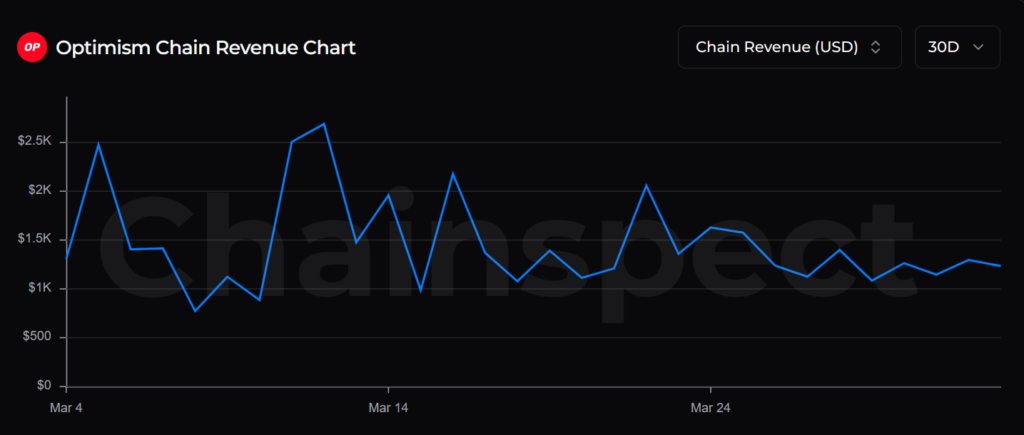
The financial data is where the Chainspect profile demands the most scrutiny. Monthly chain revenue of $1,234 alongside an average transaction fee of $0.0005964 tells a consistent internal story: Optimism has successfully delivered cheap transactions but, in doing so, has compressed its fee revenue to near zero.
The OP token currently trades at $0.1074, reflecting a market cap of $229.4 million and a fully diluted valuation of $461.1 million. The market cap to FDV ratio of 49.74% means that less than half of all OP tokens are currently in circulation, implying meaningful future dilution as the remaining supply enters the market over time.
At $229.4 million in market cap against $1,234 in monthly chain revenue, Optimism carries one of the widest valuation-to-revenue gaps in the layer 2 space. That ratio is not a miscalculation by the market. It reflects a deliberate pricing of future states: OP Stack becoming a fee-generating protocol layer, Superchain adoption creating sustainable value accrual for OP holders, and governance rights eventually carrying real economic weight. None of those states are visible in the current financials. The market is extending significant forward credit on outcomes that remain structurally unproven.
What Needs to be Focused On
Optimism sits in an analytically unusual position. Its throughput infrastructure is underutilized but capable. Its developer community is large and actively building. Its decentralization profile carries a known single-sequencer risk that is structural, not accidental. And its financial metrics reflect a deliberate trade-off of fee revenue in exchange for adoption, one that has succeeded on the adoption side while leaving revenue nearly invisible.
The most forward-looking variable to track is whether the Superchain strategy generates protocol-level revenue that flows back to OP holders or whether Optimism’s infrastructure becomes the base layer for value captured elsewhere. That distinction will determine whether the 49.74% market cap to FDV ratio represents a discounted entry point or a persistent overhang.


