





There is a number in TRON’s 30-day performance data that does not get nearly enough attention: the network’s theoretical ceiling sits at 2,516 transactions per second, yet its actual average throughput over the past month ran at 123.8 tx/s. That is 4.9% utilization and for a chain processing $21.5 billion in daily USDT volume and carrying more than $80 billion in stablecoin supply, that gap is not a sign of failure. It is the structural foundation of TRON’s entire value proposition.
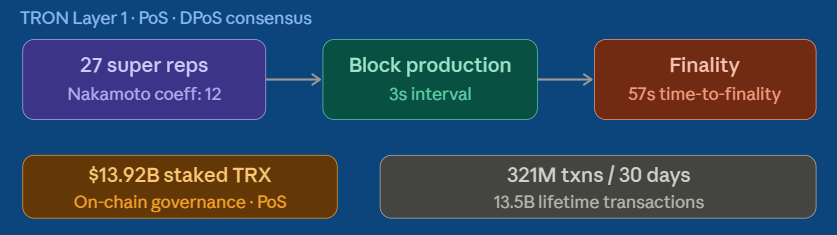
TRON launched on June 25, 2018, and has accumulated 13.5 billion lifetime transactions across its 7-plus years of operation. The network currently runs on a delegated proof-of-stake model with 27 Super Representatives, a Nakamoto coefficient of 12, and $13.92 billion in staked TRX securing the chain. Block time is consistent at 3 seconds, with time-to-finality at 57 seconds. These are not the metrics of a network still finding its footing. They are the parameters of a mature settlement layer operating within well-understood bounds.
The Throughput Data and What It Actually Says
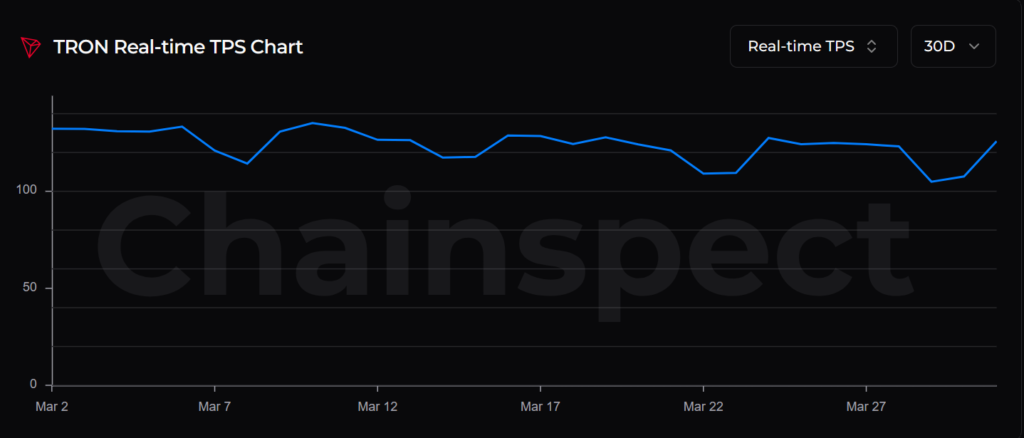
The 30-day window recorded 321 million transactions, at an average real-time rate of 123.8 tx/s. During peak congestion periods across 100-block windows, throughput reached 272 tx/s. That peak represents 10.8% of TRON’s theoretical maximum, which means even under the heaviest load observed this month, the network had nearly 90% of its capacity sitting idle.
The non-obvious insight is that TRON’s architectural design deliberately builds in excess capacity. The bandwidth and energy resource model, rather than a direct gas fee market, means the network does not price itself into congestion. Users who stake TRX or maintain bandwidth allowances can transact at near-zero marginal cost. The system absorbs demand without the fee spikes that would signal a capacity constraint. This is why average transaction fees sit at $0.09805 despite the network handling hundreds of millions of monthly transactions.
TRON’s median transfer fee of roughly $0.09 compares to Ethereum’s $3.73, with confirmation times of 3 seconds versus 12 seconds, which positions the chain as a practical middle ground: fast and cheap enough for everyday transfers, while established enough to handle billions in daily volume.
Stablecoin Settlement as the Core Business Model
The 321 million monthly transactions do not distribute evenly across use cases. Approximately 45% of all USDT in global circulation now resides on TRON, with over 69 million accounts holding USDT on the network and more than one million conducting daily transfers. TRON’s transaction volume is essentially a stablecoin clearing operation running at an industrial scale.
TRON processes approximately 2.3 to 2.4 million daily USDT transactions, which is 6.8 times more than Ethereum, with daily transfer volume reaching $24.6 billion, more than 2.7 times Ethereum’s equivalent figure. That volume-to-transaction count ratio reveals a dual-use network: large institutional transfers moving billions per transaction alongside high-frequency retail activity in the sub-$1,000 range.
In Q3 2025, 74% of TRON’s daily active users engaged in peer-to-peer transactions, the highest proportion among major Layer-1 blockchains, reinforcing the network’s identity as a retail-focused payments infrastructure rather than a DeFi or trading platform.
Chain Revenue: The +52.66% Signal
Chain revenue of $1.079 million, up 52.66% over the prior period, is the most financially significant data point in this snapshot. The directional signal matters more than the absolute figure. TRON implemented a fee reduction in mid-2025 that compressed daily protocol revenue, which means the current uptick is not baseline growth riding a favorable fee structure. It is volume-driven recovery. Transaction density is rising against a lower fee ceiling, which is a structurally stronger signal than revenue growth fuelled by fee increases. If the current monthly rate holds, annualized chain revenue approaches $12.9 million, though the more relevant observation is that the network is generating more in fees with cheaper per-transaction costs, a combination that only holds if underlying usage is genuinely expanding.
The market cap to FDV ratio of 100% is also worth pausing on. With a $30.42 billion market cap equalling its fully diluted valuation and TRX priced at $0.3211, there is no supply overhang from unvested allocations or locked tokens. What the market is pricing is the network as it currently operates, not a future state contingent on emission schedules or unlock events. That is a structural clarity most layer-1 tokens cannot claim.
Developer Activity: The Relative Weakness
The network’s weakest metric relative to its operational scale is developer activity. With 421 active developers across 54 repositories and 41,188 total commits, TRON’s developer footprint is modest for a $30 billion market cap chain. The 8,805 GitHub stars and 1,064 watchers further indicate limited external developer engagement compared to chains like Solana or Ethereum, which benefit from substantially larger builder ecosystems.
This is not an immediate operational concern because TRON’s core protocol is functionally stable and does not require the same rate of innovation that application-layer chains demand. However, if TRON intends to expand beyond its stablecoin settlement niche into more complex DeFi or programmable finance, developer depth becomes a meaningful constraint.
What it means for Traders and Investors
For TRX holders, the combination of full supply dilution (MC/FDV at 100%), $13.92 billion in staked collateral, and a 52.66% revenue uptick within a single reporting period creates a clear fundamental picture: the network is cash-flow positive, there is no hidden supply pressure, and revenue is accelerating rather than compressing. The question is whether TRX pricing at $0.3211 adequately reflects the utility value of the settlement infrastructure underneath it.
For participants in the USDT ecosystem specifically, TRON’s 4.9% utilization rate is the key number. TRON commanded 56% of global retail-sized USDT transfers under $1,000 through Q4 2025, maintaining the highest share among all benchmarked networks. At that dominance level, with 95% of network capacity structurally available, the chain faces no medium-term throughput ceiling that would force fee increases or degrade settlement reliability.
Forward Perspective
The 57-second finality time is the most meaningful technical limitation in TRON’s current architecture. For high-frequency payment use cases and any cross-chain settlement protocol requiring atomic finality, nearly one minute is a structural bottleneck that does not get resolved through higher TPS alone. The GreatVoyage-v4.8.1 hard fork, which began rolling out to mainnet in early 2026, primarily addresses EVM compatibility and node efficiency rather than finality speed directly. That gap will require architectural attention as TRON competes for institutional payment flow against newer chains with sub-second finality.
What the 30-day data confirms is that TRON is operating as designed: high volume, low fees, deliberately wide capacity margins, and concentrated around a single dominant use case it has executed with measurable precision. That is not a limitation. It is a business model.


