





Uniswap occupies a genuinely rare position in DeFi and is one of the few protocols that has maintained market leadership through multiple cycles, survived the emergence of aggressive competitors, and continued to see meaningful on-chain usage without relying on unsustainable incentive programs to manufacture volume. But protocol strength and token strength are not the same thing, and the native token, UNI at $3.60 with a 10.27% seven-day decline is a useful moment to separate the two and examine what the fundamentals actually support.
The Protocol Case: Where Uniswap Is Genuinely Strong
Uniswap V3 remains the most capital-efficient AMM design at scale. The introduction of concentrated liquidity and multiple fee tiers per pool fundamentally changed how liquidity providers deploy capital, allowing them to target specific price ranges rather than spreading liquidity uniformly across an infinite curve. That design improvement is not cosmetic. It means that for a given depth of liquidity, V3 pools produce better execution quality than V2-style designs, which is why Uniswap continues to attract professional market makers and LP strategies that would otherwise migrate to platforms with lower fees or better architecture.
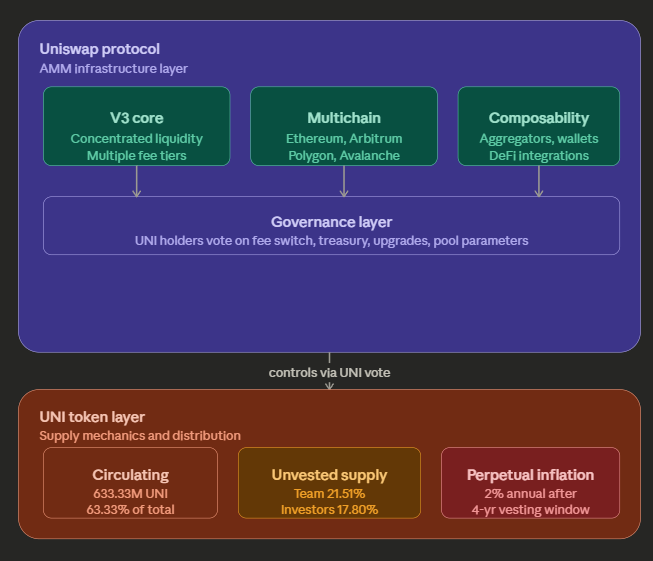
The multichain footprint extends that advantage beyond Ethereum mainnet. Uniswap is deployed across Arbitrum, Polygon, Avalanche, and several other networks, which means the protocol captures volume from ecosystem activity broadly rather than being anchored to the fee and congestion dynamics of a single chain. When Ethereum mainnet becomes expensive to use, Uniswap does not lose the user, it redirects them to a cheaper deployment on an L2 where a Uniswap pool is already present. That architecture makes the protocol structurally resilient to the chain-level rotation that has historically cannibalized single-chain DEX volume during periods of high gas or shifting user preference. The 24-hour trading volume of $227.7 million against a $2.28 billion market cap reflects that breadth in practice, confirming that UNI is not a governance token sitting on top of a dormant protocol but one backed by a platform generating consistent and measurable trading activity across multiple networks simultaneously.
Uniswap’s composability within the broader DeFi stack is another durable strength that is easy to underestimate. Aggregators like 1inch and Paraswap route through Uniswap pools as a matter of course because the liquidity is reliably present. Wallets integrate Uniswap swap functionality directly. New protocols build on top of Uniswap infrastructure because the permissionless pool creation model makes it the path of least resistance for token launches and liquidity bootstrapping. That embedded position in the infrastructure layer creates a demand baseline for the protocol that is not easily disrupted by a competitor offering marginally better fees on a single chain.
The Token Case: Where It Gets More Complicated
The protocol case for Uniswap is strong. The token case is more nuanced, and understanding the distinction is where most surface-level UNI analysis falls short. UNI’s value rests on governance rights over the protocol and treasury, not on a direct claim over what the protocol actually earns. That distinction matters more than most UNI analysis acknowledges. The fee switch, which would redirect a portion of protocol fees to token holders, has been in governance discussions for years without being implemented at any meaningful scale, meaning Uniswap can process billions in trading volume while UNI holders receive none of it directly. Until that changes through a governance vote that actually passes and holds, the gap between protocol value and token value remains structurally unresolved.
The supply mechanics compound that structural issue. Total supply is 1 billion UNI, with approximately 633.33 million currently circulating, representing 63.33% of total supply. The remaining 36.67% includes team and investor allocations subject to vesting schedules, which means supply entering the market is an ongoing consideration rather than a resolved question. More structurally significant is the 2% perpetual annual inflation mechanism that activates after the initial four-year distribution window. That inflation exists to incentivize ongoing participation but it also means UNI holders face a consistent dilution rate that compounds over time, and the value of that inflation is only neutralized if governance activity and protocol growth absorb the additional supply at current or higher prices.
The distribution breakdown warrants attention for anyone taking a conviction position. Approximately 21.51% of total supply is allocated to the team and 17.8% to investors, with advisors holding a further 0.69%. Combined, these allocations represent nearly 40% of total supply in the hands of parties with cost bases well below current market price, and governance concentration in large holders can influence protocol decisions in ways that do not necessarily align with smaller token holders’ interests.
The Competitive Pressure Is Real but Overstated in Most Analysis
Uniswap faces genuine competition from aggregators capturing order flow, from L2-native DEXes offering lower execution costs on specific chains, and from on-chain orderbook models like those emerging on Solana that offer a different execution paradigm entirely. That competitive pressure is real and it has taken measurable fee share from Uniswap in specific market segments, particularly on chains where a native DEX has established a liquidity depth advantage.
But the competitive threat is frequently overstated in analysis that treats AMM market share as a winner-take-all contest. Uniswap’s strength is not that it is the cheapest platform on any given chain. Its strength is that it is the most reliably liquid go to platform across the most chains simultaneously, which is a different and more durable competitive position. An aggregator that routes through Uniswap is not displacing Uniswap. It is using Uniswap as infrastructure while capturing the UX layer, and Uniswap continues to earn fees from that volume regardless of where the order originated. The more legitimate competitive risk is a protocol that replicates V3’s capital efficiency on a lower-cost chain with sufficient liquidity depth to attract the professional LP strategies that currently anchor Uniswap’s pool quality, and that has not yet materialized at a scale that threatens Uniswap’s core position.
Social Sentiment and the Current Price Context
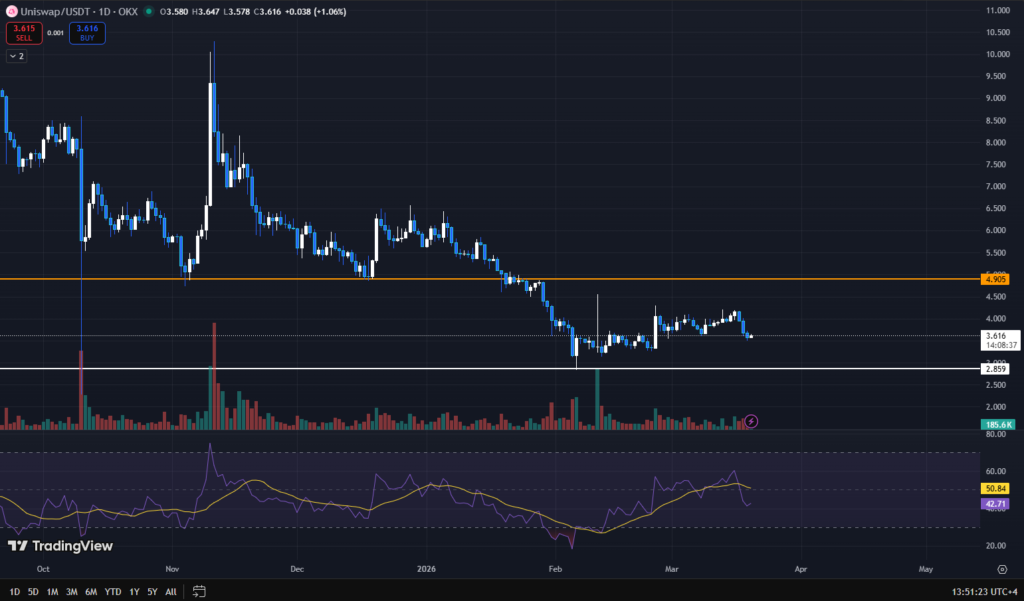
A net social sentiment reading of 4.9 out of 10 over the seven-day window is about as close to neutral as a score gets, and the price action reflects that ambivalence precisely. The 10.27% weekly decline and a daily move of essentially zero sit alongside a 30-day trading range of approximately $3.34 to $3.98, a band narrow enough to confirm that UNI is not attracting the kind of directional conviction that would break it materially in either direction. The episodic volume spikes on February 25 and March 6 are the clearest evidence that price movement in this range is being driven by broader market conditions pulling capital in and out rather than anything specific to Uniswap as a protocol, and that dynamic is reflected in the social tone where bullish technical setups and bearish trend breakdown concerns exist in roughly equal measure without either side building enough momentum to shift the narrative.


