





For years, the digital asset industry operated on a simple assumption: whoever controls the private key controls the asset. It was clean, technically accurate, and entirely insufficient for how institutions actually manage financial risk. That assumption is now colliding with a much harder reality.
As enterprises, fintechs, and regulated financial institutions move deeper into digital assets, the definition of custody has fundamentally changed. It is no longer a question of where keys are stored. It is a question of who governs access, who holds accountability, how decisions are made, and how that entire framework holds up under regulatory scrutiny. In short, custody has become the operating system for institutional digital asset ownership.
When Ownership Gets More Complicated
Digital assets introduced a simple but radical idea: ownership equals control of the private key. There is no need for an intermediary, clearing system, or reversible transaction. This was part of the original appeal: direct, frictionless, and borderless.
But institutions do not operate that way, and increasingly, neither does the digital asset ecosystem. The introduction of delegated control, regulated custody structures, and tokenized financial assets has made the meaning of ownership far more nuanced. A large institution managing tokenized securities on a blockchain is not simply asking who holds the key. It is asking who has the authority to act on the asset, under what governance framework, and with what legal accountability attached.
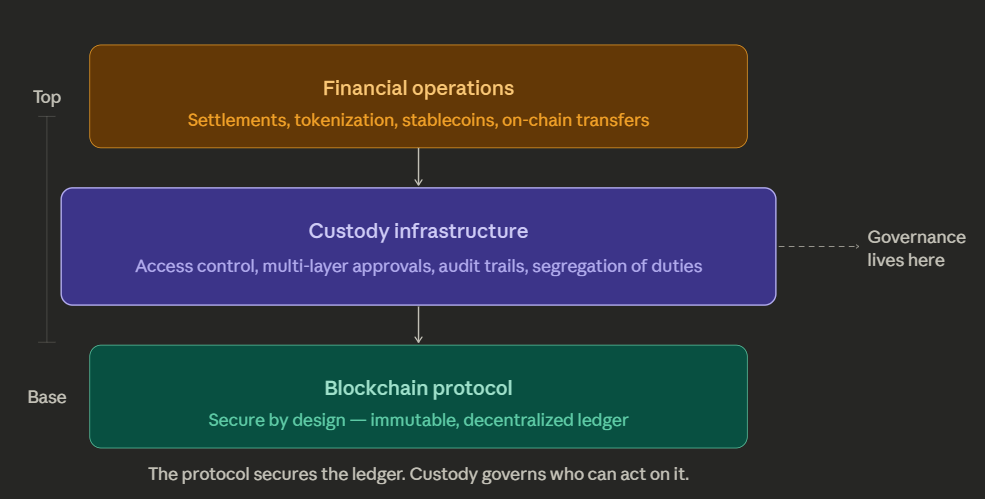
This distinction matters more than most industry commentary acknowledges. Manhar Garegrat, India Head at Liminal Custody, has been direct about this point: on a blockchain, the ledger is secure by design. But governance, which includes who can initiate a transaction, who must approve it, and who is accountable if something goes wrong, is defined entirely outside the protocol layer. That is the gap custody infrastructure must fill. And for institutions entering this space, filling that gap is not optional.
The Shift in Who Makes Custody Decisions
One of the clearest signals that custody has become a governance question is visible in who is now sitting at the table when institutions evaluate custody solutions. A few years ago, engineering and technology teams owned these decisions. Today, they routinely involve chief information security officers, chief financial officers, risk committees, compliance teams, finance functions, and external auditors.
That shift is not cosmetic. It reflects what institutions are actually asking for. Enterprises evaluating custody today are not shopping for wallets or key storage. They are looking for systems that support policy-based access controls, multi-layer approval workflows, segregation of duties, complete audit trails, and documented disaster recovery protocols. In other words, they want custody systems that behave like the governance and control frameworks they already use in traditional finance, adapted for a blockchain environment.
This is why digital asset custody is increasingly evaluated in the same category as enterprise cybersecurity and operational risk management. For institutions, it is not an IT procurement decision. It is a risk architecture decision.
Tokenization and Stablecoins Are Raising the Stakes
The governance stakes are rising further as the next wave of digital asset infrastructure takes shape. Stablecoins are being actively used for cross-border payments, treasury operations, and settlement. Tokenized financial assets, including securities, funds, and real-world assets, are moving onto public and permissioned blockchain networks. On-chain settlement is compressing transaction cycles from days to minutes.
These developments represent a structural shift from digital assets as speculative instruments to digital assets as operational financial infrastructure. And infrastructure, by definition, requires robust controls. When transactions are irreversible and value moves in real time, the cost of a governance failure is not a technical incident. It is a financial and regulatory event.
In this environment, custody infrastructure becomes the control layer for financial operations, the mechanism through which institutions can actually participate safely in tokenized markets and on-chain settlements. Without it, the institutional case for digital assets remains theoretical.
The Direction the Industry Is Heading
Traditional finance did not become institutional-grade because the technology improved. It became institutional-grade because custody, clearing, and settlement were standardized into regulated infrastructure that every participant could rely on. Digital assets are at the beginning of that same transition, and the outcome will look less like a technology upgrade and more like a structural reorganization of who controls what, under what rules, and who is accountable to whom.
Institutions will increasingly evaluate custody providers not on technical features alone but on governance frameworks, operational resilience, compliance readiness, and demonstrated risk management capabilities. The providers that will matter in the next phase of this market are not those with the most advanced key management technology. They are those that can credibly sit alongside a CFO, a risk committee, and a regulator and explain how control over assets is maintained at every level.
The next phase of institutional digital asset adoption will not be unlocked by a new protocol or a new asset class. It will be unlocked by infrastructure that institutions can actually trust. And that infrastructure starts with custody. Because in digital assets, security has never just been about protecting systems. It is about controlling assets, managing risk, and ensuring governance. That is why custody is not simply part of Web3 security; it serves as the backbone for the same.


