





Rarely do the most significant changes in the cryptocurrency market announce themselves through price movements. They first reveal through the configuration of supply, the actions of long-term investors, and the subtle changes in on-chain demand. Attention is primarily drawn to the $90K churning of Bitcoin and the post-ETF stagnation of Ethereum, but a stronger structural separation is developing underneath, one that reveals the distinct capital dynamics of the two leading digital currencies. This is not a narrative based on emotions. It is a narrative about the movements of money, the creation of new coins, the taking up of liquidity, and the transformation of demand.
Macro Supply Conditions: Bitcoin’s Scarcity vs Ethereum’s Elasticity
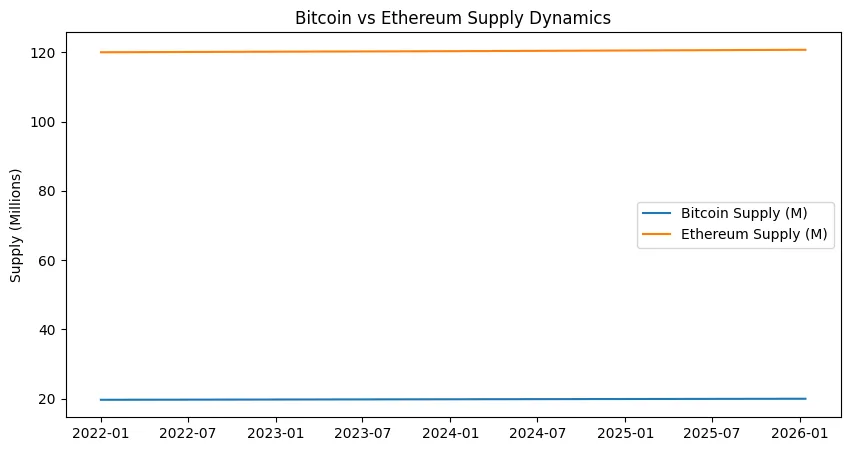
The mechanics of Bitcoin’s supply are still inflexible. After the 2024 halving, the daily mining output has reduced to around 450 BTC a day, which is creating an unyielding supply throttle that is less and less approachable for the institutional capital flows. ETFs, government allocators, and company cash reserves now constitute stable, rule-based buyers rather than mere speculative participants. This demand is not self-reinforcing; it is allocation-based. Moreover, in a market where the marginal supply is strictly limited by algorithms, the inflows create a situation of unequal pressure on price discovery through a prolongation of the inflows.
Ethereum, on the other hand, is subjected to a totally different and loose supply policy. Even though the introduction of EIP-1559 in the form of fee burning, made ETH conditionally deflationary in periods of heavy network usage, the issuance keeps responding to the staking and network activity. As staking yields return to normal and transaction fees decrease because of Layer 2 migration, Ethereum’s net supply has become less strict. A lack of scarcity is no longer the major story line. Instead, it has been replaced by use and economic throughput. This difference is significant because the markets do not value the stories they tell. Instead, they value the constraints.
On-chain demand: Accumulation vs Utilization
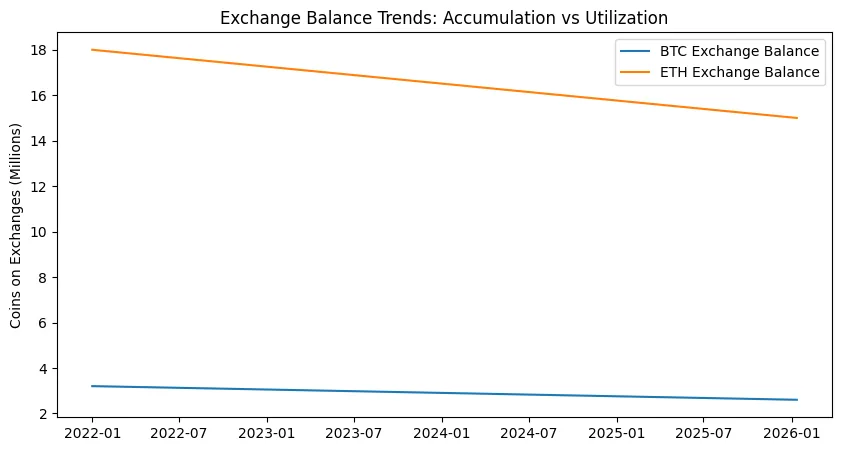
The data from Bitcoin’s blockchain indicates that the market is primarily characterized by accumulation behavior. The supply of long-term holders is still quite high, and the amounts on exchanges are still decreasing, and the amount of supply has been realized that is being locked into cold storage or ETF custody. Transaction speed has decreased, but not because of lack of interest; rather it is because the use of Bitcoin has changed to being a collateral asset, reserve, and macro hedge.
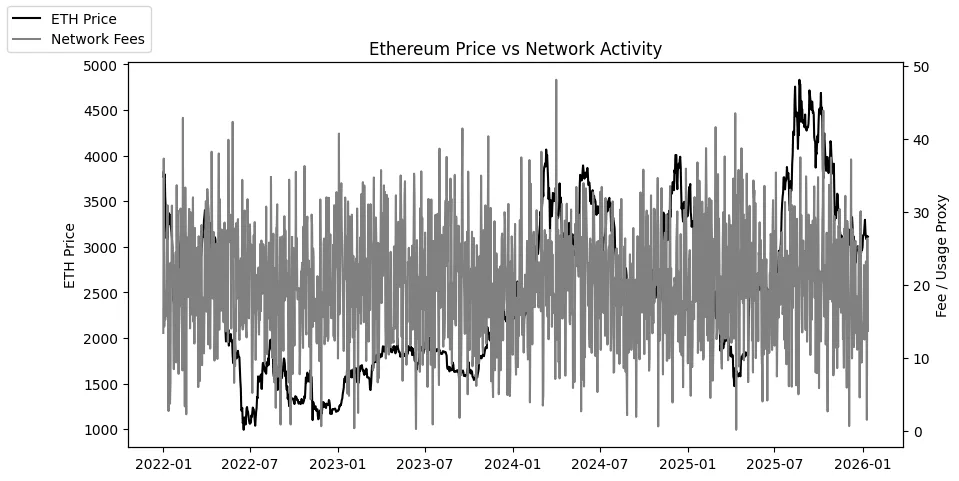
Today’s demand for Bitcoin originates from balance sheets.Ethereum’s on-chain demand provides us with a completely opposite scenario. The activity is more and more dispersed across Layer 2 networks, with the mainnet acting as a settlement and security layer instead of being a transactional hub. The gas usage has remained constant, but the fee intensity has become less. The demand pattern has changed from speculative accumulation to functional utilization: DeFi, rollups, tokenized assets, and enterprise rails. Today, Ethereum’s demand is driven by infrastructure. The situation here leads to a divergence in the response of each asset to macro liquidity.
Liquidity Sensitivity and Capital Transmission
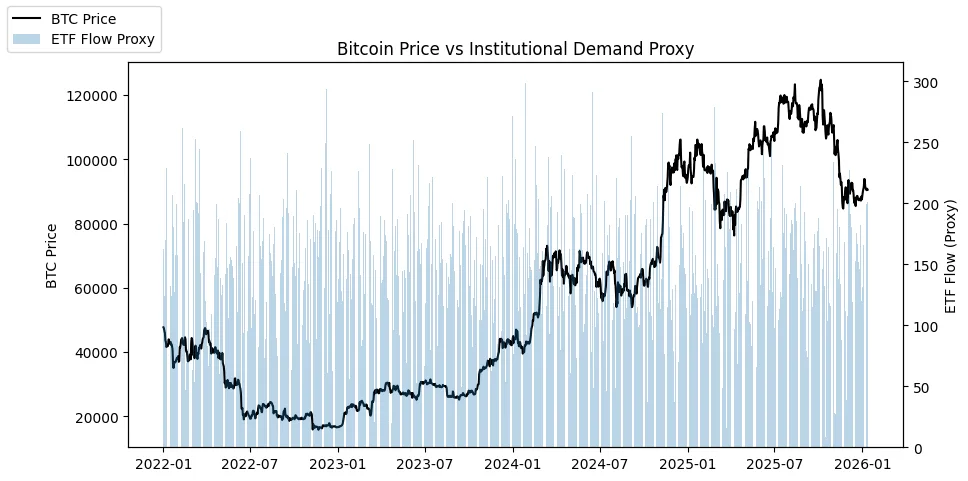
Bitcoin has the characteristics of a macro instrument and a mechanism of getting liquidity changes. Bitcoin has been absorbing the liquidity when the global liquidity expansion takes place. Conversely, it has been showing out the tightening of financial conditions. Its association with real rates, dollar liquidity, and risk-on flows has been getting stronger over time. Furthermore, the introduction of ETFs has contributed to this situation’ enormously as they are the bridge between Bitcoin and the traditional capital markets. On the other hand, Ethereum is portrayed as a platform asset that has the strongest character.
The price of Ethereum is less directly affected by liquidity expansion and more by the ecosystem’s throughput, generation of fees, and developer-initiated innovation. The capital that comes to Ethereum is due to its usage, not the allocation. This is why usually the Bitcoin liquidity cycles’ leading and the Ethereum way of always lagging until the on-chain fundamentals have re-accelerated become evident.
Supply Absorption vs Network Monetization
Bitcoin’s value capture can be described as supply absorption. Buyers, who are structurally persistent, are consuming the new issuance. The liquidity leaves the exchanges and hardly ever comes back. This results in long-term upward pressure even if the price is consolidating at that moment in time. Ethereum’s value capture can be defined as network monetization.
The economic gravity of ETH is determined by the fees, MEV, staking yields, and L2 settlement volumes. When the activity shrinks, so does the motivation for marginal demand to stack up ETH just as an asset. One is limited by the issuance while the other is limited by the throughput.
Institutional Behavior: Allocation vs Participation
Institutions treat Bitcoin as an asset, while they treat Ethereum as a network. The ways of investment in these two cryptocurrencies are quite different. Bitcoin is moving towards ETFs, treasuries, and custodial vaults. Ethereum is moving towards validators, DeFi protocols, and infrastructure stacks. Their demand functions are completely dissimilar. Bitcoin’s demand is unidirectional.
Ethereum’s demand is dependent on certain conditions. This difference is what helps Bitcoin to stay strong even when on-chain activities are low, while Ethereum needs the whole ecosystem to speed up its activity to keep the momentum going.
What The Divergence Signals For The Next Phase
The market is moving from speculation based on stories to allocations based on structures and usages through and through.Bitcoin is starting to be recognized as a monetary instrument.
Ethereum is steadily being recognized as financial infrastructure. Price stability comes before expansion in the case where supply is rigid and demand is allocative.
If the supply is pliable and the demand is based on usage, then growth needs a greater capacity. This differentiation does not indicate weakness in Ethereum or dominance in Bitcoin. It mirrors specialization.
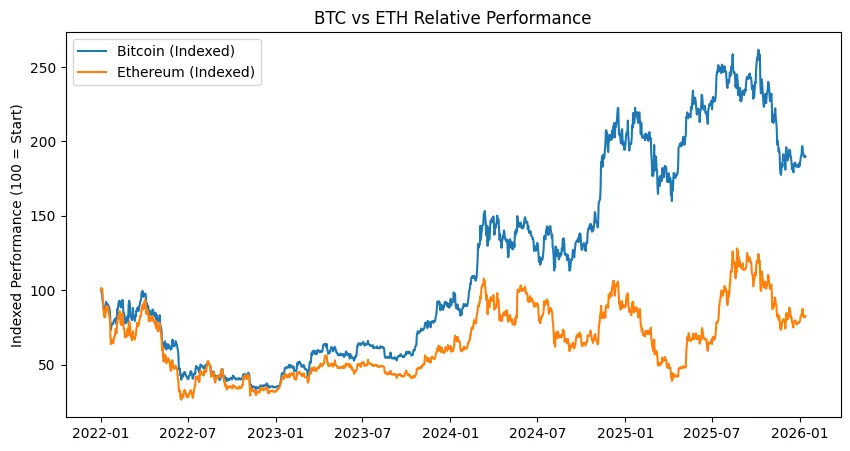
The next phase of the crypto market would not be marked by a uniform rise in prices. Rather it will be characterized by different capital behaviors. Bitcoin will be influenced by the macro liquidity scenario.On the contrary, Ethereum will be influenced by the network economics. The gap between these two reactions is where the true narrative is.


