





With Brent crude at $109 and the Nasdaq retreating 0.7% on above-consensus U.S. employment data, the default expectation was a broad risk-off move across asset classes. Bitcoin ignored that script, adding 4.09% over seven days to trade at $69,200. Understanding why that divergence is analytically credible, rather than fragile, requires looking past the price and into the collateral structure of the derivatives market.
The Leverage Picture: A Market That Has Cleared Its Excess
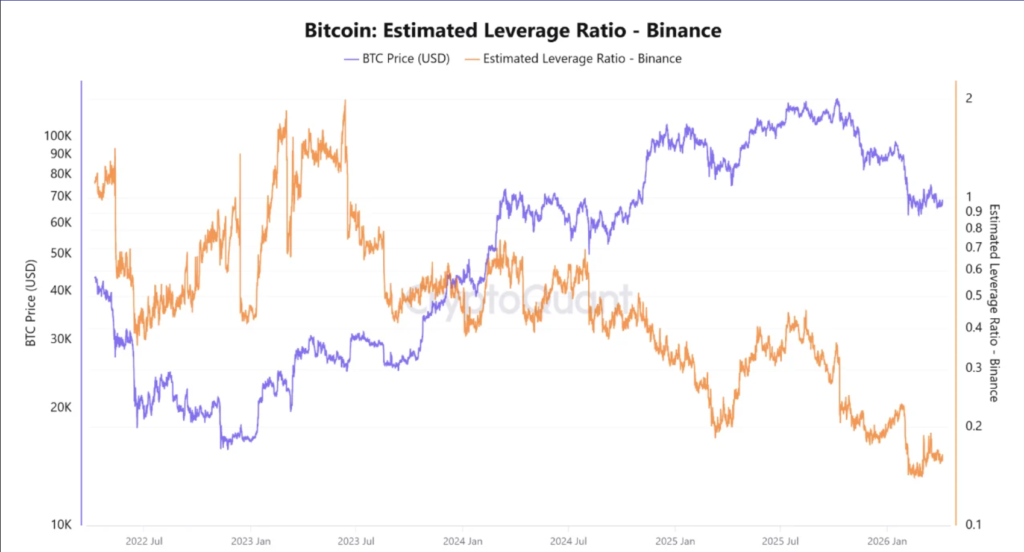
Binance’s Estimated Leverage Ratio (ELR), which measures the size of open futures positions relative to USDT reserves held on the exchange, currently sits at 0.16. This is a low reading by any historical standard on this chart.
To appreciate what that number means, it becomes important to consider the reference points. During Bitcoin’s all-time high in October 2025, the ELR on Binance registered 0.34. It read 0.20 at the height of the tariff-driven selloff in April 2025. The current reading of 0.16 is just two basis points above the deepest exhaustion level that was observed in the present bear cycle: 0.14, logged on February 6, 2026.
The analytical implication has now become more simple and straightforward. When the ELR is low, the USDT reserves sitting on Binance dwarf the aggregate notional value of open futures positions. Traders are not using the available collateral to build large directional bets. The idle USDT capital, referred to as “dry powder,” is overshadowing Open Interest by a considerable margin. This situation is structurally different from a leverage-driven rally, where rising prices are amplified by increasingly crowded long positions layered on thin collateral.
At Bitcoin’s October 2025 all-time high, the ELR on Binance read 0.34, more than double the current 0.16. At that peak, price and leverage were moving in the same direction, a configuration that concentrates fragility into the market structure. Today the relationship has inverted and the price is recovering toward $69,200 while leverage sits near the floor of its multi-cycle range. That inversion is not a minor footnote; it is the core reason the current move reads differently from prior rallies.
Funding Rates and the Coinbase Premium: Completing the Picture
A Funding Rate of 0.006993 on Binance sits well below the levels historically associated with leveraged euphoria. Perpetual futures funding becomes a risk signal when long-side crowding pushes the rate aggressively higher, forcing marginal traders to either pay steep carrying costs or exit. At the current reading, that pressure does not exist. The market is leaning long, but without the structural tension that precedes forced unwinds.
Coinbase Premium at -0.0263395 means Bitcoin is cheaper on Coinbase than on competing global exchanges. That spread reflects demand, or the current absence of it, from U.S. institutional participants who route primarily through Coinbase. A premium would indicate aggressive institutional buying pressure, and a discount indicates the opposite. At -0.0263395, the index confirms that the capital pushing Bitcoin to $69,200 is not originating from American institutions navigating equity weakness and macro uncertainty. It is coming from elsewhere.
These three indicators converge on a single conclusion: the current price recovery in Bitcoin is being absorbed primarily through spot market buying, driven by global retail participants, not by American institutional flows, and not by leveraged derivatives positioning.
What the $65,000 Support Zone Represents
The practical implication of a low-leverage environment becomes most relevant when evaluating the quality of support levels. When open interest is large relative to collateral, a sharp adverse move can trigger cascading liquidations, long positions forced to close as prices fall, accelerating the move lower and producing a self-reinforcing flush. This mechanism, commonly referred to as a long squeeze, is a function of how much borrowed capital is stacked in the market.
With the ELR at 0.16, the structural preconditions for a long squeeze are statistically weak. The $65,000 level, which represents organic spot demand based on the current onchain profile, is not defended by a wall of leveraged longs that could collapse under pressure. It is defended by buyers who have deployed actual capital, with no margin clock counting down against them.
This distinction matters considerably in the current geopolitical environment. If the geopolitical situation escalates and traditional risk assets take another leg lower, the transmission mechanism that historically connected macro shocks to crypto liquidation cascades has been significantly reduced.
The Larger Pattern
Looking at the full ELR chart from mid-2021 through early 2026, a consistent behavioral pattern emerges. Leverage tends to peak near local price tops and compress during the deepest phases of drawdown. What is unusual about the current reading is where it sits relative to price. Bitcoin is trading near $69,200 well off the cycle lows, while the ELR has continued to compress, now approaching the floor of 0.14 seen at the bear market’s most exhausted point.
Historically, periods where price recovers while leverage remains depressed have preceded more durable advances. They suggest that spot demand is doing the work of price discovery rather than derivatives amplification. The sustainability of the current move and the resilience of the $65,000 demand zone rest precisely on this structural foundation.


