





Binance Bitcoin Cumulative Net Taker Volume hit $1.02 billion on April 7, the highest 24-hour reading since March 17. That level does not just represent elevated buying activity. At four times the $250 million threshold that marks the upper boundary of routine buy-side flow on the exchange, it signals a discrete burst of aggressive directional positioning concentrated in a single session.
The data from CryptoQuant shows a chart pattern that puts the latest spike in sharp relief. Over the preceding three weeks, Net Taker Volume oscillated between roughly negative $1.2 billion and positive $600 million, with no prior reading in that window coming close to the April 7 figure. The visual gap between this latest bar and everything that preceded it is not subtle.
The Macro Trigger
The spike did not originate inside crypto markets. A two-week U.S.-Iran ceasefire reduced immediate pressure around the Strait of Hormuz, and energy markets repriced fast. Oil dropped from approximately $118 to $96 intraday, stripping out a meaningful chunk of the war-risk premium that had been sitting in energy pricing for weeks. That compression in geopolitical stress translated directly into improved risk appetite across broader markets, with Bitcoin’s Binance derivatives flow capturing the rotation in real time.
Geopolitically driven oil spikes do not stay contained in energy markets. They function as a broad liquidity tax, pulling capital into defensive positioning across asset classes at the same time. Bitcoin sits far enough out on the risk spectrum that it tends to absorb that shift more severely than most. The $22 intraday oil drop following the ceasefire confirmation ran that mechanism in reverse. Defensive positions unwound, risk appetite reopened, and the Binance net taker data registered where a measurable portion of that capital moved.
What the $1.02 Billion Reading Actually Means
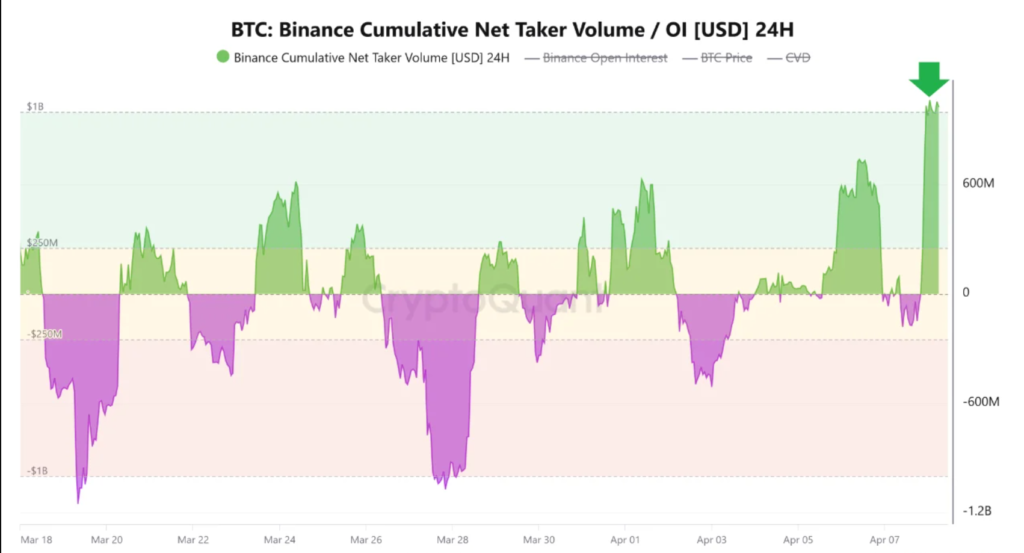
Cumulative Net Taker Volume measures the difference between aggressive buy orders (market buys hitting the ask) and aggressive sell orders (market sells hitting the bid) over a rolling 24-hour window. A reading of $1.02 billion means buyers were not simply outpacing sellers at the margin. They were doing so at a scale that has only been matched or exceeded once in the preceding three weeks, with that prior comparable occurring on March 17.
To put the magnitude in perspective: the chart’s green bars throughout late March and early April rarely sustained readings above $500 million to $600 million even during their peaks. The April 7 reading nearly doubles the most prominent prior spike visible in the same period. It is a discrete, high-velocity burst of buy-side aggression concentrated in a very short timeframe, not a case of momentum gradually building.
The corresponding Open Interest behavior and CVD lines on the chart provide additional context. Open Interest (OI) did not show a collapse alongside the net taker surge, which would have indicated short covering as the primary driver. The structure is more consistent with fresh long positioning being added to improve macro conditions rather than a mechanical squeeze forcing trapped shorts to buy back.
Reading the Pattern in Context
The three-week window captured in this chart tells a fuller story. From March 18 onwards, net taker volume repeatedly dipped into deeply negative territory, with the most severe sell-side readings touching negative $1.2 billion around March 28. Those sell-side extremes corresponded with periods of elevated geopolitical uncertainty and macro risk-off behaviour across broader markets.
The recovery pattern since then has been gradual. Net taker volume moved from those deeply negative extremes back toward neutral territory through late March and early April, with brief positive spikes that failed to sustain over $600 million. What changed on April 7 was not just the size of the number but the apparent catalyst quality behind it. Previous spikes in the same range occurred without a clear macro de-escalation narrative attached.
Market Impact and Takeaways
The ceasefire framing introduces something that purely technical buy signals do not: a defined expiry on the primary catalyst. The two-week window means traders treating this as a macro-driven long setup are effectively working with a known deadline. If Hormuz tension stays contained within that period, the risk-off pressure that kept net taker volume compressed through most of late March and early April remains out of the picture. That is a constructive condition for sustained Binance buy-side flow. If the agreement deteriorates before that window closes, the war-risk premium returns, and the April 7 reading becomes the high-water mark rather than a starting point.
Conversely, traders should note that the two-week ceasefire framing is itself a constraint. Any deterioration in that agreement, or renewed tension around Hormuz, would likely reintroduce the energy risk premium and reverse some portion of the macro tailwind that appears to have triggered this spike.
The $250 million level visible on the chart functions as a useful reference. Prior periods of sustained positive net taker volume above that threshold corresponded with the chart’s stronger green zones. Whether the April 7 spike translates into sustained positioning above that level, rather than a single-session anomaly, will be the key data point to monitor in subsequent 24-hour readings.
Forward View
The April 7 Net Taker Volume reading is most accurately characterized as a macro-reactive event rather than organic accumulation building over time. The speed and scale of the move, arriving in a single session on the back of a geopolitical development, suggest that a meaningful portion of the buy-side pressure was pent-up demand releasing as risk conditions improved rather than a new trend establishing itself.
That distinction is relevant for durability as well. If macro conditions remain constructive and open interest holds without a sharp deleveraging spike, the conditions for sustained buy-side pressure on Binance remain intact for the near term. If the catalyst fades without follow-through in the subsequent 48 to 72 hours, the more likely interpretation is that the spike represents peak-sentiment buying into a news cycle, with normalization back toward the $0 to $250 million range, the base case.


