





Monero (XMR) has spent the past three months doing something that tends to go underanalyzed: consolidating quietly after a violent run-up, while a series of structural developments accumulated beneath the surface. With price currently around $345.96 and a 90-day decline of 23.36%, the headline number looks bearish. The broader context tells a more nuanced story.
The 90-Day Price Path: Corrective, Not Capitulatory
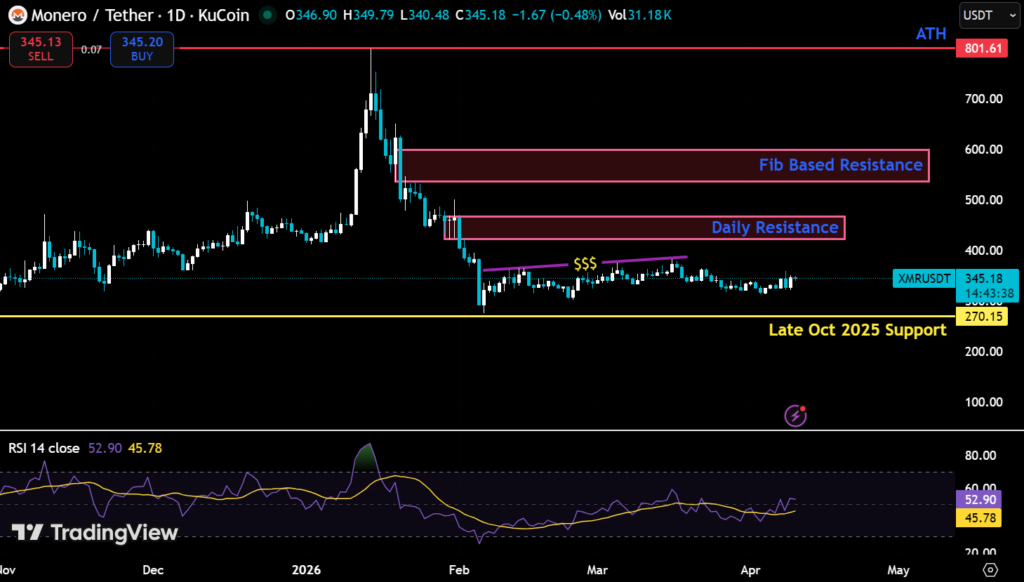
Monero entered the first week of January 2026 trading in the $470 to $500 zone, riding a multi-month rally that had taken the coin to an all-time high of $801.61 on January 14, 2026. XMR sold off aggressively through January into a mid-February low in the $318 to $330 range, shedding roughly 37% from that January peak in under five weeks. Since that bottom, the coin has ground sideways in a narrow band between approximately $320 and $350, with brief probes above that range failing to reclaim the $400 level.
The current setup across multiple timeframes shows a clear pattern: 1-hour change of -0.09%, 24-hour gain of +2.22%, 7-day gain of +5.57%, 30-day decline of -1.45%, and the 90-day loss of -23.36% that sits against a still-meaningful 1-year gain of +69.98%. A negative medium-term return combined with a strongly positive annual figure indicates a correction within a broader uptrend, not a trend reversal.
The daily chart shows resistance at $430 to $480 and a Fibonacci band extending into $530 to $600, with the late October 2025 support at $270.15 as the key downside floor. RSI reads 52.90 on the fast line and 45.78 on the slow, neutral with no directional conviction. The diagonal channel from the February low suggests a gradual drift upward without a decisive breakout.
XMR vs. The Altcoin Market: More Correlation Than Idiosyncracy
One of the more important data points for interpreting this correction is how closely XMR’s 90-day performance tracks the broader altcoin market. Over the same three months, total crypto market capitalization fell from approximately $3.09 trillion to $2.43 trillion, a decline of roughly 21.22%. The altcoin market specifically dropped from around $1.28 trillion to $998 billion, approximately 22.18%. Monero’s 23.36% decline sits nearly in lockstep with that drawdown.
Bitcoin dominance edged from approximately 58.48% to 58.98% during the same window, a modest uptick consistent with the typical pattern of capital rotating back into BTC during risk-off periods. XMR’s market cap currently stands at approximately $6.38 billion with a 24-hour trading volume of around $115.15 million, the 7-day volume reaching $917.16 million and the 30-day total near $3.02 billion. Social sentiment reads 5.08 on a normalized 0–10 scale, essentially neutral with a marginal bullish tilt, consistent with the broader Fear and Greed index sitting around 45 (Neutral) during this period.
The implication for analysts is straightforward but easy to miss: nothing specific to Monero caused this correction. The coin moved with its peer group. That means any recovery in altcoin sentiment and liquidity would likely lift XMR alongside it, with idiosyncratic catalysts then determining whether it outperforms or underperforms the pack.
FCMP++ and THORChain: Two Structural Developments That Changed the Fundamental Picture
The first was the FCMP++ upgrade, activated via hard fork in Q1 2026. It replaces the traditional ring signature system’s fixed 16-decoy model with zero-knowledge membership proofs drawn from the entire chain’s unspent output set, pushing the anonymity set from 16 to over 150 million inputs. Proof generation time for multi-input transactions drops from over five minutes to approximately one minute, no wallet migration was required, and forward secrecy prevents any future adversary from retroactively tracing historical transactions. It is arguably the most significant cryptographic advancement in Monero’s history since RingCT in 2017.
The March 16, 2026 THORChain integration gives XMR its first permissionless, non-custodial cross-chain swap infrastructure at a moment when 73 CEX delistings across 2025 had already compressed its liquidity toward smaller venues and OTC routes. Withdrawals from the XMR-RUNE pool currently settle in RUNE rather than native XMR, a technical constraint of Monero’s privacy model being worked through, not a structural barrier.
The Hashrate Disruption: Qubic’s Exit and What It Means for Mining Security
A meaningful centralization risk resolved itself in early April 2026. The Qubic network had controlled over 51% of Monero’s total network hashrate at points throughout 2025, a concentration that produced a brief blockchain reorganization and kept decentralization concerns elevated for months. On April 1, 2026, Qubic announced a full transition away from XMR mining toward Dogecoin ASIC mining. The reasoning is architectural: Dogecoin’s Scrypt algorithm runs on dedicated ASIC hardware while Qubic’s AI training workloads run on CPUs and GPUs, meaning both operations can now run in parallel without the compute-sharing compromise that the Monero arrangement required.
For Monero’s network, this development reads as a double-edged event. The immediate effect is a reduction in total hashrate as Qubic’s compute exits, which could temporarily soften network robustness until organic mining fills the gap. The longer-term effect, however, is a restoration of more natural hashrate distribution across the pool ecosystem, reducing the concentration risk that the Qubic period introduced. The current network hashrate sits at approximately 5.83 GH/s with a block reward of 0.6031 XMR under tail emission, and the mining economics still show marginal profitability at standard electricity costs of $0.10 per kWh.
Technical Levels and Near-Term Considerations
For traders monitoring price structure, the relevant parameters from the current daily chart are support at the late October 2025 level of $270.15, which has not been tested since the February low; immediate resistance in the $350 to $360 area where short sellers have been active according to current sentiment data; the broader daily resistance zone between $430 and $480; and the Fibonacci-based resistance band around $530 to $600. A sustained close above $360 with volume confirmation would be the first signal that the post-January correction is structurally complete. Until that happens, the low-$300s to mid-$340s range remains the operative trading environment.


