





NEAR Protocol’s daily chain revenue hit $3,888 on March 2, 2026 the highest point recorded across the March-to-April measurement window. By April 8, that figure had dropped to $1,047. That is a 73% decline in daily revenue over 37 days, and it is the single most important data point in understanding where NEAR stands right now as an operating network.
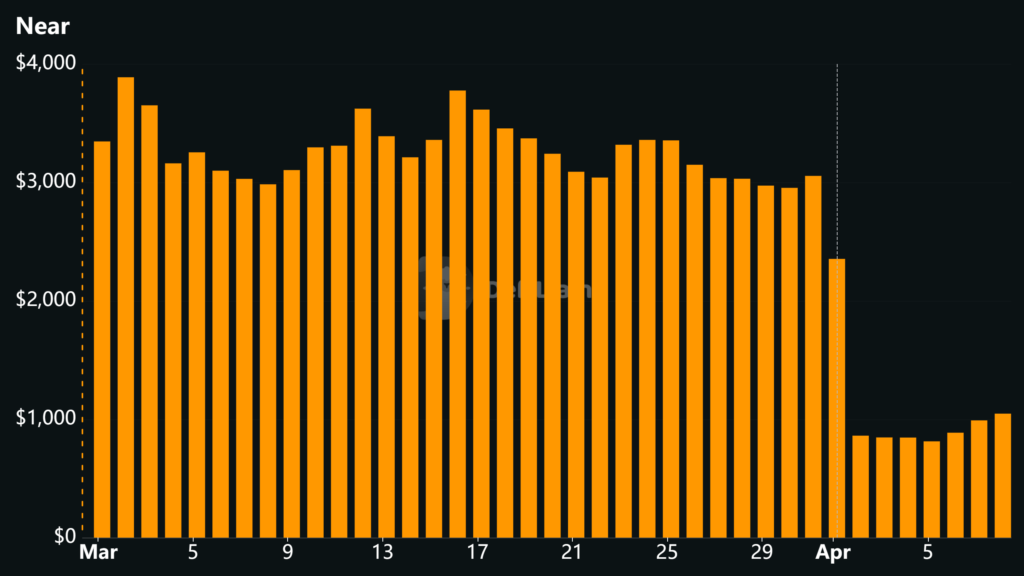
The DefiLlama chart covering March 1 through April 8 shows a consistent pattern: daily chain revenue held between $2,950 and $3,888 for nearly the entire month of March, with March 31 closing at $3,055. Then, as April opened, revenue dropped sharply and has remained compressed in the $780 to $1,047 range across the first eight days of the month. Two distinct regimes are visible in the data, and the transition between them was abrupt rather than gradual.
Parsing the Revenue Drop: Fee Structure vs. Activity Decline
Understanding what this revenue decline represents requires accounting for NEAR’s fee model. The average transaction fee across the 30-day window sits at $0.001148, meaning NEAR’s revenue is almost entirely a function of transaction count rather than fee pricing. There is no mechanism on NEAR analogous to Ethereum’s EIP-1559 base fee burn that would cause revenue to fluctuate with congestion pricing.
Working backwards from the numbers: at $3,888 in daily revenue on March 2 and an average fee of $0.001148, the implied transaction count for that day was approximately 3.39 million transactions. By April 8, at $1,047 in daily revenue, the implied transaction count drops to roughly 912,000 transactions. That is a reduction of approximately 2.48 million daily transactions between the peak and the most recent data point, representing a 73% contraction in on-chain activity within a five-week period.
This matters because the 30-day aggregate figure of 87.3 million transactions and 33.66 average TPS are both backward-looking averages that include the higher-activity March period. The actual current run rate, based on the April data visible in the chart, is running materially below those averages. Readers evaluating NEAR’s network health on the basis of the 30-day summary metrics alone are looking at a figure that flatters the present reality.
The Throughput Ceiling That Nobody Is Testing
NEAR’s recorded maximum TPS is 4,135 transactions per second, achieved at some point in the network’s history. The theoretical architectural ceiling sits at 1,000,000 TPS. At the current April run-rate of roughly 912,000 daily transactions, NEAR is averaging approximately 10.6 TPS, which represents about 0.26% of the recorded historical peak. Even during the stronger March period, a peak implied throughput of approximately 39 TPS still only reached 0.9% of the 4,135 TPS maximum.
The 0.6-second block time and 0.6-second finality remain unchanged throughout this period. The infrastructure is not degraded. What has changed is the volume of activity flowing through it, and the April data suggests that shift was not a gradual drift but a step-change downward.
Network Fundamentals: What Has Not Changed
Alongside the revenue deterioration, several structural metrics have held steady. The validator count stands at 443, with $708.1 million in staked value reflecting a 1.61% increase over the period. The Nakamoto Coefficient of 9 is unchanged, meaning consensus security has not weakened alongside the activity drop. These metrics confirm that the revenue decline is a demand-side event rather than a supply-side or security event. The network is functioning as designed; fewer users are transacting on it right now.
The developer side of the ledger shows 1,202 active contributors across 228 repositories, with 77,643 total commits and 9,945 GitHub stars. Developer activity is a lagging indicator of network health by nature, and these figures do not reflect the April revenue compression. They do, however, confirm that the technical community has not abandoned the protocol in response to market conditions.
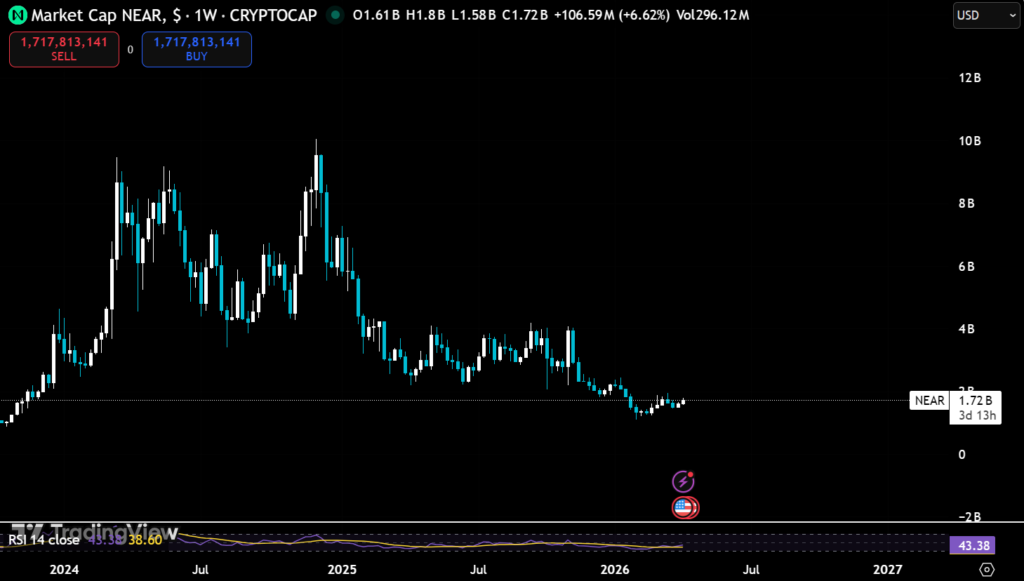
NEAR’s market cap sits at $1.72 billion against a price of $1.343 per token. The market cap-to-FDV ratio of 100% means every token is already in circulation, with no future unlock events scheduled to add selling pressure. The full-float structure means that any price recovery or deterioration from this point reflects organic market demand rather than tokenomics mechanics.
The DefiLlama revenue chart shows a network that sustained $2,950 to $3,888 in daily revenue throughout March, then lost that footing almost immediately as April opened. The current April average running below $1,000 per day is not a minor pullback from a noisy baseline; it is a 70%-plus compression that, if sustained, would place NEAR’s annualized chain revenue somewhere below $365,000. Measured against a $1.736 billion market cap, that ratio only holds if the April data is treated as a temporary anomaly rather than a directional signal. The difference between those two interpretations is the entire investment thesis.
For traders with shorter timeframes, the April revenue floor is the key variable to watch. A recovery back toward the $2,500 to $3,000 daily range would suggest the March activity was not an anomaly but rather the more representative baseline. Continued compression below $1,000 per day through mid-April would signal that the March period was the outlier and that reassessment of the demand narrative is warranted.
The honest read on the data is that NEAR’s infrastructure case remains intact and its tokenomics are clean, but the demand curve that would justify the current valuation is moving in the wrong direction over the most recent measurable period.


