





The most actionable on-chain signals rarely announce themselves loudly. The latest stablecoin exchange netflow data across all ERC-20 stablecoins and all exchanges reveals a pattern that deserves careful attention. After a period of historically large and volatile flows in March, the market has settled into a phase of small but consistently positive net flows, with both the 30-day and 50-day EMAs now trending sideways near the zero line. That behavioral shift tells a more nuanced story than the headline numbers.
What the Data Shows
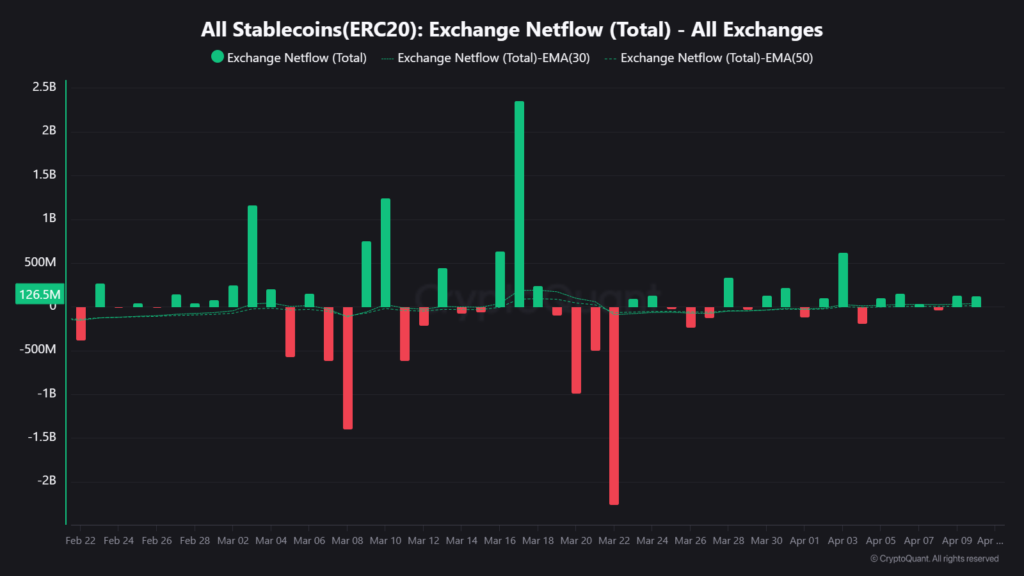
Between late February and mid-April, ERC-20 stablecoin exchange netflows moved through three distinct phases, each carrying different implications for market structure.
The first phase, running from approximately February 22 through March 6, was characterized by moderate positive inflows in the $200 million to $1.1 billion range, punctuated by smaller outflow sessions. This represented a relatively normal accumulation and distribution cycle, with no single session dominating the picture.
The second phase, covering roughly March 7 through March 24, was where the data turned extreme. A $1.15 billion inflow session around March 10 was followed almost immediately by a $1.4 billion outflow. Then on approximately March 16, inflows spiked to their cycle high near $2.3 billion, only to be followed within days by two of the most severe outflow sessions on the chart: approximately negative $1.1 billion around March 20 and a near $2.2 billion outflow around March 22. These back-to-back extremes are not random noise. They reflect coordinated large-participant activity: capital moving onto exchanges at scale, followed by rapid repositioning or withdrawal after positioning was established.
The third phase, from late March through the most recent data point showing a $126.5 million positive net flow, is where the current signal emerges. Flows have compressed dramatically. Sessions are registering in the $100 million to $550 million range on both sides, the EMA lines have flattened, and the current reading is modestly positive. Volatility in the netflow data itself has declined sharply relative to mid-March.
Why the Sequence Matters More Than Any Single Data Point
The explosive inflow-outflow pattern observed between March 10 and March 22 follows a recognizable behavioral cycle among large market participants. Stablecoins are moved to exchanges not as a passive act but as a precursor to positioning. Large inflows signal that capital is being staged for deployment. When those inflows are followed almost immediately by large outflows, it suggests that the positioning cycle completed quickly, whether through derivative activity, spot accumulation at specific price levels, or profit realization on short-side trades executed during the volatility that typically accompanies such flows.
What matters for the current setup is what comes after that cycle completes. The post-March compression into small, consistently positive netflows suggests that a new accumulation phase may be forming, distinct from the violent repositioning of mid-March. Capital is entering exchanges, but at a measured pace rather than in concentrated bursts. The flat EMA readings confirm that this is not a directional surge but the kind of slow-build liquidity positioning that tends to precede more sustained moves.
The Altcoin Season Framework: Early Signal, Not Confirmation
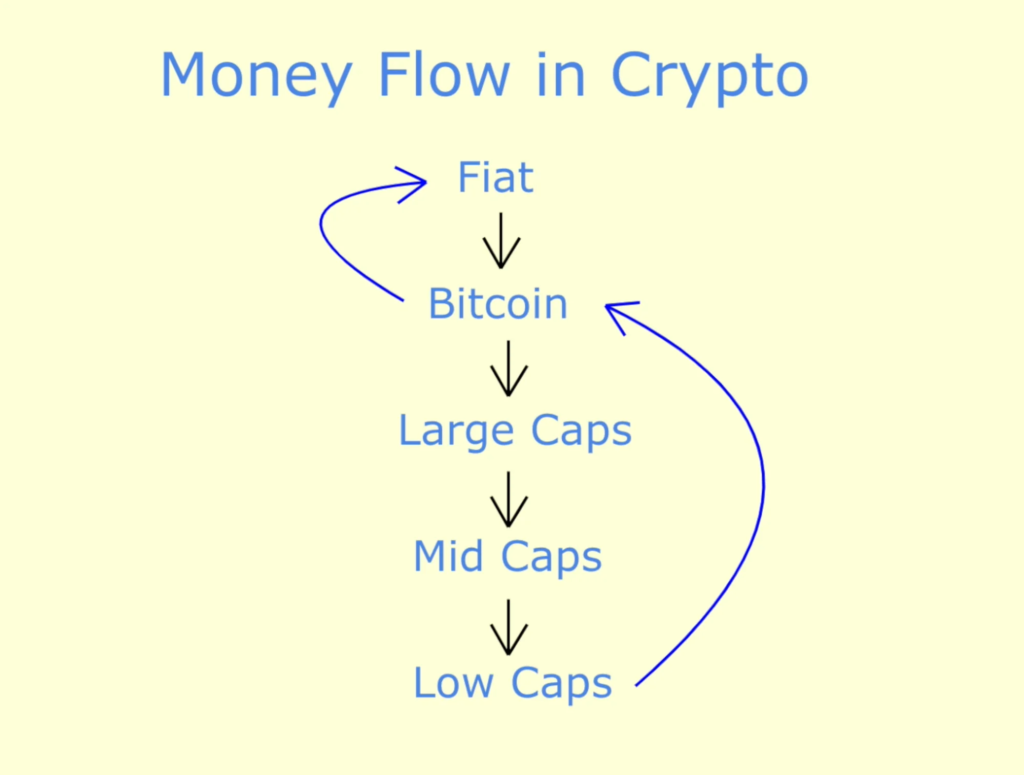
Stablecoin flows typically follow a comparatively linear rotation path when liquidity begins moving into risk assets. Inflows often find their way into the largest cryptocurrency, which is Bitcoin, given its liquidity and institutional accessibility. From there, money rotates into Ethereum and eventually into the broader altcoin market as risk appetite expands and participants seek higher-beta exposure. The current data sits at the beginning of that potential sequence, not the middle or end of it.
Describing the current phase as an altcoin season signal is accurate only in the loosest sense: the preconditions are forming, but the process is in its earliest stage. A full altcoin rotation historically requires a confirmed market bottom, sustained Bitcoin dominance contraction, and several weeks of consistent stablecoin inflows before altcoins see broad-based capital allocation. None of those conditions are definitively in place yet, and the data does not support claiming otherwise.
What the data does support is that exchange-side liquidity is building at a measured pace, that the violent outflow pressure of mid-March has dissipated, and that the market is in a transition zone. Whether that transition resolves bullishly depends on how incoming flow data evolves over the next several sessions.
The Important Technicals
The $126.5 million current reading becomes analytically relevant only if subsequent sessions confirm the direction rather than reverse it. What traders should be watching is whether stablecoin inflows continue building while prices stay suppressed, because that specific combination reflects active staging of buying power on exchanges, not passive holding. If the divergence between rising inflows and flat or declining prices persists, the probability of a near-term relief move increases materially.
Binance remains the primary venue to watch, given its dominant share of institutional and high-volume activity. Stablecoin inflow data specific to Binance would provide higher-resolution confirmation of whether the current broad-market accumulation pattern is concentrated among sophisticated participants or distributed more widely.
The flat EMA structure also introduces a near-term volatility consideration. When netflow EMAs compress and then break directionally, the resulting move tends to be sharp. That dynamic increases the probability of a high-volatility event in either direction before a sustained trend establishes itself.
Looking Forward
The transition from violent flow volatility to quiet positive accumulation is, on its own, a constructive development. It suggests the worst of the reactive repositioning that defined mid-March has passed and that exchange-side stablecoin liquidity is rebuilding. Whether that liquidity becomes the fuel for a sustained recovery or simply stabilizes before another leg lower depends on variables the current data does not resolve.
What the data does resolve is that the capital is entering exchanges rather than leaving them, and the pace of that entry is measured enough to suggest accumulation rather than panic. That is a meaningful starting point, even if it is only a starting point.


