





Liquidity being a retail phenomenon was the case for the major part of crypto early history. The order books consisted of many small traders who made small bids and offers across various trading places. Points of market price were not accurate but there was enough volume. At the same time price swings were attributed to traders’ sentiments rather than to the market structure. The entire scenario has changed now. The modern-day crypto market is largely the result of institutional aggregation.
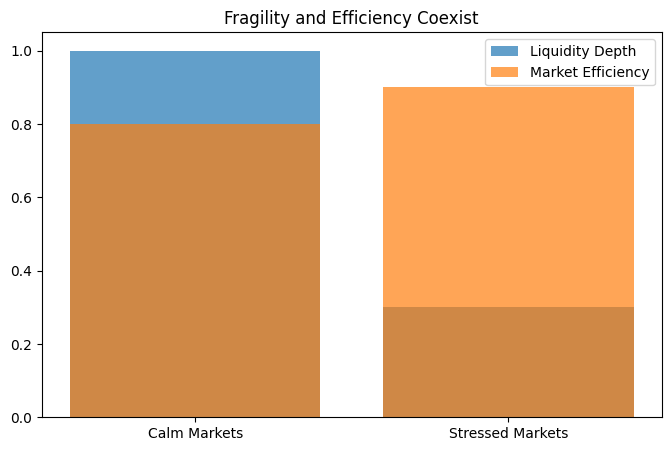
The trade of large trading houses, ETF companies, Market Makers, and routers that connect different venues has constituted the flow. Liquidity is on the whole lot deeper, so to speak, but in reality, it is no longer spread out evenly, rather it is very limited, highly coordinated, and extremely fragile. Such a situation is led to a market of order books that show the buying and selling volumes to be thick during the calmness and then suddenly becoming thin as soon as the tension comes in.
The Illusion of Depth
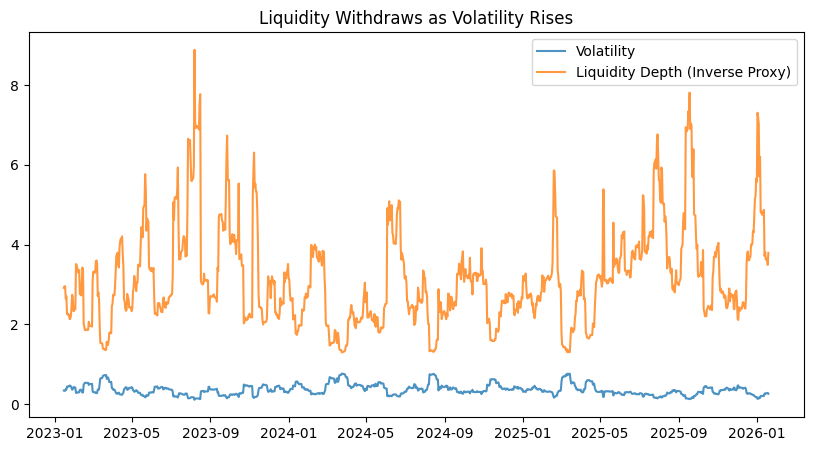
Modern cryptocurrency exchanges often have very high headline liquidity displayed on their order books. Tightest spreads, big visible sizes, and smooth execution for usual trade sizes are all factors that contribute to the perception of strength in the market. The reality is, however, that much of this depth is contingent. It will be there as long as the volatility is kept in check, the correlations are stable, and there are no abrupt shifts in the macro signals.
The institutional liquidity is designed for efficiency rather than endurance. The algorithms are continuously repricing, cancelling and repositioning the orders depending on the volatility regimes, funding conditions and cross-asset signals. When the uncertainty goes up, these system do not absorb the risk. They just distance themselves from it. This gives rise to the perception of depth. The order book appears to be strong until it is most needed.
Aggregation Concentrates Risk
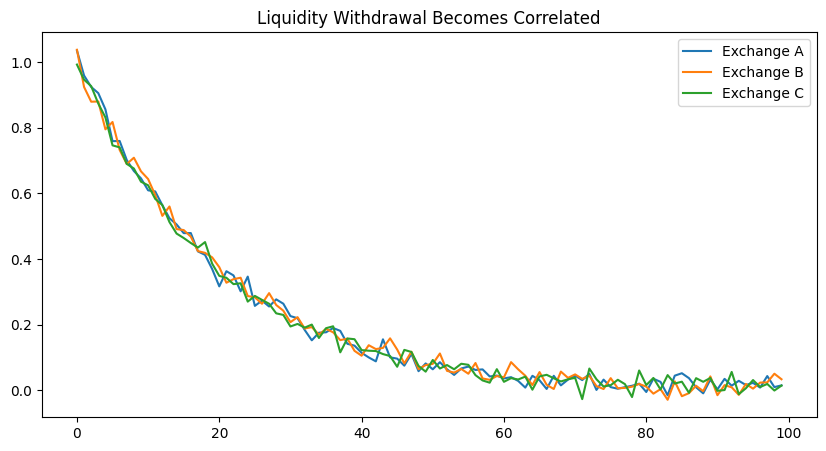
Institutional aggregation moves liquidity through different places, pools, and instruments. In principle, this would lead to less fragmentation and better price discovery. However, it centralizes the decision-making process. When the same models, risk limits, and volatility filters control order placement at different exchanges, liquidity gets linked. A single macroeconomic shock may cause order cancellations at all places at once. Rather than any one place losing liquidity, all places do. A liquidity environment that used to be decentralized now acts like a single system with common failure points.
Speed Amplifies Fragility
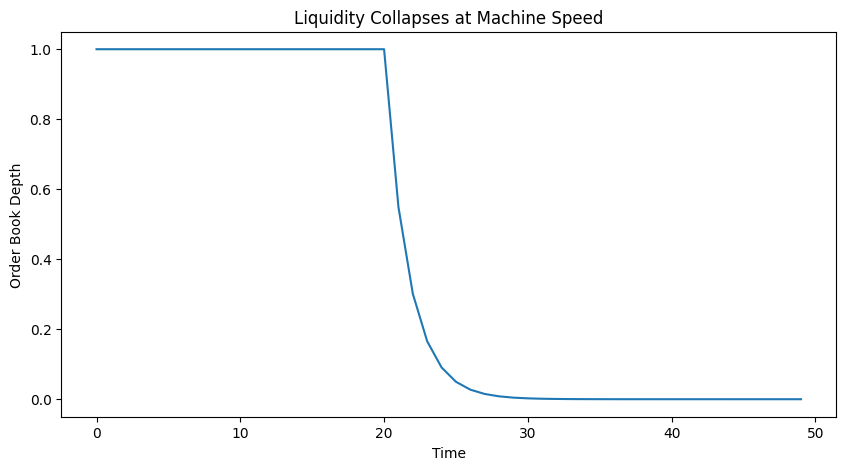
Institutional trading works at the speed of machines. Order books get updated in milliseconds while recalculation of risks is done instantaneously. This facilitates efficiency in tranquil times but, on the other hand, during stress, the situation is the opposite and efficiency is totally lost. When a price change is drastic, liquidity is taken out by algorithms quicker than human beings can react. The order book does not slowly weaken. It disappears. This is the reason why today’s cryptocurrencies drop often have gaps rather than continuous reductions. It is not the case that price decreases because sellers are larger in number than buyers. It is the contrary; price decreases because buyers are no more.
ETFs Changed the Flow
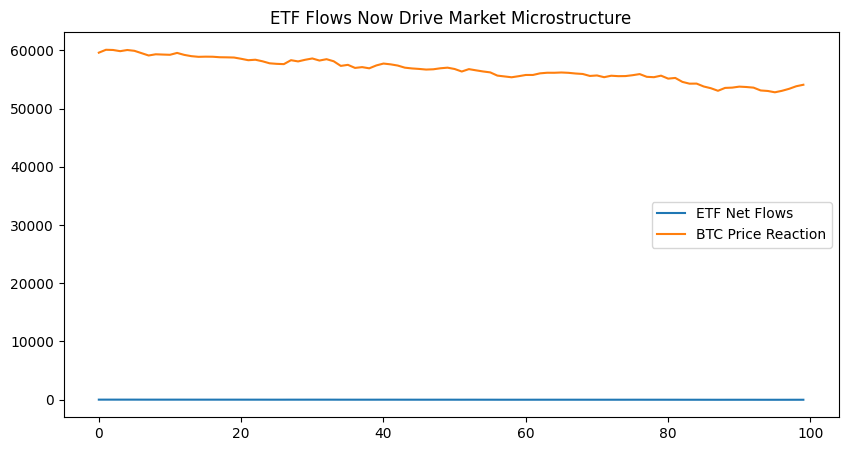
Spot Bitcoin ETFs have an impact of not only creating a new structural demand but also opening up a new liquidity dynamic. The exchange-traded fund flows are large, directional, and greatly connected to the traditional market hours, macro news, and portfolio rebalancing cycles. The market makers take positions on spot and derivatives markets to cover their risks related to the ETF. The hedging activity can quickly change the order books when the ETF flows go up or down sharply. Hence, liquidity turns out to be reactive instead of proactive. This situation links crypto’s microstructure more closely with that of traditional finance, which results in higher sensitivity to macro shock and risk-off events.
Fragility Is Not Weakness
An order book that is so delicate does not indicate a market that is weak. It rather indicates a quick one. The underlying elements of crypto are speed, efficiency, and mobility of capital. These characteristics inherently make the system less tolerant to uncertainty. When the situation is clear, there is plenty of liquidity and when it is not, there is no liquidity. The market has not turned into a more risky one but a more accurate one.
What This Means for Traders
Retail buyers usually see sharp spikes and rapid price gaps as manipulative measures. However, such price movements are actually caused by the withdrawal of liquidity. It is not the pushing of anyone that makes price move quickly; it is the thinness of the book. This is known by institutions who then not only focus on the direction but also on volatility expansion when designing their strategies.
They trade the order book patterns almost as much as the underlying asset itself. For retail traders, it is less about guessing the price and more about accepting the structure that determines their survival.
The Future of Crypto Liquidity
The depth of order books will be increased to a certain extent and the conditions attached to them will be more prominent as the institutional participation increases. There will be a constant strong liquidity in the non-stressed market which would be weak and unstable in the stressed market. This is not just a passing phase; it is the new setup in the market.
Crypto has moved from being an experiment dominated by the retail class to becoming a fast and secure financial system able to react like institutions. And in that kind of environment, confidence is the only source of stability.


