





When mathematics meets market risk
Bitcoin was a mathematical creation, however, its continuity might be partly reliant on the future of mathematics. For more than a decade and a half, the very network’s power has been based on cryptographic assumptions that were deemed unbreakable even with the most powerful classical computers. ECDSA, SHA-256, and public-private key cryptography have created an environment where trillions of dollars in assets are being actually and the trustless global monetary system is provided.Now, that the concept of quantum computing is in the picture, and it is a new, different kind of threat model. Quantum computers will be able to use the so-called Shor’s algorithm to theoretically break the very cryptography that forms the basis of Bitcoin wallet and transaction signature security. However, even though such supercomputers are yet to come, the path of technological advancements is already obvious.Certainty is not a condition for markets. They have already pricing the risk in advance. This is the reason why a “Quantum Bitcoin Fork” has ceased to be a mere theoretical concept. It is a scenario where Bitcoin has to change its cryptographic core in order to be secure and this will cause a complete reshaping of its technical architecture and market dynamics.Post-quantum cryptography, in fact, is not only a security enhancement. It is a major structural change that can impact the area of custody, mining rewards, participation of institutions and even of the very long-run valuation framework of Bitcoin.
Bitcoin’s Cryptographic Backbone
Bitcoin’s ownership model is based on the principles of asymmetric cryptography. A user is able to spend the coins by demonstrating that they possess the private key that corresponds to the public key which is exposed on the blockchain. Digital signatures are used to authorize the transactions and the network checks those signatures through ECDSA. Given the present computing power, obtaining a private key from a public key is practically impossible. The security level is based on the difficulty of the discrete logarithm problem. For a long time this has been considered a not-too-unsafe supposition. The quantum computing technology has overturned this supposition. Algorithm created by Shor is able to find discrete logarithm many times quicker than the classical way. In a nutshell, a quantum computer with the required power could take the public key and derive the private key, then sign a transaction as if it were the legitimate owner.Besides, this is not solely going to effect the SHA-256 hashing used in mining to the same degree.
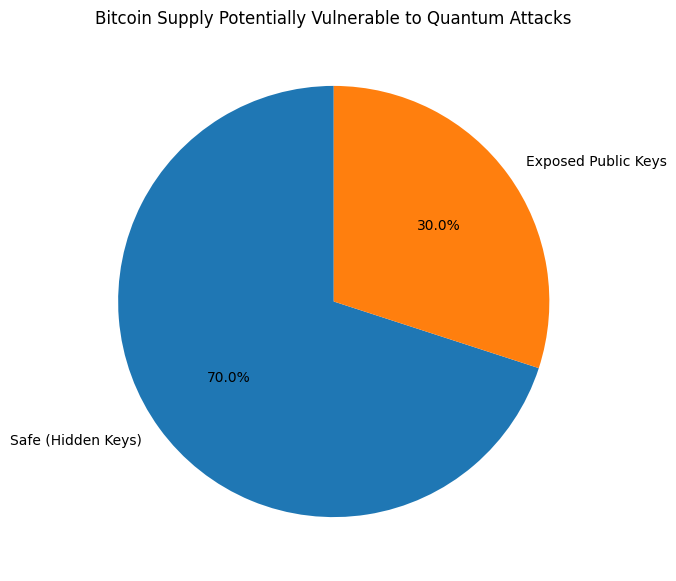
Grover’s algorithm gives a quadratically faster approach only, which can be countered by enlarging the hash sizes. The main target of vulnerability is digital signatures rather than proof of work.The danger is not equal for everyone. Every Bitcoin address that has its public key disclosed – which occurs every time money is taken out – becomes, in theory, at risk of attack. The wallets that are older, the addresses that are reused, and the long-dormant funds are especially at risk. Thus, a new category of latent systemic risk is created: cryptographic obsolescence.
The “Harvest Now, Decrypt Later” Problem
Even before the situation in which quantum computers turn into such a powerful force that they can practically break cryptography, opposite parties have a chance to take encrypted data today and keep it for the time when they will be able to decrypt it. The data on public blockchains is irrevocable. So when quantum technology has progressed, it will be easy to take advantage of the past transactions again. This is not merely a danger to Bitcoin but a major issue that many pre-quantum crypto systems will have to deal with. However, the very openness of Bitcoin drives the danger higher.
From the perspective of the market, this is a risk that has got a new dimension in the time horizon. Security is now a dynamic process rather than a fixed one that gets weaker with the increase in computing power. The investors are not expect to be convinced that quantum assaults will occur just the next day, however, they have to consider that the scenario of non-zero probability of it happening is valid for the entire timeline of Bitcoin which is several decades long.
Why Post-Quantum Cryptography Matters
Post-quantum cryptography (PQC) is the term used for cryptographic systems that are theoretically secure even if quantum computers would be able to break any existing methods. The post-quantum schemes include lattice-based, hash-based, multivariate, and code-based signature schemes. Despite being insecure to Shor’s algorithm, ECDSA isn’t the only one. Many have been already recognized by NIST as standards for future-proofing the government and financial infrastructure. For Bitcoin, the transition to PQC would imply a change in the signature scheme. This change is not merely a visual upgrade; it impacts the foundation of property rights, transaction acceptance, wallet development, and rules for the network.
A quantum-resistant Bitcoin would necessitate the introduction of novel address patterns, the change in signature verification process, and a way for the current funds to move. The topic is not if this would be technically feasible, but rather if this would be able to take place without splitting the network.
The Fork Question: Evolution or Fragmentation
By nature, Bitcoin’s governance model is a conservative one. A wide-ranging agreement between developers, miners, node operators, and economic stakeholders is a must for every major amendment. One drawback of this policy is that it makes Bitcoin adaptation slower. The post-quantum upgrade, if it happens, would be unavoidably the most dramatic change through the history of protocols in Bitcoin. The way it would be carried out depends on the implementation and could mean either a soft fork, a hard fork, or even an entirely new quantum-safe chain that is parallel to the existing one. A soft fork would maintain the ability of the old versions to coexist with the new one, but it might also hinder the flexibility in the choice of cryptography.
A hard fork would be clearer in terms of design but could result in the network being divided. A parallel chain would be less disruptive but would not be upgrading Bitcoin rather creating a new asset. Investors have not forgotten about Bitcoin Cash and Bitcoin SV. One of the negative effects of fragmentation is that there is confusion and liquidity gets diluted. Additionally, there is the issue of communication among the concerned parties being disrupted. However, in the long run, security upgrades are not something that can be ignored. This puts Bitcoin in a strategical dilemma. The network needs to evolve, but it must find a way to do so without losing its social consensus.
Custody, Institutions, and Market Structure
Bitcoin’s institutional adoption has been significantly sped up during the last ten years. ETFs, corporate treasuries, state funds, and regulated custodians are now in possession of considerable amounts of BTC. These entities have a long-term risk framework in place. Quantum vulnerability, even if it remains a long way off, is going to be a very important factor for the allocation of capital over the next decades. A quantum-resistant Bitcoin will bear the mark of Bitcoin’s being a long-term store of value.
Not being able to adapt might lead to a permanent discount in its valuation. The supportive infrastructure would have to be changed, as well. Wallets, hardware security modules, multi-signature schemes, and cold storage protocols would need to be so that they could be used in a post-quantum world. This would initiate another round of infrastructure investment, like the SegWit and Taproot upgrade cycles, but much more profound. For the markets, this will lead to volatility around the upgrade narratives, through which speculative flows will be directed into quantum-safe alternatives, and lastly the stable and legacy cryptographic assets might even undergo a major re-pricing.
The Rise of Quantum-Safe Alternatives
There are projects that from the very beginning have considered quantum resistance as a main feature. In fact, these are post-quantum signature algorithms based on which they claim to be secure against any future attacks. On the other hand, security measures cannot establish network effects entirely. The strong points of Bitcoin are its liquidity, brand, decentralization, and acceptance all over the world. A chain that is more technologically advanced does not mean that it takes over Bitcoin automatically.
Therefore, the most plausible scenario is not the replacement but rather the evolution. The reason is that Bitcoin has gone through different technologies yet it maintains its existence because it is very patient, very careful, and only takes consensus. Resistance against quantum computing will probably take the same path.

The Economic Meaning of Cryptographic Trust
Bitcoin is more than a simple computer program. It is a social agreement which is cryptographically secured. The primary source of its value is the conviction that the right to possess cannot be violated without a good reason. A change, even a minor one, in that conviction leads to a change in market behavior. Risk premiums are increased. The long-term investors become uncertain about the safekeeping of their assets. The institutions insist on better security.
The transition to quantum-safe encryption techniques is not merely an enhancement of security, it is a support of Bitcoin’s monetary legitimacy. Bitcoin will not be able to hold onto the pre-quantum assumptions forever as the world including central banks, governments, and corporations is getting ready for the quantum era. The conflict is not about division of the blockchain but about division of the time periods.


