





The January Effect, Repriced
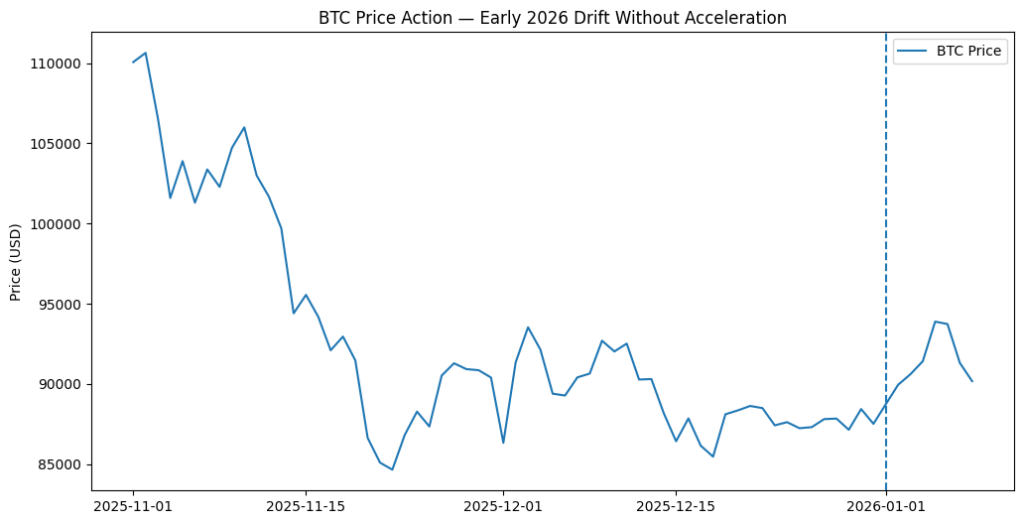
The year 2026 for the crypto market began with a pound rather than a strong sway. The prices of significant cryptocurrencies along with some high-beta ones went uphill, but the nature of the lift-up was the same as before: a combination of thin liquidity, mechanical inflows, and stakeholder changes rather than actual risk expansion. The price movement in January was less related to new developments and more to the reopening of balance sheets that followed the defensive stance of December. The rate at which traders were borrowing money (i.e. funding rates) stabilized, and the volumes of cash transactions increased quietly, while the fluctuations in prices also decreased just enough for the price-finding process to move upward without any barrier.
What happened was not a case of the market getting high on its own supply. The market got the mistrust out of its system.The market movement from the quantitative point of view closely correlated with the calendar effects. The systematic strategies came back to the marketplace, the short-dated hedges were rolled off, and the passive allocations were re balanced at the beginning of the year. All these forces usually make the bias in the direction without the depth created that way. The output was a well-organised climb that, though it looked powerful on the charts, was still tenuous underneath.
What the Data Confirms
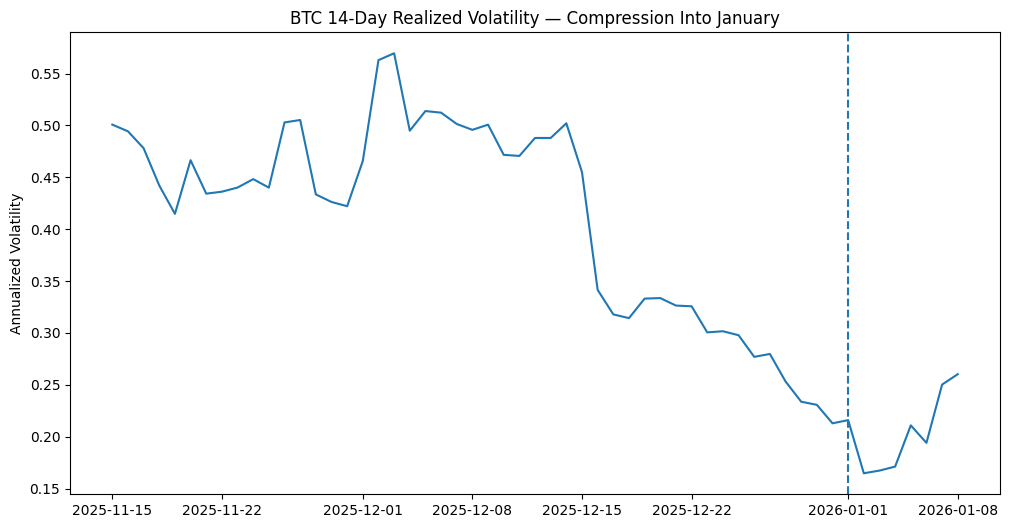
The internals of the market confirmed that there was no structural commitment. The ratios between spot and derivatives improved but the situation was still not decisive in favor of spot. There was an increase in open interest as prices also went up, but the leverage was still mainly in short-duration instruments, which indicated that the participants were mainly taking tactical positions rather than being in it for the long run. The realized volatility was going down at a faster rate than the implied volatility, which was a signal that the market was ready to sell options but not yet to take shocks. The market breadth also told a story of limitation.
The gains were not uniform, with capital going through the liquid leaders rather than spreading over the whole curve. The correlations got tighter, which showed that the market was sensitive to macro rather than having strong individual stocks. To put it another way, the capital moved because the conditions were favourable not because the stories were compelling.
The fragility layer
The silence that ensued was not a shift in the trend but rather a test of trust. Typically, the rallies in the early year die down when the marginal buyers get exhausted before the new demand comes in. In January 2026, that exhaustion was felt immediately. Liquidity was enough for a consolidation but not for an acceleration.
Any outside factors like volatility rates, dollar strength, or risk-off impulses could easily disturb the positioning that was based on calmness rather than confidence. This weakness was seen most clearly in the derivatives complex. The neutrality of funding covered up the directional uncertainty, and gamma exposure was tightly packed around the key levels. The markets became very sensitive to small dislocations because the buffers were already thin. The rally had no margin for error.

Structural Versus Tactical Momentum
Tactical momentum and structural trend are the two main distinctions which have emerged from January. Tactical momentum exists in low-volatility situations where one-sided betting can be done without much risk. Structural trend needs continuity: long-term demand, decreasing correlation in the market, and money being patient even if the market is noisy.
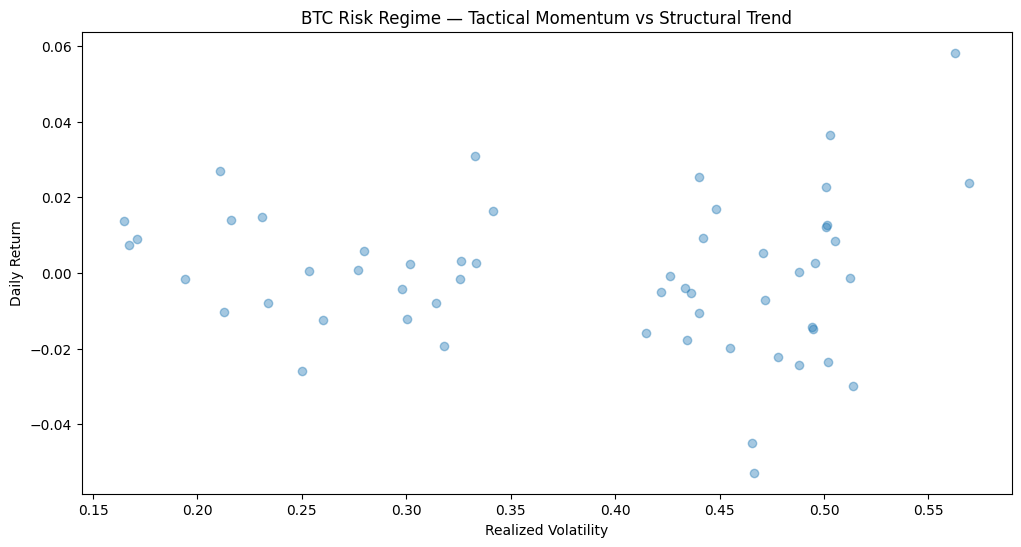
January gave us the first phase, but not yet the second. This does not mean that the larger market cycle is dead. It simply points to the fact that the cycle’s current phase is being clarified. The crypto market is moving from a reflexive rebound to a selective confirmation phase. Those assets that can maintain their value without leverage support are considered to be strong. While, on the other hand, the dependence of those requiring constant inflow is being revealed.


