





Key Takeaways
- Italian backing with caution: Banks support the ECB’s digital euro initiative but are urging a gradual rollout to ease financial pressure.
- Liquidity concerns: Lenders in Germany and France warn that a central bank digital euro could pull deposits away from commercial banks.
- Political response: European lawmaker Fernando Navarrete has proposed limiting the ECB’s role to safeguard private payment systems.
- Balanced approach: Italian banks advocate a model where central bank and commercial digital currencies develop side by side to keep Europe competitive.
Table of Contents
Italian banks have expressed support for the European Central Bank’s (ECB) plan to introduce a digital euro but are urging that implementation costs be spread over time to avoid pressure on their balance sheets.
According to a Reuters report, Marco Elio Rottigni, General Manager of the Italian Banking Association (ABI), said the sector supports the digital euro as a way to strengthen Europe’s financial and digital sovereignty. However, he warned that the project’s high implementation costs pose a significant challenge for banks and should be managed gradually.
“We’re in favour of the digital euro because it embodies a concept of digital sovereignty,” Rottigni told reporters during a press event in Florence on Friday. “Costs for the project, however, are very high in the context of the capital expenditure banks must sustain; they could be spread over time.”
Beyond Italy, banks in Germany and France have also expressed concerns about the project. Lenders in both countries worry that a digital euro, managed directly by the ECB, could draw deposits away from commercial banks and into central bank-controlled wallets, weakening their liquidity positions.
To ease those concerns, European Parliament member Fernando Navarrete has proposed a scaled-back version of the plan. His paper recommends limiting the ECB’s operational scope while preserving room for private-sector payment systems such as Wero, a digital platform backed by 14 major European banks.
Rottigni said Italian banks support a model that balances innovation with stability, allowing both public and private digital currencies to develop in parallel.
We’re in favour of a twin approach, a central bank digital currency and commercial bank digital currencies which may develop faster, because what Europe shouldn’t do is fall behind,” he added.
The Digital Euro Project
The digital euro project began in 2020 when the European Central Bank (ECB) released its first report on the potential creation of a euro-area digital currency.
In July 2021, the ECB officially launched the investigation phase, a two-year study to explore design options, distribution models, and policy implications.
In November 2023, the project entered its preparation phase, focusing on drafting operational rulebooks, selecting technical partners, and running trials with banks and payment providers. This phase will continue until late 2025, when the ECB’s Governing Council will decide whether to proceed with full development and issuance.
If approved, pilot testing is expected to begin in 2027, with a potential launch in 2029, pending the adoption of supporting EU legislation.
What the Digital Euro Aims to Deliver
The digital euro is envisioned as a publicly issued electronic form of cash, serving as legal tender in digital format and available to individuals and businesses across the euro area for both online and offline payments.
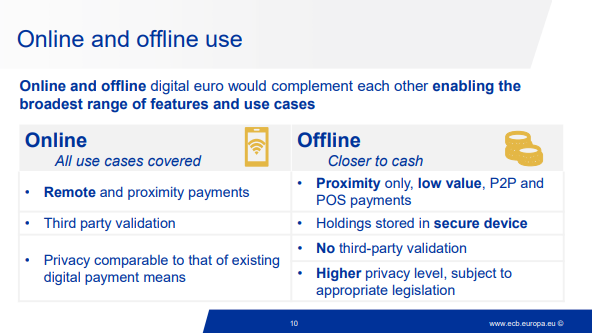
Its main objectives are to maintain public access to central bank money in an increasingly digital economy, preserve the euro’s relevance as the use of cash declines, strengthen Europe’s control over its payment systems, and promote a more competitive and inclusive financial ecosystem.
Technical features under consideration include allowing payments through smartphone wallets or physical cards, enabling transactions without an internet connection, setting limits on how much digital euro users can hold to prevent it from being used as a savings instrument, and defining how banks and fintech firms will act as intermediaries to distribute and manage the currency.
Key Challenges and Risks
Despite its potential benefits, the project faces several challenges. Commercial banks warn that widespread adoption could drain customer deposits, tighten funding conditions, and heighten financial stability risks. Implementation costs are significant, with ECB estimates placing initial development at around €1.3 billion and annual operating expenses near €300 million once the system is live.
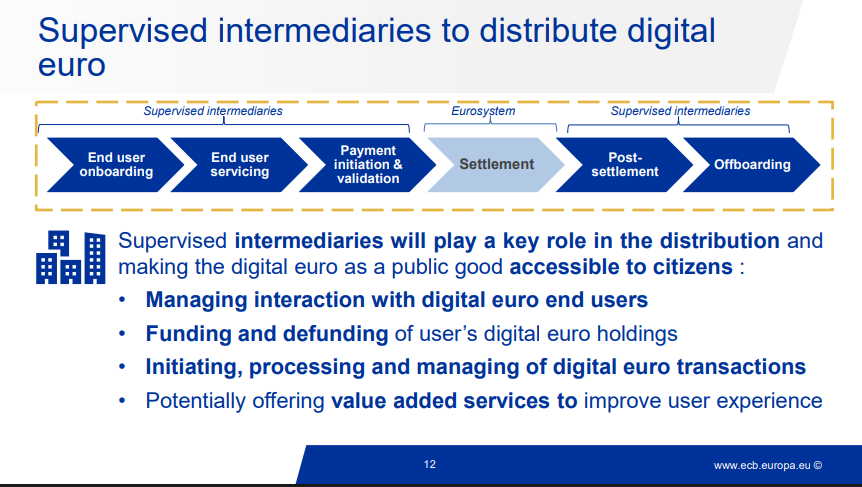
To address these risks, holding limits could be implemented to prevent large outflows of deposits from commercial banks to the central bank. Additionally, financial institutions are expected to play a central role in a two-tier distribution model, acting as intermediaries between the ECB and end users to manage accounts, transactions, and compliance.
Read More: UK to Unveil Stablecoin Framework on November 10, Keeping Step with U.S.


