





Tokenized money market funds are still a small corner of global finance, but their rapid growth is beginning to draw closer scrutiny from policymakers worried that old vulnerabilities could reappear in new digital form.
In an ECB article published this month, the bank said the market for tokenized money market funds, or TMMFs, remains limited at around 7 billion euros globally, though it has expanded sharply over the past year.
The ECB noted that the sector’s market value had roughly doubled in that period, outpacing growth in both stablecoins and traditional money market funds, while warning that the products could also introduce familiar fragilities, including liquidity mismatches, run risk, and operational vulnerabilities.
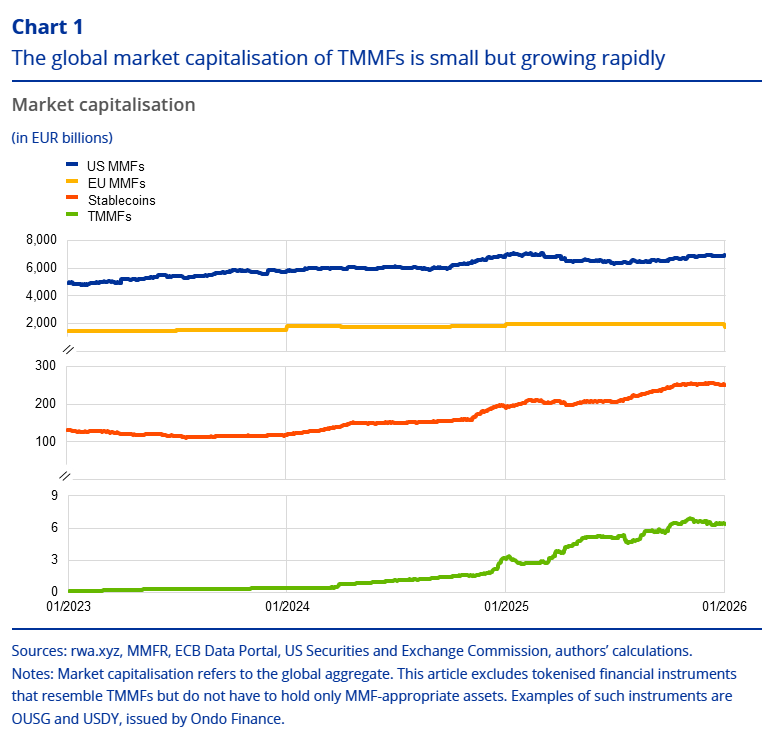
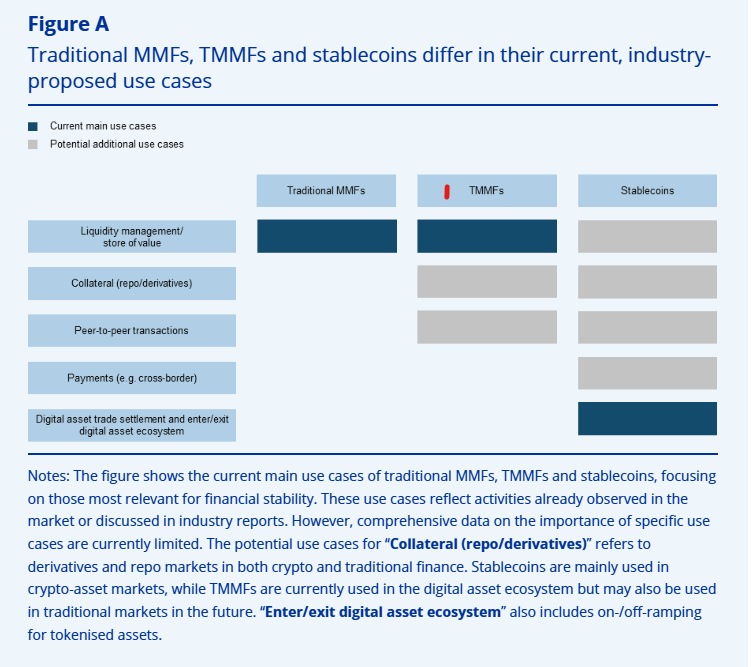
Unlike conventional money market funds, which record investor holdings through traditional securities infrastructure, TMMFs issue fund shares as digital tokens on distributed ledgers. The structure is designed to allow faster transfers, broader trading access, and potential use in digital-asset markets, including as collateral.
Old Vulnerabilities in a New Form
The central bank said tokenization could improve efficiency by enabling faster settlement, near round-the-clock availability, and programmable transactions. It also noted that tokenized fund shares could support new uses, particularly in collateral management and digital finance.
However, the ECB warned that TMMFs carry many of the weaknesses associated with traditional money market funds, particularly when investors seek to pull out cash faster than the underlying assets can be sold.
That mismatch, the ECB said, could become more severe in tokenized structures. While some TMMF tokens may appear to offer near-constant tradability, the underlying assets and many of the operational processes behind the funds remain partly off-chain and tied to conventional market hours, cut-off times, and settlement practices.
The result is that liquidity may look more immediate on the surface than it really is underneath.
What Could Go Wrong
The ECB warned that the speed, transparency, and programmability of distributed ledger technology could magnify stress in periods of market strain, as instant settlement and automated trading features may encourage highly synchronized redemptions, while around-the-clock tradability could encourage investors to rush out before others.
It also said that if tokenized fund shares are used as collateral in digital markets, forced liquidations could transmit shocks from crypto-linked trading venues into the underlying money market funds and, in turn, into traditional assets, such as short-term government debt.
The paper added that secondary trading in tokenized fund shares could create fresh pressure points, as market prices for tokens may diverge from the net asset value of the fund, potentially signaling distress and prompting redemptions.
Operational risks are another concern. The ECB said cyber incidents, service outages, smart-contract weaknesses, oracle failures, and coordination problems between third-party providers could all disrupt subscriptions, redemptions, or valuation processes.
Stablecoin Links Add Another Layer
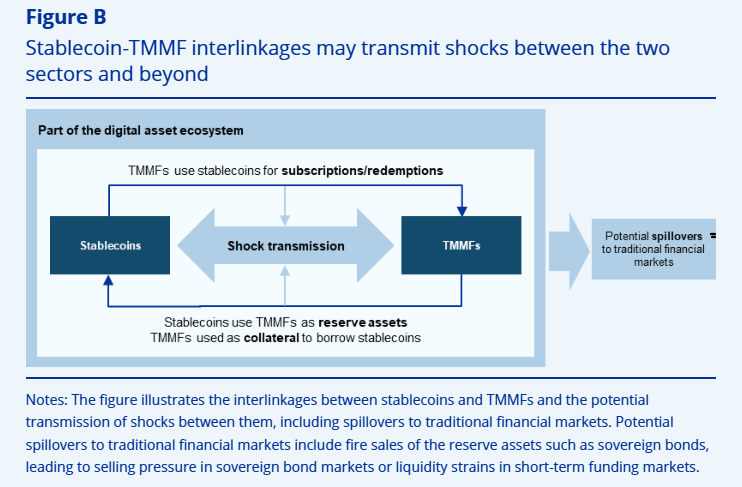
In a separate section, the ECB compared TMMFs with stablecoins and said the two markets could become increasingly intertwined. Stablecoins can be used for subscriptions and redemptions, while tokenized funds could also become part of stablecoin reserve structures.
Those links could matter in a crisis, as stress in one market could spill into the other, increasing redemption pressure and forcing asset sales that reach beyond digital markets and into mainstream finance.
For now, the ECB said the sector remains small, but as tokenized money market funds spread further into both crypto and traditional finance, it said regulators and supervisors will need to watch closely whether efficiency gains materialize faster than the risks.


