





Key Takeaways
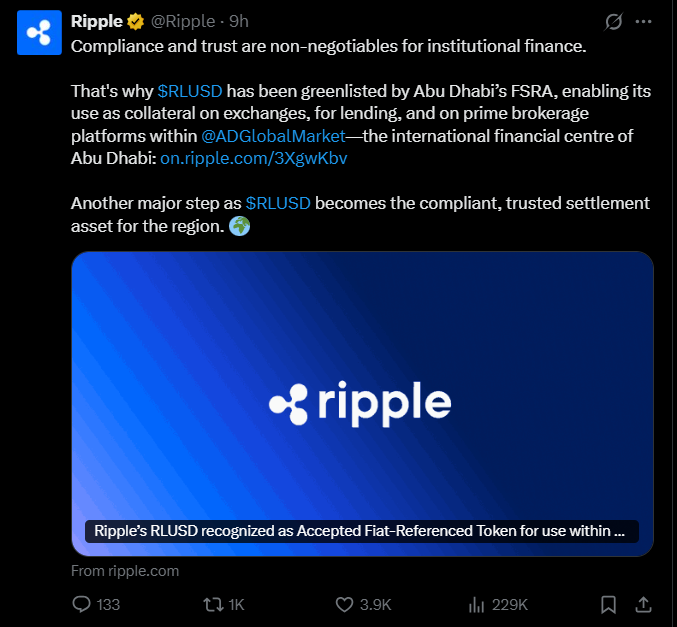
- Abu Dhabi’s Financial Services Regulatory Authority has recognized Ripple USD as an Accepted Fiat-Referenced Token, clearing it for use within the ADGM.
- The approval allows licensed firms to deploy the stablecoin in regulated financial activities under (FSRA) rules.
- Ripple says circulation of the token has passed 1 billion dollars, supported by segregated reserves and regular third party attestations.
- The recognition strengthens Ripple’s growing footprint in the Middle East as the firm expands partnerships in Bahrain, the UAE and Africa.
Table of Contents
Ripple said on Monday that its dollar-backed stablecoin, Ripple USD (RLUSD), has been cleared for use inside the Abu Dhabi Global Market after the Financial Services Regulatory Authority (FSRA) classified it as an Accepted Fiat-Referenced Token.
According to Ripple’s announcement, the decision allows licensed firms operating under the (FSRA) to employ (RLUSD) in permitted financial activities as long as they meet the regulator’s requirements for handling fiat referenced digital assets.
Jack McDonald, Senior Vice President of Stablecoins at Ripple, said the FSRA’s ruling underscores the importance of regulatory certainty for institutions exploring digital asset settlement. He noted that Ripple USD has grown to more than one billion dollars in circulation and is gaining traction for different uses, such as payments and collateral.
Reece Merrick, Ripple’s Managing Director in the Middle East and Africa, said the recognition from Abu Dhabi strengthens the company’s efforts to expand its presence in the region and reflects the emirate’s reputation for clear and advanced oversight of digital finance.
ADGM’s chief market development officer, Arvind Ramamurthy, said the financial center’s framework is intended to support the growth of firms bringing new financial technologies to market while maintaining international standards for governance and compliance.
Ripple expects the regulatory certainty to make it easier for enterprises to use the token in areas, such as cross-border payments, entry points into the digital asset market, and capital markets through Ripple Prime.
Ripple USD was introduced in late 2024 under a charter granted by the New York Department of Financial Services. The company says each token is supported by an equivalent amount of high quality liquid assets, held in segregated reserves, and verified through third party attestations.
Ripple Gains Support From Middle East Regulators
Ripple has been growing its presence throughout the Middle East and Africa establishing a network of collaborators and customers as demand for digital asset infrastructure rises in the region.
Recent advancements include a partnership in Bahrain, along with the integration of Absa Bank as its initial custody client, in Africa.
In the United Arab Emirates, the firm has also gained institutional users of its blockchain-powered payment solutions, including Zand Bank and Mamo.
The endorsement of Ripple USD by the Abu Dhabi Global Market gives the firm a regulated position within one of the region’s key financial centers, and reflects rising interest in compliant settlement tools.
Industry experts say the combination of regulatory clarity, institutional appetite and government-led support for financial innovation has made the region a critical growth arena for Ripple as it scales its services and extends its partnerships across key markets.
Read More: Bolivia Brings Stablecoins Into Its Banking System as the Government Seeks Major Financing


