





Pudgy Penguins native token PENGU is one of the most compelling-looking recoveries currently, up 52.10% over the time period of 30-days, 38.29% over the past week and 11.55% over the past day. But there is one more key data point to this move, which is that the 30-day is flatlining to the 90-day: up a negligible 0.89% over the past 90-days, PENGU’s recent price rise is recovering a significant drawdown, not starting a new bullish wave, and the implications for a trader moving forward are vast.
The Current Market Setup
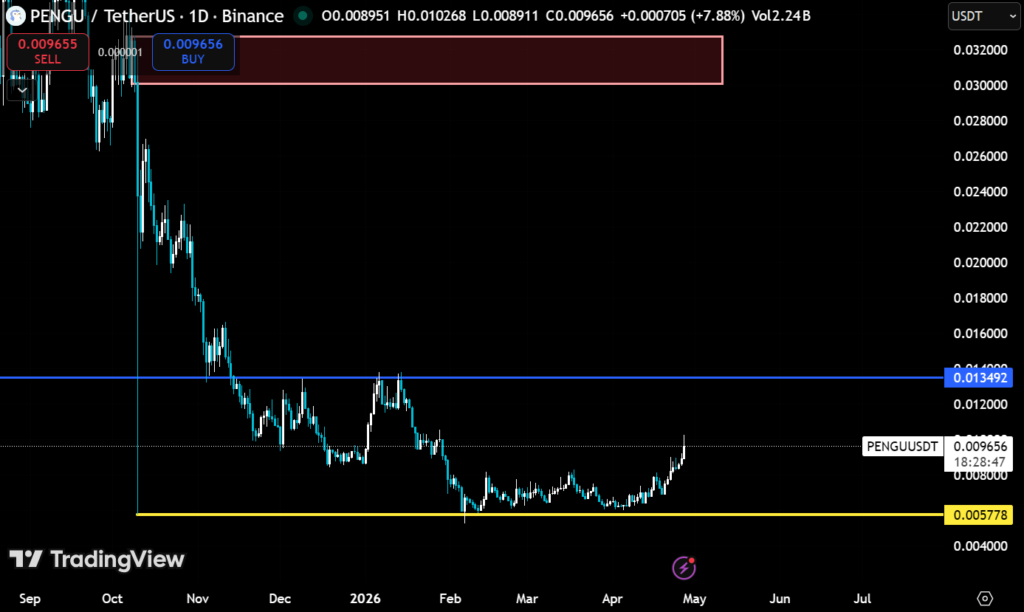
PENGU was launched in a large wave across various blockchains: Solana, Ethereum, BNB Smart Chain, Abstract Chain, and HyperEVM. The asset has since reached highs of $0.05738 before pulling back around 84% down to lows around $0.003715. Currently priced at $0.009725 it sits around 83% down from its peak and the yellow support at $0.005778 shown on the daily chart acted as the structural floor, which had held during the depths of the sell-off.
The current run has seen a significant volume surge that needs to be taken into consideration. As PENGU is experiencing a daily volume of $318.62M while having a market cap of $612.12M, it’s turning over ~52% of its market cap in the time period of just 24 hours. This ratio does not indicate accumulation in the way we would hope it does; it likely indicates speculation or rotation or both. Volume’s conservation or lack will be the key variable over the next 72 hours.
Where the Chart Gets Complicated
It can confirm that the real issue is very clear on the Daily chart. There is a large area of supply from around $0.010268 (the most recent intraday high) and it stretches all the way up to about $0.032. This box reflects that sellers who entered the market during the post-launch dump are sitting at a loss. The individuals that purchased between November and December 2024 whilst PENGU was crashing down are all likely to be either break-even or still in loss. That’s a massive area of potential sell pressure.
The 200 day MAs are sitting right in this range. SMA 200 is at $0.01078 and EMA 200 at $0.010428. PENGU has yet to recover either. Until this is reclaimed, the broader trend structure continues to be a bear market bounce, not a definitive reversal. Being able to recover and hold above the 200 day SMAs would be the first signal that market participants should truly consider structurally significant.
There is also a secondary resistance around the level of $0.013492, marked as the blue horizontal line, which is aligned with the 200-day cluster. The upside targets from Fibonacci levels points as extensions are $0.01009 at the 127.2% extension, $0.01119 at 161.8%, and $0.01241 at 200%. As for the price structure, the targets are aligning within the supply zone, which suggests that it can work as clean breakout levels instead of resistance.
Momentum vs. Structure
The short-term momentum readings do not seem to be anything less than positive. The RSI 7 reading of 77.69 is deep in the overbought range and the RSI 14 of 69.04 is nearly overbought. RSI 21 is 63.94, indicating solid intermediate-term positive momentum. The MACD line of 0.0004816 is higher than the signal line of 0.0003006. This momentum indicator’s histogram is printing a positive reading of 0.0001810 that shows that the short-term momentum seems certain.
The conflict is structural and the price has taken off above short-term SMAs (7 on 0.008278, 30 on 0.007074) and the prior session pivot on 0.008901, but still stays below the SMA 200 and EMA 200. The conflict has the short-term trend continuing to struggle with the medium-term trend. Breaking into supply zones from overbought RSI readings is statistically the best-known setup for quick reversals or consolidation.
The Data Sequence Underneath
The 30-day price history puts the trend into perspective. The close on March 29, was at $0.006367 and was accompanied by a volume of $53.94 million. It then leveled off at $0.006263 based on volume, which went up to $97.54 million on April 7. There was selling on volume as it rose during that surge. The steady accumulation started near April 10th at $0.006567 on $106.70 million volume with rising volume in the next sessions.
By April 22, the price moved up to $0.007777 on $240.06 million volume. It was the first time where large volume occurred and the buyers weren’t simply transacting and taking both sides but were willing to buy. April 26 close was at $0.008614 with $186.94 million volume, continuing the sequence.
From the price point of $0.006263 on April 7 to roughly $0.009725 today, it points out that there was a gain of around 55% in 20 days. This surge is showing up as the final leg move and is visible in the widening gap of the short-term moving averages and the current price. Before the move from the structural problem, the current price is showing as the characteristic of the momentum-based move.
Pudgy Penguins: The Key Levels to Watch
The fibonacci retracement of 23.6% is now standing at the price of $0.008467 and works as the important meaningful test in terms of any pullback. This is also roughly aligned with the SMA7 at the asset’s price of $0.008278. Under the price point of $0.007624 representing the 50% retracement converges with the long-term SMA 30 at $0.007074 to form up as a support zone. In the case of a weak medium-term case, the price could fall below the SMA 30, but till then, the structural support floor remains at $0.005778.
Conversely, the initial target remains on the 127.2% Fibonacci extension at $0.01009, a value that is essentially $0.01, a level that has psychological significance. Furthermore, breaking the 200-day SMAs at roughly $0.01043 to $0.01078 with the daily closes would provide the first indication that this move has structural follow-through.
Conclusion
The move by the memecoin, PENGU, comes up as measurable momentum. This is demonstrated by the 52% 30-day gain, $318 million average daily volume, and favorable MACD pattern, all of which support considerable buying pressure. The configuration heading toward the zone of $0.010, however, presents challenges in terms of its structure. The 200-day averages have not yet been regained; there is a great deal of overhead supply to contend with, and overbought readings on the short-term RSI limit the upside.


