





Bittensor (TAO) is right back to where it started. Following a vicious run from the mid-$150s all the way to a local top near $375 in March 2026, the price has totally retraced that advance and is now holding $246.73 directly within the very same zone of support that briefly caught the price at the tail end of January before the price broke down to new lows.
The current scenario is what that re-entry into this zone tells structurally and what the momentum picture indicates regarding the chances of it holding support a second time around.
The Structure with Two Zones
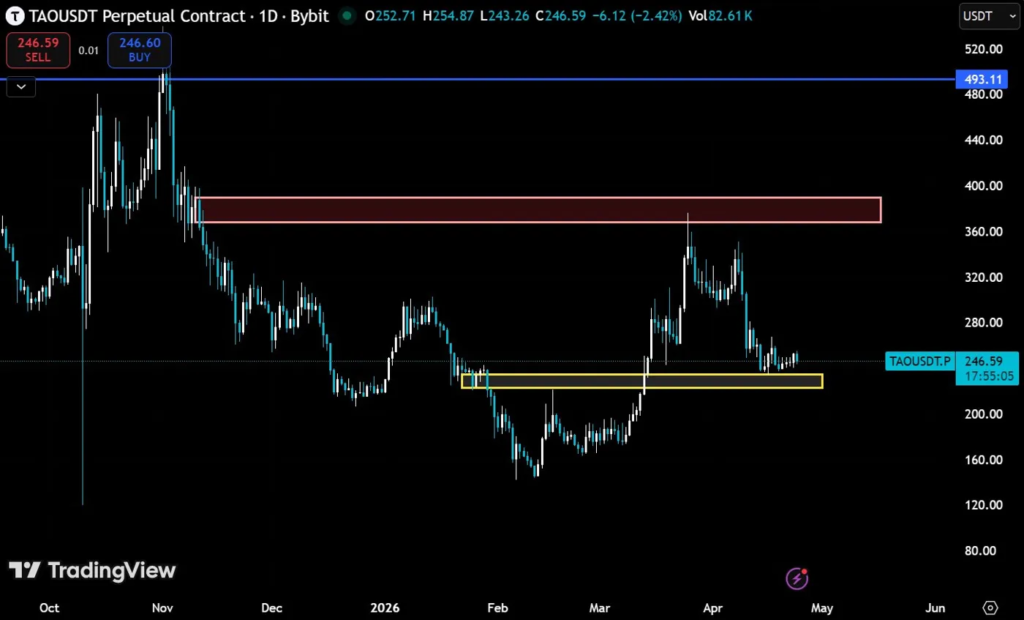
Structure can be seen clearly in this Daily chart. There are only two zones defining the entire range for TAO, back from November 2025.
The first is the red resistance block, which lies roughly from $360-$390. That zone was formed in the initial decline from $493 in November, which is the price that we use today as our main reference on the chart, $493.11. When the price came through the band in November, overhead supply was created from support. Every test to reclaim that band is a test of that overhead supply.
The second zone is the yellow support band (at the moment it lies between roughly $220 and $235). This zone is where price consolidated from late Jan to early Feb 2026 for several weeks before giving up and falling back to the mid-$150s. Its decline is important because it is where the price is sitting yet again and it got here more quickly and with less buying pressure behind it this time around.
March appeared to have a trend shift for the relative asset. TAO was able to recover all the way to the top of the red zone to touch the $370 region for a moment. That is up roughly 140% from the lows in a matter of weeks. A move that large normally provides follow-through for most assets but not for TAO. Price bounced off the red zone and traded back through every single significant level ($300 region, $280 region, and directly back into the yellow zone).
Where Price Stands Now
The asset has experienced a 30 day change of -26.98%. The current number makes up the different perspective that the decline isn’t just a consolidation after the long bull phase. It can be termed the failed recovery attempt and is more of the distribution phase.
Price is now just below the 7-day simple moving average of $247.13 and is effectively flat on the short-term average. However, step back a bit and it turns negative. The SMA 30 is at $285.72; the SMA 200 is currently trending at $277.68 with the EMA 30 at $265.21. The EMA 200 is at $271.33 with the relevant moving averages all overhead.
The alignment of a shorter-term EMA below a medium-term EMA below a long-term EMA is the typical downtrend formation. The interesting part about TAO’s setup, however, is how close the 200-day moving averages ($277.68 SMA / $271.33 EMA) are to hypothetical levels. Those are really the first significant level we need price to break for any kind of recovery narrative to start being constructed.
Mid-Range RSI Masks a Specific Problem
The readings from the RSI show not much but a comfortable position at 45.19 on the 14 period. We’re nowhere near oversold and that is the problem. A second attempt on a previously failed support should have come in with some type of selling exhaustion. The RSI for TAO shows no exhaustion and for the Sellers it hasn’t been pressured into washing their hands of shares. This means this second support is not being tested by an exhausted supply; it is being tested by one that has slowly bled back into this zone.
As Price bounces off support and isn’t oversold, it either means a steady absorption of supply by buyers (Constructive) or it simply means that there wasn’t enough sell-off to drive out the weak hands (less constructive). Considering that TAO had a completely failed 140% rally recently, the second meaning becomes more relevant,There is no exhaustion sign here. Mid-range RSI at a support retest after a failed rally gives uncertainty, not accumulation.
This trend is supported by the MACD as well. The MACD is at -10.16, the signal is at -7.09 and the histogram is showing a value of -3.07 at the time of writing. The histogram has remained negative, implying the MACD is trending away from the signal and not moving closer toward a bullish crossover. Momentum is slowing down, not picking up.
It is also needed to look for the situation when the price first dropped into the yellow zone for the first time at the end of January. At that point the momentum setup was indicating that the price was tight in the down phase after a dramatic sell-off, and the MACD was very early into a down trend phase. Here, the momentum setup is at a much more advanced negative trend phase following a failure of a rally to break through the upside. The structure of the setup appears the same, but it is much weaker fundamentally from an indicator standpoint.
Understanding What the Fibonacci Levels Indicate
Currently the price lies under the 78.6% retracement at $265.53; this figure is marked from the Fibonacci retracement grid starting from the swing low of $235.62 to the swing high of $375.36.
Its level below 78.6% is also crucial and at that level, the asset has retraced almost the entirety of the previous swing. Such an extensive retracement is generally characteristic of either a completed cycle (test of $235.62 lows) or a lengthy period of basing before any strong directional move.
The 78.6 level at $265.53 is the first retracement level that needs to be regained for the Fibonacci pattern to remain positive. Above that, $289.00, the 61.8 level and $305.49, the 50% level create the next key congestion. Significantly, those levels are also very close to the 200-day averages, creating a cluster of multiple short-term support/resistance between $270 and $305.
From the extension side, the 127.2% extension is determined at $413.36, the 161.8% extension at $461.71 and the 200% extension at $515.09, a level not far removed from the prior $493.11 high. Although important targets from a long-term structural viewpoint, they require a completely different momentum environment.


