





These are completely two separate narratives for XRP depending on which market one looks at. On Binance perpetuals, Net Selling Pressure has expanded into -$392.5M. That’s down approximately $327M from the $319.5M it was on 19th march. Conversely, on spot, All CEX Estimated Spot CVD increased by $310M and now is $1.39B up from $1.08B it was on 2nd april.
The Current Setup
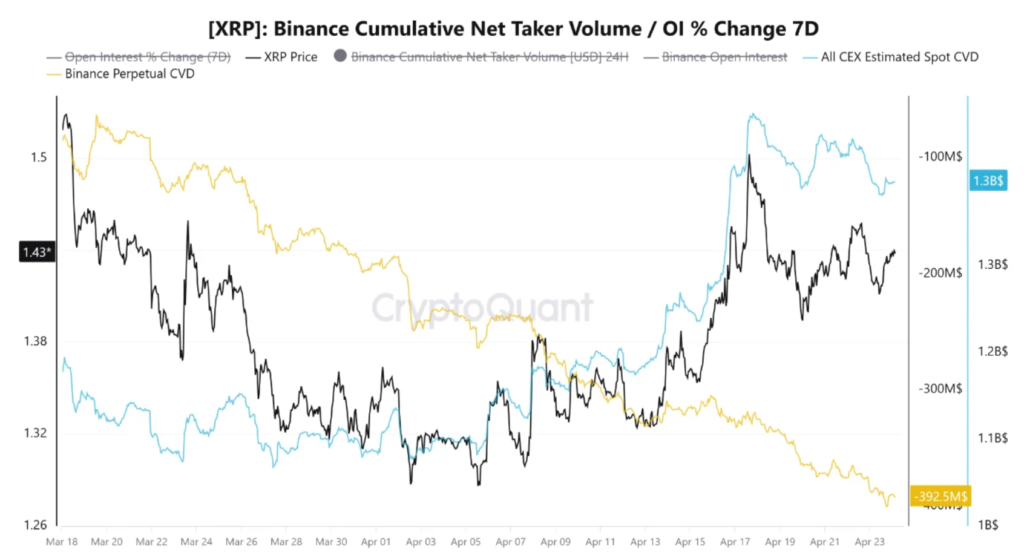
Many of the market participants view the Binance Perpetual CVD as a clean bearish indicator. The level of net futures selling is at its most negative reading on the chart window from March 18 to April 24. Based on just these numbers, the story is obvious-derivatives traders are hugely positioned short against XRP. But framing the situation as a simple bear signal misses the more important layer.
The Spot CVD is not used as a measurement of retail noise or low-conviction dip buying. CVD refers to the net taker volume on the centralized spot side. When spot CVD goes up $310 Million in just under 3 weeks, it is signaling that in real, unlevered markets, orders to buy are outweighing orders to sell. There is no funding rate distorting spot and no liquidation cascade mechanic. Simply Buyers vs sellers and buyers are winning here.
So the market, what the data is describing here, is not a bearish turning of a market. It is a market in which two distinct participant groups have both come up with opposing views.
Breaking Down the Numbers
Total CEX Estimated Spot CVD grew from approximately $1.08 billion on the 2nd of April to approximately $1.39 billion on the 24th of April. This wasn’t a quick spike in activity. This was a steady, stair-step gain while XRP was grinding up from ~$1.28 to $1.43. Buyers aren’t panically buying a breakout but on the other side, they’re trying to buy the weakness and the continuation.
Binance Perpetual CVD tells the exact opposite story. From opening the window with -$65 million on the 19th of March, it has been consistently dropping throughout the entire window, closing the period at -$392.5 million. There are no exceptions to its trend; every single point follows it. Perpetual traders on Binance were selling during the exact same time the spot traders on Binance were more into accumulation.
At the time of writing, Binance OI (open interest) is at around $1.3 billion. While the 7d OI percentage change has been volatile, the fact that Absolute OI is high while CVD is declining needs to be noticed. There is still exposure at a high level in this market.
The Important Take From Liquidation Data
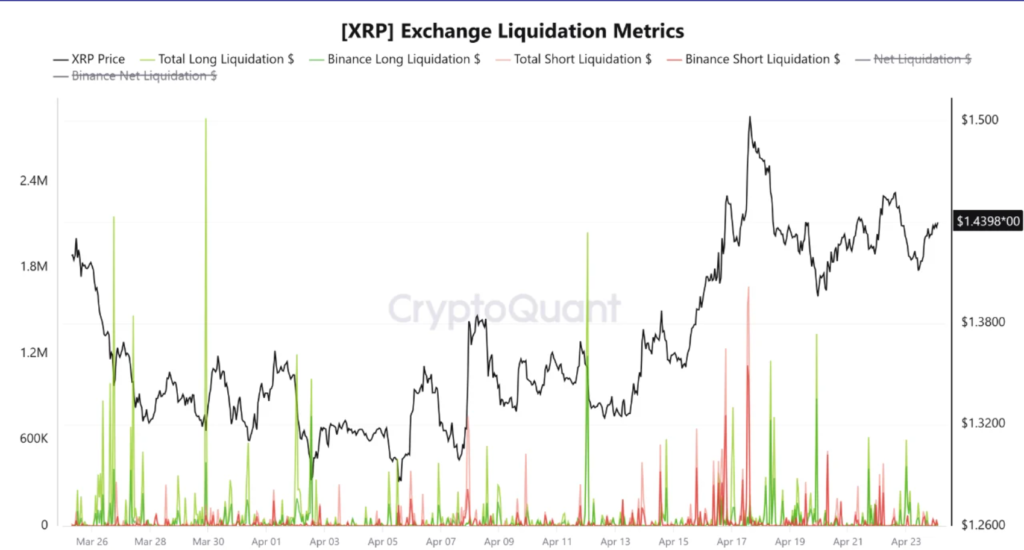
The CVD story is supported by the liquidation chart covering the time period from March 26 to April 24.
In the recent history of XRP liquidation data, the dominant phenomenon seems to have been long liquidations since roughly April 18th. The green spikes, which show total long liquidations, have consistently outweighed the red short liquidation bars in that window. Binance long liquidations have been evident within that cluster as well. The April 17th cluster represents the peak of liquidations together on the window, which is the timeframe XRP price hit close to $1.50 and reversed quite strongly.
Considering it mechanically, this means the following for this data: Some portion of the constant deterioration in the perpetual CVD isn’t actually new bearish sentiment being entered into the market. Rather, these are leveraged longs being squeezed out of their positions. They don’t want to sell; they are being liquidated. This appears as sell-side taker volume within the CVD numbers and skews the negative readings higher than the true intent behind the new entrants may be.
This distinction is important. A market where CVD is falling because sophisticated traders are building short books has a different structure than a market where CVD is falling because leveraged longs are being liquidated. Visually on a CVD chart they are identical, but liquidation data provide context to distinguish between the two.
In XRP’s case, the liquidation-heavy period from April 18 onward aligns almost exactly with the steepest decline in Binance Perpetual CVD. That is not coincidence.
What a Futures Reset Actually Looks Like
This can be described as a futures reset in terms of market structure. Longs pile up on an uptrend, funding rates rise, so longs become more expensive to hold, and eventually a dip brings cascade liquidations and washes out the overleveraged positions from the market. CVD decreases, funding rates normalize, and the market can reset on a clean base for a move higher without structural overhead.
The spot accumulation during the liquidation flush is the meaningful confirmation here. If genuine demand was actually degrading and continued to fall along with the perpetual reset, then spot CVD would have started to turn over as well, but it hasn’t. Spot CVD increased by 310M over approximately the same time frame Perpetual CVD experienced a fall by 327M.
Implications for Positioning
XRP has also turned the $1.38-1.40 area into a repeated pivot throughout April. With price respect, the futures reset thesis holds true. This fails if the price fails in that area while spot CVD turns over at that time simultaneously. Confirmation from traders should look for Funding rates normalizing while the price is consolidating within that range, not the price breaking out of it. Price break-out does not mean as much if its underlying structure hasn’t finished clearing out yet. The CVD slope through that consolidation serves as the entry signal.
The scenario that disrupts this reading is OI unwinding into a spot CVD rollover simultaneously. If spot buyers stop absorbing supply and open interest begins declining in size rather than just repositioning, the current divergence could close in the wrong direction. That would move the setup from “futures reset within a trend” to “distribution under cover of spot buyers.”
The $1.50 level remains overhead supply from the April 17 rejection. Achieving sustained spot CVD above $1.4 billion and OI growth would create a fundamentally different market structure than what exists now.


