





At the time of writing, Bitcoin was climbing to $76,400, its highest level since a key sell-off back in February that dragged prices toward the $65,000 mark. An assessment structure level better than ordinary appears to be there at this point, yet regarding that layer, four unique on-chain and subsidiary pointers diverged from cost activity in a manner that requires your consideration before any cases about a pattern change are drawn.
ETF Demand Is Softening Into the Rally
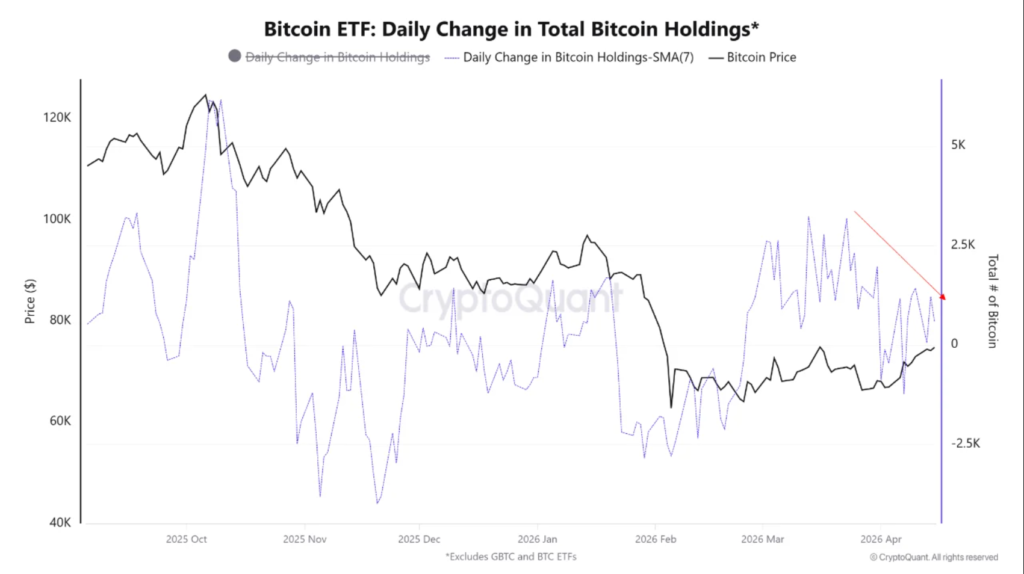
The 7-day SMA of the daily change of total holdings within Bitcoin ETFs has actually decreased as the price continues to break out and grind higher throughout April. This is one of the best metrics that we have for what the actual net flows into spot ETF products of bitcoin are. The importance of this metric has already been highlighted, as increased demand from spot ETF purchases was one of the largest structural forces cited during Bitcoin’s ascent to $125k in late 2024, and the 7-day SMA for total ETF holdings moved with price.
Now as we see the opposite behavior in price to the one seen previously, we observe that, despite the recovering price, the momentum of ETF inflows, measured by the 7-day SMA, continues to decline. This does not mean that ETFs see outflows in every session, but it indicates that new spot demand is not adding enough fuel to the recent upward price action to support it proportionately. A price action that moves upward without an equal rise in structural spot demand brings the sustainability of the upward price action into question.
Realized Profits Spiked to Post-February Highs
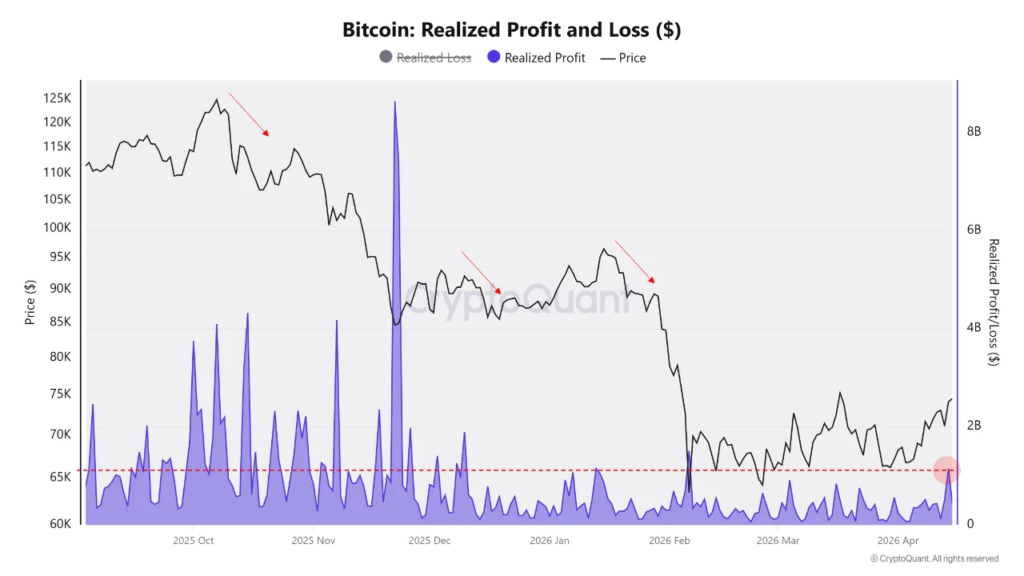
Bitcoin realized profit and loss, which reflects the total dollar amount of profit captured by on-chain participants as coins are spent at a higher price than they were acquired, had its second highest reading ever on the 14th of April following the selloff seen through February. The spike in realized profit corresponds to the price appreciation back to the mid-$70s from the $65,000 range; this implies that the long holders who were accumulating through the drawdown period were taking profit as the price moved up. This is typical for relief rallies in a broader corrective period as individuals who acquired coins through the February-March drawdown are taking advantage of a move to profit for their positions that came back to break even or green.
This results in greater selling pressure from on-chain activity at a time the price is attempting to hold higher. The long-term support at ~$65,000, demarcated by the red dashed line, has also historically acted as a support throughout the various periods of the bull cycle; in this instance, it suggests that a large number of on-chain participants have their cost base between the $65,000 and $75,000 level.
Large Wallets Are Depositing Bitcoin Back to Exchanges
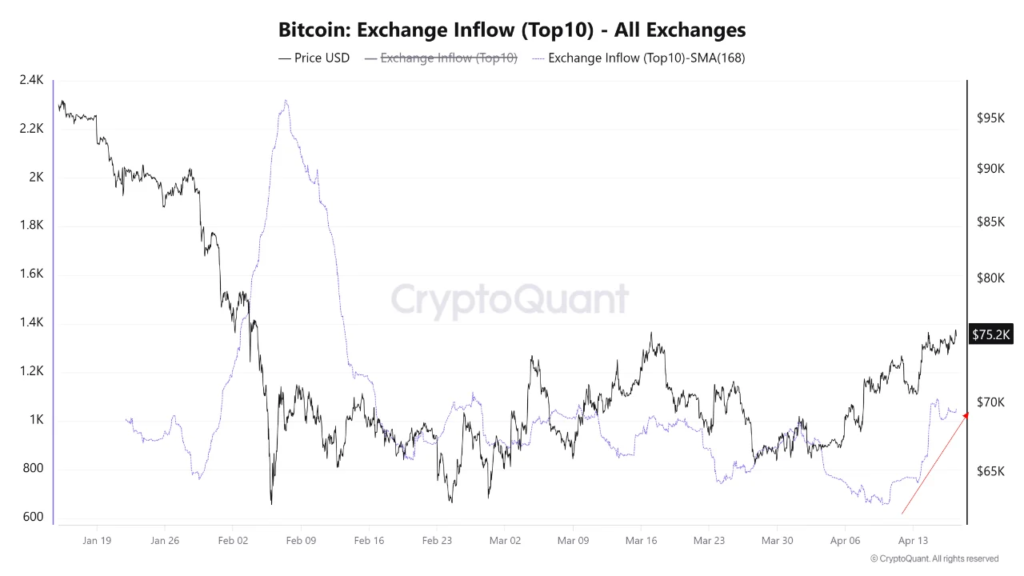
The Exchange Inflow (Top 10) measure, which records the size of the 10 largest deposits into exchange wallets across the largest venues, has recently upticked into the second half of April, following a significant downturn in inflow momentum between early February and late March. It had also previously shown a downward trend from the early February bump, where 2,300 BTC were seen as one single inflow cluster. This SMA-168 measure is beginning to roll higher as well.
The influx of funds into exchange wallets can be interpreted as potential selling sentiment due to its association as a necessary prerequisite to take profits out of the ecosystem, where funds must enter exchange infrastructure before they can be exchanged for fiat or other cryptocurrencies. When paired with increased realized profit data, such as currently, both signals can suggest that realized profits are occurring on-chain and are migrating to venues of execution. This pair of indicators currently suggests a cautiously bearish signal in April.
Futures Open Interest Diverges From Price at $75.4K
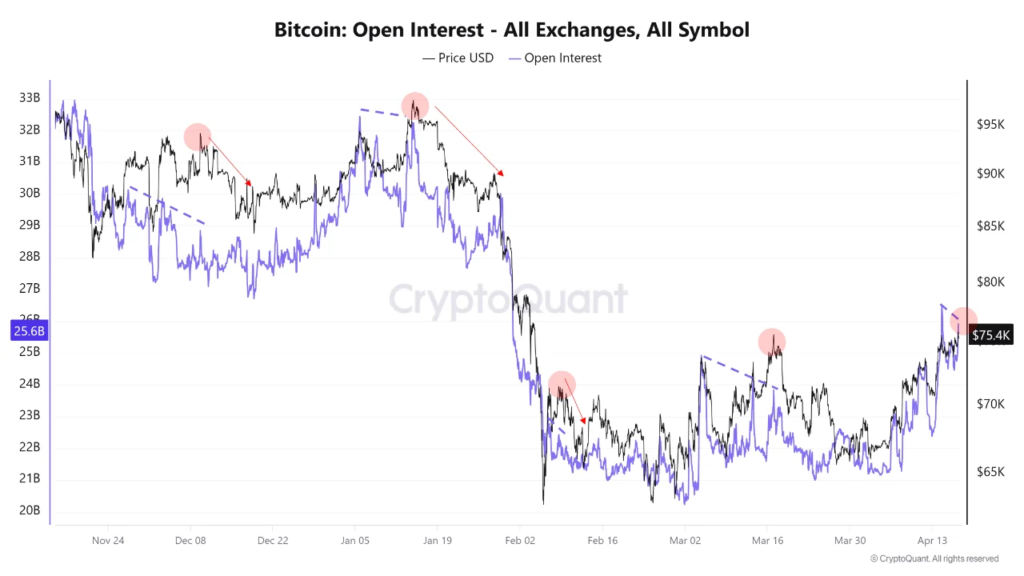
Total open interest across all Bitcoin futures exchanges and contract types is now hovering around $25.6B after the February recovery from the $20B lows. But there is a crucial difference in the pattern of the recovery: open interest is beginning to diverge from price at the last high.
A clear pattern within this cycle, visualized in the chart, involves decreasingly high peak open interest in relation to peak prices. These peaks (highlighted at the divergence points from Dec 2025 and Jan 2026) exhibit this trend. Now, an identical trend seems to be forming where open interest is rising towards $25.6B to $26B while price pushes $75,400. The price subsequently corrected in all instances where this divergence occurred at a local high. This suggests that leveraged participants are not aggressively entering long positions on pace with price gains. True market momentum will generally see open interest rise together with price. Participants can get a lot of their directional conviction as more people join them in long positions. This isn’t quite what seems to be the case with this recent data trend.
What the Four Signals Suggest Together
On their own, none of these indicators might be considered nothing more than the typical volatility of an early recovery. However, the indications of slowing spot ETF demand; the peak on-chain profit-taking as noticed since February; and significant inflows from large holders to exchanges, including the derivatives market, are not mirroring the move with corresponding leveraged positioning. The trend is painting a somewhat cautionary picture of the recent move to $76,400.
None of this data guarantees any further downside; indeed, a macroeconomic catalyst or re-emergence of institutional capital could easily send prices back towards previous highs. However, without confirmation across these four very different categories of data, there is no evidence yet to treat the move higher as anything but a temporary uptrend. At $65,000 (where realized P&L gives us a long-term reference point), market support has not yet been tested.


